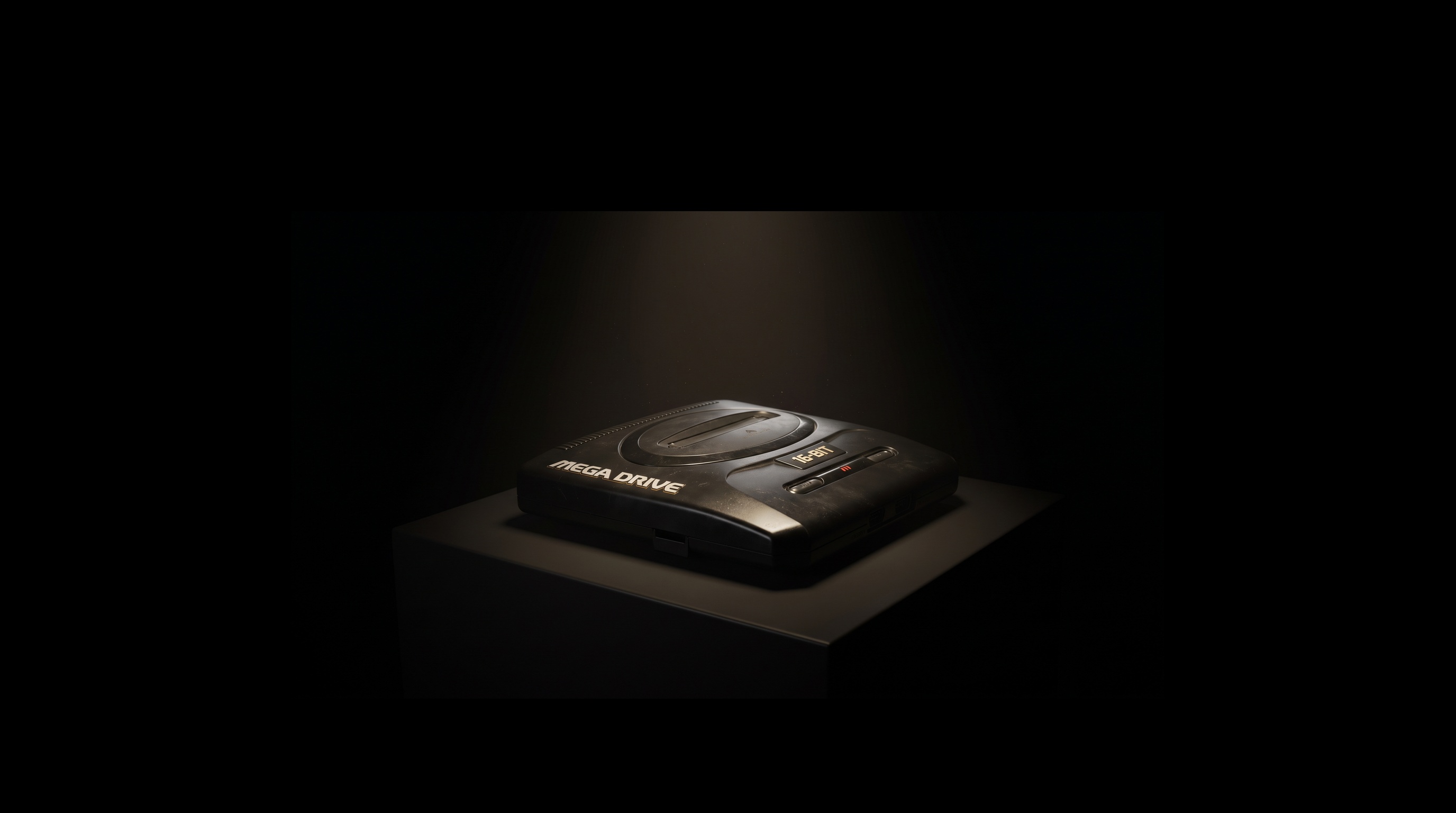
All photographs — genuine units from the Enjoy Game Japan inventory. Toyohashi, Japan.
Sega's 16-bit machine that took the fight to Nintendo — and briefly won North America.
About the Sega Mega Drive / Genesis
The Sega Mega Drive launched in Japan on October 29, 1988, and reached North America in 1989 as the Genesis. A 16-bit console built around the Motorola 68000 — the same processor powering Sega's own arcade boards — it was the machine that dared to say: Nintendo does not own this industry. In North America, the Genesis became the first console to give Nintendo a genuine fight since Atari, reaching a 65% market share at its peak. Its FM synthesis sound, expansive cartridge library, and defiant marketing campaign shaped a generation.
Yuji Naka finished the smooth high-speed running first — the feel of speed came before the character, before the story, before everything.
Yuji Naka's account of building Sonic the Hedgehog begins not with a character, not with a story, but with a sensation: smooth, continuous, high-speed running. Naka has stated that the first part of the code he completed was the physics of that movement — the feeling of speed that became the Mega Drive's defining experience. The Mega Drive launched in Japan on October 29, 1988, built around the Motorola 68000 processor — the same chip in Sega's own arcade boards, chosen so that developers who already knew the hardware could port games without rebuilding their tools. Sega's designers looked at audiophile equipment and cars for visual reference; the result was a black console with a gold '16-BIT' badge, positioned deliberately as not a toy. What Naka's story suggests is that the machine's greatest strength — the sensation of momentum, of something moving faster than it should — was discovered before its mascot, its marketing, or its cultural identity. The feeling came first. Everything else was built around it.
— inspired by Yuji Naka
Design Characteristics
Form & Feel
The original Mega Drive is a sleek, all-black console — a deliberate visual contrast to Nintendo's grey-white boxes. Its top surface carries the gold "16-BIT" wordmark, a marketing statement in hardware form: this machine belongs to a new generation. The launch controller — the MD3 — has three action buttons (A, B, and C) arranged in an arc, plus Start. This was a clean, minimal layout suited to fast-action arcade ports. In 1993, Sega introduced the six-button controller (MD6) alongside the Street Fighter II port, adding X, Y, Z buttons and a Mode switch — the first controller redesign of the era driven directly by a specific game's requirements. The console has two cartridge-compatible expansion ports: one on the underside accepting the Mega CD (1991), a full CD-ROM drive that attached below the console, and one on the front accepting the Super 32X (1994), a processing expansion that sat atop the cartridge slot. This philosophy of modularity — building a base console that could grow — was Sega's answer to the question of how to extend a console's life without replacing it entirely.
Era & Context
The World It Was Born Into
1988 was the year Sega decided that patience was over. The Mega Drive arrived into a Japan still in love with the Famicom, and a North America where Nintendo controlled the market with a legal exclusivity arrangement that barred most large publishers from releasing on competing platforms. Sega was the underdog — and chose to fight exactly like one. The Mega Drive's North American campaign was built on aggression: "Genesis does what Nintendon't" was not a vague slogan but a direct comparison. Sega's advertising pointed to specifics — the Mortal Kombat blood code (MKT holds the full blood; SNES replaced it with sweat), the superior arcade ports, the faster scrolling. The console war between the SNES and Genesis is one of the defining cultural events of early 1990s Western childhood: you were either a Sega kid or a Nintendo kid, and that identity — carried in the schoolyard, argued in living rooms — shaped a generation's relationship with entertainment brands. The Genesis sold over 30 million units worldwide, and at the height of the console war in North America, it held over 65% market share — the only time in the post-Atari era that a non-Nintendo home console led the market in the United States.
A Social Phenomenon
The Side That Didn't Ask Permission
In 1989, a company that had spent years in Nintendo's shadow did something that no one in the industry had done before: it said Nintendo's name out loud — in an advertisement — and said it was not enough. "Genesis does what Nintendon't." The apostrophe and the letter T at the end were not an accident. They were an argument.
The argument was not really about hardware. It was about who you were, and who you were allowed to be. Nintendo's world was polished, orderly, approved by parents. Sega's pitch was different. Their internal philosophy, as one marketing executive described it, was simple: if children love it, parents will be annoyed. That was not a side effect. That was the point. Sonic the Hedgehog was designed to be impatient, fast, a little rude — the deliberate opposite of a plumber who smiled and asked you to have a nice day.
It worked. In the 1991 holiday season, the Genesis outsold the Super Nintendo nearly two to one in the United States — driven, in large part, by a blue hedgehog who could not stand still. By January 1992, Sega controlled sixty-five percent of the 16-bit console market. It was the first time Nintendo had not been the market leader since 1985. Seven years of certainty, undone by a company that had decided not to behave itself.
The market-share numbers are in the history books. What they do not record is what it felt like, at thirteen years old, to be the kid in the room who had made the other choice — and to know, without needing to say it, exactly why.
Then came September 1993. Mortal Kombat — a fighting game built around the spectacle of consequence — arrived on both consoles on the same day. Nintendo required the violence to be softened. Sega's version shipped with the content restricted by default, but included a code that removed the restriction. Players who wanted the unaltered game could have it; players who did not, did not have to. Sega's Genesis version outsold Nintendo's by a factor of five.
Three months later, the United States Senate held hearings. The question being asked, officially, was whether video games were appropriate for children. The question being answered, practically, was who got to decide. Within twelve months, the industry had the ESRB — the rating system that still appears on the corner of every game box. It exists, in part, because one company had decided to let players make a choice, and the choice turned out to matter.
If you were on that side — if you remember which side you were on, and why you chose it — you already know what the argument was. The specifications are easy to look up. The rest of it is yours.
Engineering
How It Was Built — and Why
The Mega Drive's primary CPU is the Motorola 68000 — a 16-bit processor running at 7.67 MHz, the same chip used in Sega's System 16 arcade boards. This was not a coincidence; Sega built the Mega Drive so that its own arcade developers could port games to the home console with minimal rearchitecting. The secondary processor is a Zilog Z80 running at 3.58 MHz, inherited from the Master System, and used primarily for sound processing and backward compatibility with Master System software (in the Japanese and European models). The audio system pairs a Yamaha YM2612 FM synthesiser — six channels of frequency modulation synthesis — with a Texas Instruments SN76489 programmable sound generator (PSG) for four additional channels. The YM2612 was the sound of the era: its six FM channels produced the driving bass lines, stabbing synth leads, and percussive textures of composers like Yuzo Koshiro (Streets of Rage), Masato Nakamura (Sonic the Hedgehog), and Hiroshi Kawaguchi. "Blast Processing" — Sega's marketing term for the 68000's processing advantage over the SNES's 3.58 MHz 65C816 — was partly exaggerated, partly real: the 68000's higher clock speed did enable faster scrolling and more responsive action games, which was the Genesis's strongest selling point. The Mega CD expansion (1991) added a single-speed CD-ROM drive, additional RAM, and a separate processor, briefly positioning the Genesis as a CD-capable platform before the PlayStation changed everything. The 32X (1994) added two 32-bit SH2 processors and a new video chip, extending the hardware into the 32-bit era.
Design Philosophy
The Belief Behind the Machine
"Genesis does what Nintendon't."
Sega built the Mega Drive on a simple conviction: Nintendo was beatable. Not in Japan — not yet — but in North America, where Nintendo's dominance was contractual as much as cultural, and where an older, underserved audience of teenagers and young adults was waiting for a console that spoke to them. The Mega Drive's philosophy was contrast: where Nintendo was family-friendly and curated, Sega was aggressive and open. Where Nintendo removed the blood from Mortal Kombat, Sega published the blood code. Where Nintendo's characters were round, cheerful, and safe, Sega's mascot — a blue hedgehog who could not stand still and tapped his foot impatiently when the player did nothing — was designed to embody impatience, speed, and a certain arrogance. Sonic the Hedgehog was not just a game character. He was a brand statement. The Mega Drive's engineering philosophy mirrored this: rather than designing a new architecture for the home market, Sega repurposed its own arcade silicon. The machine was built by and for the developers who already knew it. This allowed a wave of faithful arcade ports — Golden Axe, Altered Beast, Thunder Force — that made the Genesis feel like the most authentic arcade experience available at home. Sega did not win the 16-bit era — the Super Nintendo ultimately outsold the Genesis worldwide. But Sega proved that Nintendo could be challenged. The era they created — defiant, fast, FM-synthesised — is one of gaming's most vivid cultural chapters.
Birth Story
How the Mega Drive Was Born
Sega's Unlikely Origins
To understand the Mega Drive, you have to understand where Sega came from. Unlike Nintendo — a Kyoto toy company with deep Japanese roots — Sega was founded in Japan by Americans. Marty Bromley and David Rosen built the company's early business around importing coin-operated amusement machines for American military bases in Japan. The name 'Sega' is a contraction of 'Service Games.' The company that would challenge Nintendo for dominance of the home console market had started out shipping pinball machines and jukeboxes.
The Arcade DNA
By the mid-1980s, Sega had become the dominant force in Japanese arcades with titles like Out Run, Space Harrier, and After Burner — all using bespoke hardware that pushed graphical performance far beyond what home consoles could replicate. The Mega Drive was Sega's attempt to bring that arcade power home. Its 16-bit Motorola 68000 CPU — the same processor that drove Sega's System 16 arcade hardware — was chosen to provide genuine continuity with the arcade experience, not a scaled-down simulation of it.
The Black Console Arrives
On October 29, 1988, the Mega Drive launched in Japan. Its design sent an unmistakable signal: this was not a family toy. The all-black casing, the sharp lines, the aggressive styling — everything about the Mega Drive communicated 'serious hardware for serious players.' The three-button controller was ergonomically refined, the boot-up sequence confident. This was Sega positioning itself as the grown-up alternative to Nintendo's red-and-white family console.
The Battle of Two Continents
In Japan, the Mega Drive faced difficult competition. The PC Engine had arrived a year earlier and captured a strong market position; Nintendo's Super Famicom was approaching. But in North America, the Genesis (as the Mega Drive was renamed) found open territory. The NES had aged and Nintendo's successor was delayed. Sega moved aggressively, targeting older teenagers with edgier marketing. The famous 'Genesis does what Nintendon't' campaign drew a clear battle line.
Sonic and the American Counterattack
The console needed a character to rival Mario. Sega's answer arrived in 1991: Sonic the Hedgehog, designed by Yuji Naka and Naoto Oshima. Fast, irreverent, and deliberately un-Nintendo, Sonic embodied Sega's entire brand positioning. Bundled with the Genesis in North America, Sonic sold the console to millions of players who had never considered a Sega product before. For several years in the early 1990s, the Genesis outsold the SNES in North America — the only period in gaming history when Nintendo was not the dominant console platform.
Overextension
Sega's ambition did not stop at software. The Mega-CD (1991) added CD-ROM capabilities, and the 32X (1994) was a stopgap 32-bit adapter intended to bridge the gap to the next generation. Both were commercially disappointing. The Mega-CD was expensive and produced few defining titles beyond the library it imported from CD-ROM arcade conversions. The 32X confused the market and split Sega's development resources at the worst possible moment, just as Sony's PlayStation was about to redefine the industry. Sega's inability to consolidate its hardware lines cost it dearly.
Pioneers of 3D
In the arcades, Sega was already building the next revolution. Virtua Racing (1992) and Virtua Fighter (1993) established the polygonal 3D fighting and racing game. Brought home on the Saturn and later the PlayStation, these games defined what fifth-generation gaming would become. The Mega Drive era is when Sega was at its most creative and most commercially dangerous — outrunning Nintendo in its strongest market and pushing the technical horizon forward at the same time.
The Legacy Under Pressure
History records the Super Famicom as the winner in Japan, the SNES as dominant in the long run globally, and the PlayStation as the machine that ended Sega's console ambitions entirely. But the Mega Drive era produced some of the richest game development of the 16-bit period — Streets of Rage, Gunstar Heroes, Castlevania: Bloodlines, Phantasy Star IV, Shining Force — and gave Sega its only sustained period of genuine platform leadership outside Japan. The machine that came in black, playing loud, refusing to be polite, earned its place in the history of the medium.
Reflection
What Lasts
In 1990, Sega was losing. Nintendo held the market. The original Sega Master System had not broken through in North America. The Genesis existed, but it was struggling to find its footing against a company that seemed unmovable.
Hayao Nakayama, Sega's CEO, flew to Hawaii and tracked down a former Mattel executive named Tom Kalinske — a man who had spent his career marketing toys to children, not video games to anyone. Nakayama offered him the role of president and CEO of Sega of America. Kalinske had no particular reason to say yes. But he did.
Kalinske flew to Japan and presented a plan to Sega's board. It had four points: drop the price of the console, replace the pack-in game with a new character called Sonic the Hedgehog, develop games specifically for the American market, and run advertising that directly attacked Nintendo by name. Every person in the room disagreed. Nakayama himself disagreed. The meeting appeared to be over.
Nakayama stood up. He walked toward the door. Then he stopped.
He turned back and told Kalinske that when he had recruited him, he had promised him the authority to make decisions for the Western markets. That promise still stood. "Go ahead and do it," he said.
The 1991 holiday season arrived. The Genesis outsold the Super Nintendo nearly two to one. By January 1992, Sega held sixty-five percent of the 16-bit console market. Sega of America grew from seventy-two million dollars in revenue to more than one and a half billion.
What Nakayama did in that doorway is not easy to name. It was not agreement. It was not indifference. It was something more precise: the recognition that he had already made the real decision — the decision to bring in someone whose judgment he respected — and that reversing it in a conference room would undo everything that decision had been worth.
Delegation is often described as a management technique. But what happened at that door was not technique. It was the willingness to let someone else carry something important, even when every instinct in the room said no. That is one of the hardest things a person can do. It requires trusting not just the individual, but the act of trusting itself.
Most of us hold on too long to the things we should pass to others. We tell ourselves it is because we care about the outcome. Sometimes that is true. Sometimes we are simply afraid of what it means to need someone else.
The Mega Drive is more than thirty-five years old. The market it disrupted has been disrupted many times over since. But the moment at that door — one person deciding to honor the trust they had already extended — that kind of moment does not expire.
Is there someone you have already chosen to trust, whose judgment you have not yet had the courage to follow?
Five Things From the Console War
A famous slogan that was mostly a bluff, two names for one machine, a mascot built to dethrone Mario, a two-year head start spent attacking Nintendo by name, and the add-ons that splintered it all. Five stories from Sega's boldest machine.
"Blast Processing" was mostly a bluff
Sega's 1992 slogan promised the Genesis had something the SNES didn't: "Blast Processing." Most players assumed it meant a faster brain — and the Genesis's 68000 chip did run at 7.67 MHz against the SNES's 3.58. But the phrase actually came from an obscure graphics trick, a way of firing data into the video hardware at high speed. The catch: it consumed the entire processor, so no released Genesis game could ever use it while you were actually playing. The producer who named it later apologised for coining "that ghastly phrase."
It had two names because of a trademark
Everywhere in the world the console was the Mega Drive — except in North America, where it was the Genesis. The reason was mundane: another company already held the "Mega Drive" trademark in the United States, so Sega renamed it rather than fight. That split is why retro collectors today switch casually between two names for the same machine, depending on which side of the Pacific they grew up on.
Its mascot was built to be cooler than Mario
Sega already had a mascot — Alex Kidd — but in April 1990 it asked its staff for something new: a character who could go head-to-head with Nintendo's Mario. The answer was Sonic the Hedgehog, designed and marketed to look faster, sharper, and cooler than the cheerful plumber. It worked. Sonic replaced Alex Kidd almost overnight and helped push the Genesis to brief control of around 65% of the American market.
It beat the SNES by two years — and said so loudly
The Genesis reached North America in 1989, roughly two years before the Super Nintendo. Sega spent that head start swinging: its American ads attacked Nintendo by name, with the slogan "Genesis does what Nintendon't." For a moment it worked spectacularly — during the 1991 holiday season the Genesis outsold the new SNES nearly two to one in the United States. It was the closest Nintendo had come to losing since the Famicom.
Sega splintered its own console
Having won ground, Sega lost it by multiplying. It bolted two expensive add-ons onto the Mega Drive — the Sega CD in 1991–92 and the 32X in 1994 — each effectively a new platform under the same name. The result confused shops and players alike: to run everything you had to stack three pieces of hardware and pay for all of them. The 32X in particular flopped, and the fragmentation did lasting damage to the brand Sega had fought so hard to build.
Before You BuyWhat to watch for, so you don't regret it
Mega Drive and Genesis are the same console — 'Mega Drive' in Japan, Europe, and most of the world, 'Genesis' in North America where the Mega Drive trademark was already taken. The two practical decisions are region (Japanese/European and North American cartridges use different shapes and region-lock tabs) and revision (Model 1 versus Model 2), which mostly comes down to sound. As with any thirty-five-year-old console, it does not need to be perfect — it needs to have been honestly cared for.
Full buying guide →Caring for One You OwnKeeping a vintage machine running
The Mega Drive launched in 1988 as an all-black machine built for fast arcade ports, and most surviving units still run. At over thirty-five years old, its character ages in two places above all: the FM sound, which thins and distorts as the electrolytic capacitors age, and the cartridge edge connector, which oxidises and causes read errors. Knowing those two points is most of what it takes to keep one healthy.
What ages inside a Mega Drive
- Electrolytic capacitorsAgeing electrolytic capacitors are the primary cause of audio distortion and video noise on a Mega Drive. Music that sounds thin, harsh, or distorted is the classic sign. The earliest Model 1 boards are the most prone to this, so a unit's capacitor condition is the single most important thing to verify on an early machine.
- Cartridge slot pin oxidationThe cartridge edge connector — on both the console and the cartridge — oxidises over decades and is the most common source of read errors. Loading errors or resets often trace back to a slot that simply needs cleaning rather than a deeper hardware fault.
- Power and voltage regulationAn aged AC adapter can deliver unstable voltage, and the Model 2 in particular is subject to voltage-regulator failure. Power-related instability is worth ruling out before suspecting the main board.
- Video processor degradationOver a very long service life the VDP (video processor) chip can degrade, contributing to picture problems. This is far less common than capacitor or connector issues, which should always be checked first.
What you can do yourself
- Clean the cartridge contactsClean the cartridge edge contacts with a cotton swab lightly dampened with 90% or higher isopropyl alcohol, and let them dry completely before inserting. This resolves most read errors. Never blow into the slot — moisture from breath accelerates the very pin corrosion you are trying to prevent.
- Clean the console slot pinsFor persistent read problems, the console's cartridge slot pins can be gently cleaned the same way using a thin swab and high-purity isopropyl alcohol. Confirm that several different cartridges then load cleanly to know the slot itself is sound.
- Use a sound power supplyBecause an aged adapter can introduce voltage instability, verify you are using a correctly rated power supply for the console. A clean, stable supply removes one common cause of erratic behaviour before any board-level work is considered.
- Listen for the warning signsThe FM sound is part of what makes a Mega Drive special, so listen to it. Thin, harsh, or distorted music is an early signal of ageing capacitors in the audio section — a cue that the machine is due for the specialist work below rather than a sign of imminent failure.
When to call a specialist
The Mega Drive's defining long-term repair is capacitor replacement, which requires soldering.
- Electrolytic capacitor replacement (recapping)Replacing the ageing electrolytic capacitors — especially in the audio section — is the single most effective fix for distorted sound and video noise, and the most preventive action for long-term reliability. It is most relevant to early Model 1 boards. The work requires soldering and PCB handling and is best done by someone experienced.
- Voltage regulator and VDP-level repairPower-regulation faults, particularly the Model 2's voltage regulator, and any degradation of the VDP video chip call for board-level diagnosis and component-level work. These are specialist repairs rather than user maintenance, and worth addressing properly before they cause further damage.
The Sounds and Images of an Era
The Mega Drive defined a generation of fast, aggressive play. These videos capture the console as it was — on television, at launch, in the shops.
Mega Drive Console CM
Genesis Does What Nintendon't (1990)
Sonic the Hedgehog Commercials (1991)
Megadrive Full Volume — Dark Exhibit
When a Mega Drive reaches my bench, I notice the same thing before anything else: it is lighter than it looks. In 1988, most consoles were still being drawn for children — soft, friendly, aimed low. This one is blunt and grown-up, and for its time that was a genuinely bold face to put on a game machine. Then you open it, and there is far more air inside than board. The shell was drawn from audio components and cars, and the electronics were fitted into a shape that had already been settled. The carts, though, almost never fail. Nearly every one I test still reads.
Representative Games
A handful of titles that define this console — each with a shop owner's note, collector's guide, maintenance tips, and memory prompts. The complete library is one click away.
View all 63 Sega Mega Drive / Genesis games →
A Mega Drive Title Worth Your Time
A title that stands apart in the Mega Drive library — documented with historical context and collector notes.
Explore the Mega Drive World
The studios
The Mega Drive was Sega's challenge to Nintendo — fast, loud, and the home of some of the finest action games ever made for the hardware.
Deeper cuts
Beyond Sonic, the Mega Drive library is a treasury of action and adventure:
Questions people actually ask about the Sega Mega Drive / Genesis
Tell it apart
People often meet Sega Mega Drive / Genesis under another name, or mistake it for the machine beside it. These pages exist to settle that.
Hear the sound of this chip — original music composed on the YM2612: The Sound of the Machines: Mega Drive →