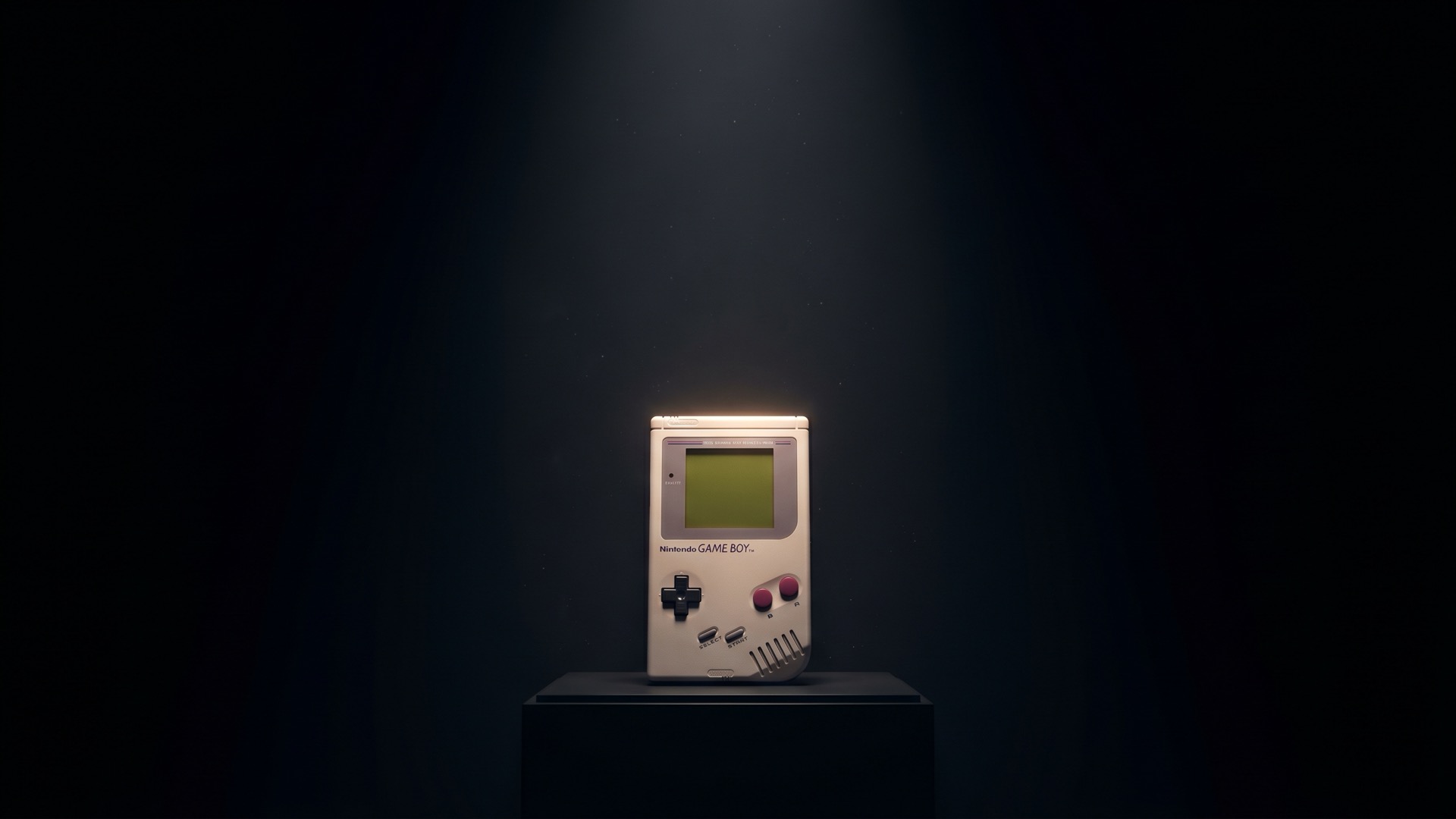
All photographs — genuine units from the Enjoy Game Japan inventory. Toyohashi, Japan.
Monochrome, modest, and unstoppable — "withered technology" that outlasted every colour rival.
About the Game Boy
The original Game Boy launched in Japan on April 21, 1989, and reached North America on July 31, 1989. Designed by Gunpei Yokoi and Satoru Okada under Nintendo's R&D1 division, it was a monochrome handheld with a green-tinted LCD, four AA batteries, and a price point that competitors could not match. Its rivals — the Sega Game Gear, Atari Lynx, and NEC TurboExpress — had colour screens and faster hardware. The Game Boy had none of that. It had thirty hours of battery life, a Link Cable for multiplayer, and Tetris. That was enough.
Meet Max — your guide to the Game Boy
A quick tour of what made this machine special
Video created by the Enjoy Game Japan team · Max voiced by Leda · 40 seconds
It drew two circles on a blackboard and called it a snowman. Everyone understood. That was the point.
Gunpei Yokoi described his philosophy with a blackboard image: draw two circles, call it a snowman, and everyone will feel the whiteness of snow — though the board is black. The screen of the Game Boy, released in Japan on April 21, 1989, was a reflective monochrome LCD with no backlight, displaying four shades of grey-green. Yokoi's rivals — the Sega Game Gear, the Atari Lynx, the NEC TurboExpress — all had colour. All of them required six AA batteries and lasted three to five hours. The Game Boy used four, and lasted up to thirty. Yokoi called his guiding principle 'lateral thinking with withered technology': do not chase the cutting edge; use what is already cheap, mature, and reliable, and apply it to a problem others have defined incorrectly. The Game Boy's problem was not graphics. The problem was where you could take it and how long you could stay. Yokoi's snowman survived every rival that tried to outpaint it.
— inspired by Gunpei Yokoi
Design Characteristics
Form & Feel
The Game Boy — model number DMG-01, named after its internal codename "Dot Matrix Game" — is a vertical handheld: 90 mm wide, 148 mm tall, 32 mm deep, weighing 390 grams with batteries. Its body is a single-piece off-white plastic shell with a dark grey directional pad on the left and two circular action buttons (A and B) on the right. Start and Select sit centrally below the screen. The screen is a reflective monochrome LCD, 47 mm diagonal, displaying 160 × 144 pixels at four shades of grey-green — the characteristic greenish tint that is inseparable from the Game Boy's visual identity. A 3.5 mm headphone jack sits on the base, alongside the external link port that connects two Game Boys with a cable. Four AA batteries in the rear compartment power the unit. On the right side, a single speaker grille. There is no backlight — the screen is designed to be read in daylight or under a lamp. This was not an oversight; it was the engineering choice that enabled the battery life that no competitor could match.
Era & Context
The World It Was Born Into
In 1989, the handheld gaming market was about to be redefined. The Game Boy arrived the same year as the Atari Lynx — a machine with a backlit colour screen, stereo sound, and a fast processor that put it ahead of the Game Boy on every hardware metric. The Sega Game Gear followed in 1990 with colour graphics and the ability to use a TV-tuner accessory. NEC's TurboExpress (1990) was technically the most powerful: it ran PC Engine cartridges natively, offering console-quality graphics in a handheld. Nintendo's entry looked humble by comparison. Yet by 1991, the Game Boy had outsold all three combined. The Game Gear drained six AA batteries in three to five hours. The TurboExpress required six batteries for barely three hours. The Lynx consumed six batteries in a similar span. The Game Boy ran four AA batteries for up to thirty hours. Children could play through a long-haul flight, a road trip, a school holiday — without their parents scrambling for batteries. The Game Boy's defining victory was not hardware. It was the shape of the problem it solved.
A Social Phenomenon
The Machine That Went With You
On April 21, 1989, Nintendo released a grey plastic rectangle in Japan. It was heavier than it looked. The screen was small, the graphics were monochrome, and its battery life ran for roughly ten hours. By every measure of hardware specification, it should have lost.
It didn't lose. It sold out in two weeks.
What the Game Boy had that its rivals — sharper, faster, more colorful — did not, was one thing: it fit in a pocket. Not a bag. Not a backpack. A pocket. And because it fit in a pocket, it went everywhere. The train to work. The waiting room. The long drive across a country you had never seen before. The space under the blanket at night when you were supposed to be asleep.
Before the Game Boy, video games lived in the living room. They required a television, a power outlet, and the permission of whoever else was using the room. The Game Boy removed all of those conditions. It asked only that you bring it with you.
The pack-in software was Tetris. Henk Rogers, who had spent years securing the rights to that game, made a single argument to Nintendo: while Super Mario Land would appeal to children, Tetris would appeal to everyone. He was right. Adults who had never considered buying a game console found themselves carrying a Game Boy. By 1995, Nintendo's own figures showed that 46 percent of Game Boy players were women — a proportion unmatched on any Nintendo platform before or since. Tetris went on to ship more than 35 million copies for the platform. It remains the best-selling handheld game in history.
The sales figures record how many units were sold. They do not record what it felt like to be on a long journey with a grey rectangle in your coat pocket — and to realize, somewhere along the way, that you were no longer bored.
There is a Game Boy that survived a bombing. A U.S. Army medic named Stephan Scoggins carried his during the Gulf War in 1990–91. The barracks where it was stored took a direct hit. The unit was found in the wreckage: casing scorched, buttons melted, screen intact. Nintendo technicians inserted a Tetris cartridge and powered it on. It worked. That machine was displayed at Nintendo's New York store for years, Tetris running on a loop, as evidence of something hard to put into words but easy to understand: this was a machine that was made to be carried.
Then, in 1996, something else happened. Pocket Monsters Red and Green arrived in Japan. Satoshi Tajiri had designed the game around a memory from his childhood — the feeling of watching insects travel between fields. The Game Boy's link cable, he thought, could carry something like that: a small creature, passing between two devices held by two people sitting next to each other. The mechanic that resulted required two Game Boys to complete the game. To catch them all, you needed someone else. The machine that had always been about going somewhere alone had quietly become a reason to sit down beside another person.
If you were there — if you remember the weight of it in a jacket pocket, or the greenish glow of the screen in the dark — you already know what the numbers cannot tell you.
Engineering
How It Was Built — and Why
The Game Boy's processor is the Sharp LR35902 — a custom 8-bit hybrid chip running at 4.19 MHz, combining elements of the Intel 8080 and the Zilog Z80 architectures. It is paired with 8 KB of work RAM and a separate video RAM. The LCD is a reflective STN (Super-Twisted Nematic) panel with no backlight, which is the single most significant engineering decision in the device's history: it eliminated backlight power consumption entirely, extending battery life to fifteen to thirty hours on four AA batteries — three to ten times longer than any colour handheld competitor. The cartridge bus is 8-bit, allowing game cartridges to range from 256 KB in early titles to 8 MB in late-era releases using bank-switching. The Link Cable port on the base uses a simple serial communication protocol at 8 Kbit/s (or up to 512 Kbit/s in fast mode), enabling two-player Tetris battles and, later, Pokémon trading. This communication infrastructure — designed in 1989 — became the foundation for one of the most important social mechanics in gaming history: the Pokémon trade. Without the Game Boy Link Cable, the core loop of collecting and trading 151 species would not have been possible.
Design Philosophy
The Belief Behind the Machine
"Hardware should serve play — not display its own capabilities."
Gunpei Yokoi called his guiding principle "lateral thinking with withered technology" — kareta gijutsu no suiheiteki shikō. The concept is precise: take technologies that are already mature, already cheap, already well-understood, and find new ways to apply them. Do not chase the cutting edge. The cutting edge is expensive, power-hungry, and unreliable. The Game Boy's monochrome display was not new technology in 1989 — Sharp had been producing similar LCD panels for calculators for years. The 8-bit processor was not new. The Game Boy's innovation was not in any individual component, but in the combination and the purpose: all of it assembled toward a single goal, playing games anywhere, for as long as you want, without needing to be near a power outlet. Yokoi had applied the same philosophy to the Game & Watch a decade earlier — using calculator LCD technology for handheld games. The Game Boy was its fullest expression. Every design choice derived from that goal: no backlight (battery life), monochrome display (battery life, cost), simple processor (battery life, cost, heat), four AA batteries rather than six (smaller form factor). Yokoi's belief was that hardware should serve play, not display its own capabilities. A machine that runs out of batteries in three hours, however powerful, is a machine that has failed at its primary job.
Birth Story
How the Game Boy Was Born
The Man Who Made It
Gunpei Yokoi joined Nintendo in 1965 as a maintenance worker, keeping the company's card-printing machines operational. When Hiroshi Yamauchi walked past and noticed Yokoi playing with a toy he'd made on the factory floor — an extendable arm made from lattice — Yamauchi ordered a production run for Christmas. The toy sold 1.2 million units. Yokoi became Nintendo's first dedicated product developer, and over the next two decades he created the Game & Watch series, the D-pad, and the design language of handheld gaming. The Game Boy was his largest bet.
Against the Spec Sheet
When Yokoi presented the Game Boy's specifications to Nintendo's management in the mid-1980s, the reaction was mixed. The Atari Lynx would have a colour screen and backlit display; the Sega Game Gear would follow. Yokoi was proposing a green monochrome screen with no backlight — a machine that looked underpowered compared to what competitors were building. His reasoning was precise: a colour screen consumed battery power at a rate that would require frequent recharging; the target audience was children who would play in cars, on trains, in classrooms. The four AA batteries that the Game Boy required could power it for four hours. That, Yokoi argued, was the correct specification. The machine needed to work where children actually were.
April 21, 1989
The Game Boy launched in Japan on April 21, 1989, at ¥12,800. It sold through its initial stock on launch day. Nintendo had bundled Super Mario Land as the pack-in game in Japan, demonstrating the hardware's capability from the first box opened. In North America, the $89.99 price point positioned it below any competing device, and the decision to bundle Tetris — not Super Mario Land — was one of the most consequential marketing decisions in gaming history.
The Tetris Factor
Tetris had not originally been intended as the North American bundle title. Nintendo's research — including testing with its own staff — found that the game was uniquely accessible: it required no prior gaming experience, no tutorial, and produced near-instant competence. Children who had never played a video game could pick it up and understand it immediately. So could their parents. The Game Boy with Tetris sold to households that had never bought a gaming product. It created an audience that competitors with technically superior hardware — the Lynx, the Game Gear — had not found and could not reach.
The War It Won
The Game Boy faced three serious challengers: the Atari Lynx (1989), the Sega Game Gear (1990), and the NEC TurboExpress (1990). All had colour screens. All had more processing power. All had better display quality by every objective measure. The Game Boy outsold all three combined by an extraordinary margin. Battery life — 4 hours for the Game Boy, 4-5 hours for the Lynx with 6 AA batteries, 3-4 hours for the Game Gear — was decisive. But so was price, library depth, and the cumulative effect of a machine that parents trusted and children loved.
A Machine That Refused to Die
The original Game Boy sold over 119 million units across its various revisions — the original, the Pocket (1996), and the Light (Japan only, 1998). It remained in production until 2003, fourteen years after launch, outlasting two generations of Nintendo's own successor hardware. Some of the original units manufactured in 1989 are still running today. Yokoi died in October 1997, struck by a car on a motorway in Japan, before the Game Boy Color launched — the machine that carried his invention into a new era. The Game Boy's legacy is not measured in technical specifications. It is measured in the number of people who remember where they first played Tetris.
Five Things About the Little Grey Brick
It was weaker than its rivals on purpose, won on battery life, survived a war, shipped with Tetris instead of Mario, and was saved from death by Pokémon. Five stories from the handheld that outlasted everything.
It was deliberately weaker than its rivals
When the Game Boy launched in 1989, its rivals — the Atari Lynx and Sega Game Gear — had full colour screens. The Game Boy had a small monochrome display in four shades of greenish grey and an ageing 8-bit processor. That was a choice. Its designer, Gunpei Yokoi, followed a principle he called "lateral thinking with withered technology": take cheap, proven parts everyone else has moved past, and find a clever new use for them. He bet that people wanted fun and affordability more than cutting-edge specs. He was right.
Its secret weapon was battery life
The colour handhelds that challenged the Game Boy had a fatal weakness: their screens drained batteries in a few hours. The Game Boy, with its modest monochrome display, ran for around thirty hours on four AA batteries. For a machine meant to be carried — on a train, in a car, through a long afternoon — that was everything. The cheaper, plainer machine simply kept playing long after its flashier rivals had gone dark.
One survived a bombing and still plays Tetris
During the 1991 Gulf War, a US Army medic named Stephan Scoggins kept a Game Boy in his barracks to unwind. When the base was bombed, the console came out scorched, its buttons melted and its board exposed and warped. It still worked. Nintendo's technicians slid in a Tetris cartridge and it played. Rather than repair it, Nintendo sent Scoggins a replacement and kept the charred original, which sat for decades in its New York store running Tetris on a loop.
It shipped with Tetris instead of Mario — on purpose
In North America and Europe, the Game Boy came packed not with a Mario game but with Tetris. That was a deliberate argument. Henk Rogers, who held the handheld Tetris rights, told Nintendo's Minoru Arakawa: "If you want little boys to buy your machine, include Mario. But if you want everyone to buy your machine, include Tetris." He was proved right — the falling blocks pulled in adults, women, commuters, people who had never owned a game system. Tetris became the Game Boy's killer app.
Pokémon brought it back from the dead
By 1996 the Game Boy was seven years old and fading. Then Pokémon arrived. From the start, Satoshi Tajiri had imagined creatures crawling through the link cable that connected two Game Boys — and built a game you could only complete by trading with another player. Red and Green released in Japan in February 1996, and the trading turned a dying handheld into a social phenomenon, extending the Game Boy's life by years.
Reflection
What Lasts
In 1965, a young man named Gunpei Yokoi was hired by Nintendo to maintain the machinery on the playing-card production floor. He was not an inventor. He was not a product designer. He was the person who kept the equipment running.
In his spare time, he built a small mechanical toy — an extendable arm that could pick up objects from across a room. Nothing groundbreaking. A curiosity made from inexpensive parts, assembled quietly in the margins of an ordinary workday. Nintendo's president happened to see it during a factory visit, and by Christmas it was a product. Yokoi had not set out to create anything. He had simply looked at what was in front of him, and asked a different question.
This became his philosophy, and he gave it a name: lateral thinking with withered technology. The idea was not complicated. Take components that are already mature — already cheap, already understood, already plentiful — and place them somewhere no one has thought to place them before. Don't chase the newest. Find the use that the familiar thing has not yet been put to.
The Game Boy's processor was from the 1970s. Its screen showed four shades of grey. Inside Nintendo, some called the prototype DameGame — "hopeless game." Yokoi kept working.
When the Game Boy arrived in 1989, its competitors were brighter, faster, and more powerful. The Sega Game Gear had a color screen. The Atari Lynx had a backlit display. Both were technically superior in nearly every measurable way.
The Game Gear ran for three hours on six batteries. The Game Boy ran for thirty hours on four.
The question Yokoi had asked — not "what is the most powerful?" but "what does a person actually need, on a train, in the hands of a child?" — turned out to be the more important question. The Game Boy went on to sell nearly 120 million units. The others are footnotes.
What you have in your hands right now — the ordinary skill, the familiar knowledge, the unglamorous experience — it has not yet been placed in all the contexts it belongs in.
Yokoi never claimed to be ahead of his time. He claimed only to look carefully at the time he was in. The difference between those two things is quieter than it sounds — and more useful. The maintenance man's idea outlasted the engineers who built faster machines. Not because he had more, but because he asked a different question about what he already had.
What is the withered thing in your hands that you have not yet thought to use differently?
Before You BuyWhat to watch for, so you don't regret it
With a Game Boy, the first question is not 'what condition is it in?' but 'which model is it — and does the screen show lines?' The family spans the original DMG-01 (1989), the slimmer Game Boy Pocket (1996), and the backlit, Japan-only Game Boy Light (1998). All are fully region-free. The faults are predictable and easy to miss in a listing, so knowing what to ask before you buy is what separates a satisfying purchase from regret.
Full buying guide →Caring for One You OwnKeeping a vintage machine running
The original Game Boy launched in 1989 and was built to be carried, dropped, and run on four AA batteries for thirty hours at a stretch — a robustness that is part of why so many still work today. At over thirty-five years old, the concerns are predictable and well-documented: a reflective LCD whose ribbon connection weakens with time, batteries that leak if left inside, and contacts that oxidise. Almost none of it is mysterious, and much of it is reversible with patience.
What ages inside a Game Boy
- LCD vertical lines (ribbon cable)Missing vertical or horizontal lines of pixels are the Game Boy's signature ageing defect. The cause is delamination of the heat-bonded ribbon cable that connects the LCD panel to the board. It is the most common and most recognisable fault on the original DMG, and it worsens gradually rather than all at once.
- Battery-terminal corrosionThe DMG runs on four AA batteries, and old cells left inside leak alkaline electrolyte that corrodes the contact springs. This is a very common cause of a unit that will not power on. Caught early, light corrosion on the terminals usually cleans up; residue that has spread to the board makes the repair more involved.
- Speaker membrane and power switchThe speaker membrane deteriorates over time, producing distorted, weak, or buzzing audio. Separately, the power switch contacts oxidise, causing intermittent power or a failure to turn on. Both are wear items rather than catastrophic failures.
- Contrast dial wearThe contrast control uses a potentiometer that wears with age, leaving the screen too dark or too bright at any setting, or unstable at certain positions. It is a contact issue rather than a failed panel, and often responds to cleaning.
What you can do yourself
- Use fresh alkaline AA batteriesUse fresh alkaline AA cells. Rechargeable NiMH cells run at a lower voltage and can cause erratic behaviour, particularly near the end of charge. When the battery indicator turns red, save if you can — the unit will shut off within an hour or two.
- Clean corroded battery terminalsIf corrosion is present in the battery compartment, clean the terminals with vinegar on a cotton swab, then dry thoroughly. Inspect for white or greenish powder before assuming the unit is dead — terminal corrosion is one of the most repairable causes of a Game Boy that will not power on.
- Clean the contrast dialIf the image is unstable at certain dial positions, the contrast potentiometer can be cleaned with contact cleaner. This often restores a stable picture without any further work.
- Mind the lighting on the DMGThe original DMG has a purely reflective LCD with no backlight; it needs ambient light to be seen. In daylight or under a bright lamp the display is perfectly legible, but in dim rooms it is effectively unplayable. Factor your lighting in before assuming a screen is faulty.
When to call a specialist
The Game Boy's two most common repairs both involve heat or soldering.
- Ribbon-cable reflow for missing linesThe standard repair for missing screen lines is to apply gentle heat along the ribbon cable near the LCD edge — a low-temperature soldering iron run slowly along the cable reflows the connection and usually clears the lines. It is a documented, well-established repair that needs no replacement parts, but the margin for error is small, so it is best left to someone experienced if you are unsure.
- Speaker and cartridge save-battery replacementA failing speaker can be replaced with any 8-ohm 0.5W speaker of similar dimensions, often with a noticeable improvement in audio. Separately, earlier cartridges used a battery-backed coin cell for saves; on most original cartridges that cell is now dead, so saves are lost on power-off. Replacing it is a standard soldering repair that erases existing save data in the process.
The Sounds and Images of an Era
The Game Boy defined an era of portable play. These videos capture the machine as it was — in pockets, on playgrounds, on long journeys.
Console CM
Game Commercials 1989-1990
US Launch CM — Tetris
Game Boy — Dark Exhibit
Sound Gameboy — Dark Exhibit
Yokoi Game Boy The Gray Screen That Won — Feature
Yokoi Gameboy The Machine He Never Finished — Feature
My fondest memory of the Game Boy is playing out on the laundry deck, basking in the sun. The warmth on my back, my eyes bent over that tiny screen — I can still call up how good it felt. That screen, in fact, was a reflective LCD with no backlight: without outside light it was hard to read, and so, up on the sunlit deck, the little world only stood out all the more clearly. When I think about it, that may have been the beginning, for me, of no longer playing in the living room. Until then, games were something you did in the family room, where everyone was; now the whole thing fit in the palm of my hand and could be carried anywhere.
The screen was black and white — nothing more, not a single colour. And yet, once I began to play, I slipped straight into that small world. Even without colour, given only sound and movement and a story, a person can stand in another world entirely. That little monochrome screen taught me as much, quietly.
Representative Games
A handful of titles that define this console — each with a shop owner's note, collector's guide, maintenance tips, and memory prompts. The complete library is one click away.
 ▶
▶ Game Boy
Tetris
テトリス
Tetris for Game Boy is a 1989 puzzle game developed by Nintendo R&D1, based on Alexey Pajitnov's original 1985 design. B…
Read more → Uncommon
 Game Boy
Pokémon Red and Green
ポケットモンスター 赤・緑
Pokémon Red and Green launched in Japan on February 27, 1996, after six years of development by Game Freak and creator S…
Read more →
Game Boy
Super Mario Land
スーパーマリオランド
Released in Japan on April 21, 1989 — the same day as the Game Boy itself — Super Mario Land was one of four launch titl…
Read more →
Game Boy
Kirby's Dream Land
星のカービィ
Kirby's Dream Land, released in April 1992, is the debut appearance of Kirby and the first game in the series. Its direc…
Read more → Uncommon
 Game Boy
The Legend of Zelda: Link's Awakening
ゼルダの伝説 夢をみる島
Released in Japan on June 6, 1993, The Legend of Zelda: Link's Awakening is the first Zelda game on a handheld console —…
Read more → ▶
▶ Game Boy
Pokémon Yellow Version: Special Pikachu Edition
ポケットモンスター ピカチュウ
Released in Japan on September 12, 1998, Pokémon Yellow was created directly in response to the explosive success of the…
Read more →Explore the Game Boy World
The makers
The Game Boy came from Gunpei Yokoi's "lateral thinking with withered technology" — a deliberately modest machine that outlasted far more powerful rivals.
Deeper cuts
The Game Boy library runs far past Tetris and Pokémon. A few worth knowing:
Questions people actually ask about the Game Boy
Tell it apart
People often meet Game Boy under another name, or mistake it for the machine beside it. These pages exist to settle that.
Hear the sound of this chip — original music composed on the DMG APU: The Sound of the Machines: Game Boy →