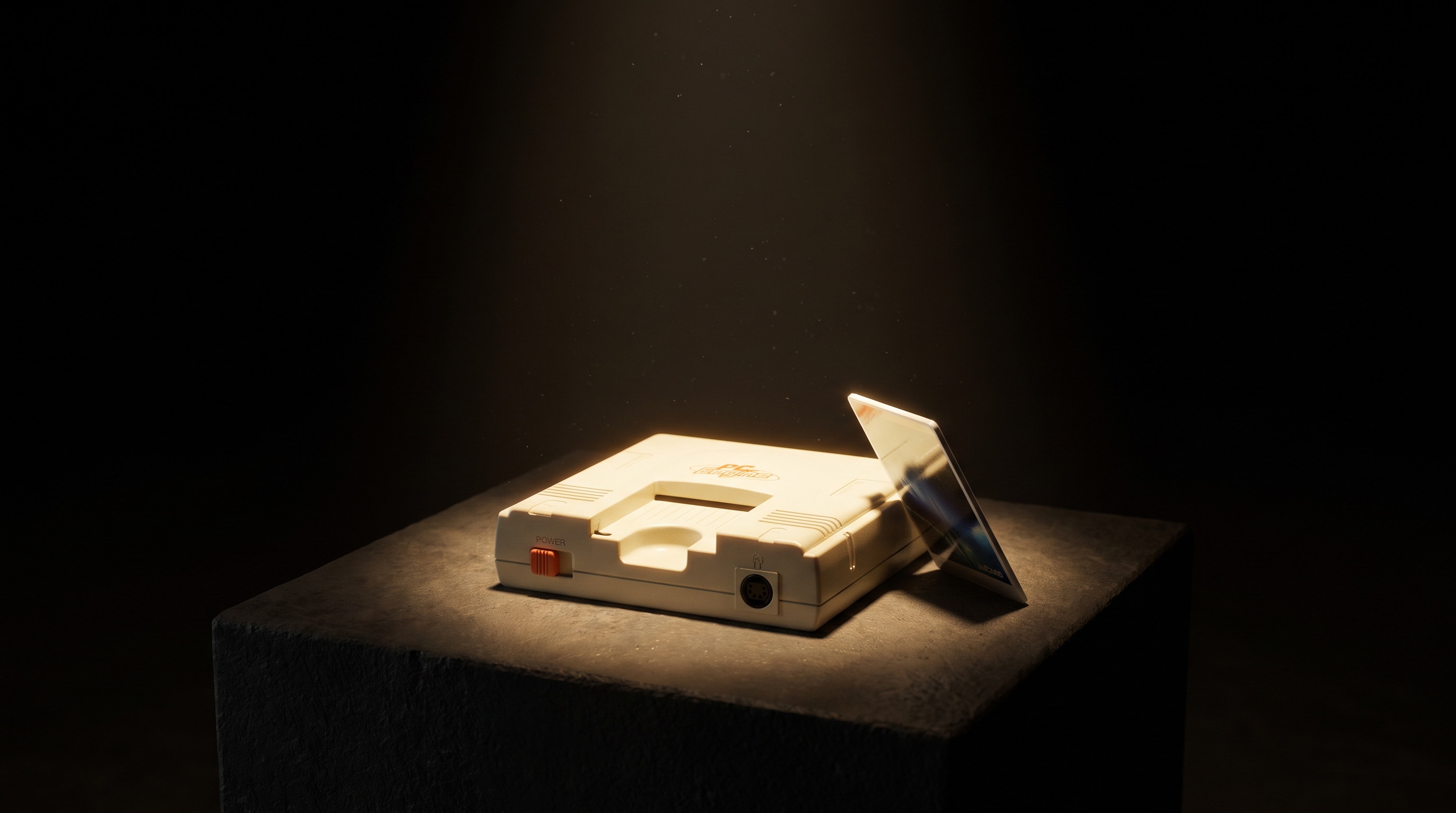
All photographs — genuine units from the Enjoy Game Japan inventory. Toyohashi, Japan.
The smallest major home console ever released — and the first in the world to play games from CD-ROM.
About the PC Engine / TurboGrafx-16
The PC Engine launched in Japan on October 30, 1987 — and nothing about it looked like it should work. A near-perfect 14 × 14 cm white cube, smaller than any major home console before or since, co-designed by NEC and Hudson Soft. Its CPU was technically 8-bit, yet its dual 16-bit graphics processors could display 482 colours on screen simultaneously. It launched on HuCard — a credit-card-sized ROM format — and then, in December 1988, did something no console had ever done: it attached a CD-ROM drive and changed what a game could be. In North America it arrived in 1989 as the TurboGrafx-16.
Three years before the world caught up, it played music from a disc.
On December 4, 1988, NEC attached a CD-ROM drive to the PC Engine — a white cube the size of a hardback book — and created the first console in history to use optical disc storage. The Sega CD followed in 1991. The PlayStation followed in 1994. The PC Engine was there first. What that meant in practice was audible in the opening minutes of Ys I & II: CD-quality orchestral music, voice-acted dialogue, animated cutscenes — on a home console, three years before any competitor offered the same. The PC Engine itself had launched in Japan on October 30, 1987, as a collaboration between NEC, a computer manufacturer, and Hudson Soft, a game studio — neither capable of building it alone. The smallest major home console ever produced, its 8-bit CPU was paired with dual 16-bit graphics processors, and the combination produced something that did not look possible from the outside. The world that the CD-ROM made — story-heavy games, full voice acting, games as narrative art — arrived everywhere, eventually. The PC Engine was the first place it arrived.
Design Characteristics
Form & Feel
The original PC Engine is, physically, extraordinary. At 14 × 14 × 3.5 centimetres, it remains the smallest major home console ever released — a white square that fits in the palm of a hand. Its games are delivered on HuCard: a credit-card-sized ROM module that slides into a slot on the right side of the console. HuCards are thinner than a modern credit card, and the format name — coined internally at Hudson — reflected the ambition: Human Card, suggesting something personal and portable. The console's controller connects via a single proprietary port on the front; the launch pad has a D-pad, two action buttons (I and II), Run, and Select. There is no power LED on the original white unit — the console simply is on or off. NEC released a string of follow-up hardware forms — the PC Engine Duo (1991), which integrated the CD-ROM drive into a single unit; the PC Engine GT (1990), a handheld version that ran HuCards on a 2.6-inch colour LCD; and the TurboDuo (1992) for North America — each expanding or repackaging the core hardware for different audiences. The CD-ROM² add-on, which launched in 1988, connects beneath the console via a proprietary interface card. It took the storage available to a game from a HuCard's usual ceiling of 8 megabits (1 MB) to a CD holding hundreds of megabytes.
Era & Context
The World It Was Born Into
1987 was the year NEC and Hudson Soft forced the question that the entire game industry would spend the next decade answering: what happens when a game console has access to compact disc storage? The PC Engine arrived into a Japan still dominated by the Famicom, and immediately made its presence felt: its graphics capabilities exceeded the Famicom's considerably, and its compact form made it feel like a different kind of object entirely. But the strategic move came in 1988. CD-ROM² was not just a hardware accessory. It was a declaration about the future. While Sega and Nintendo were fighting a 16-bit cartridge war, NEC had already moved to a different battlefield. The CD-ROM era of gaming — which would define the PlayStation, Saturn, and the N64's place in history — began here, in Japan, on December 4, 1988, with a white cube the size of a hardback book. The PC Engine's relationship with Japan was always closer than its relationship with the West. In Japan, it mounted a genuine challenge to the Super Famicom; at its peak in the early 1990s, it held over 30% of the Japanese home console market. In North America as the TurboGrafx-16, it struggled against Sega's aggressive Genesis marketing and never achieved the same foothold. The platform's true legacy is the software it produced — particularly on CD-ROM²: Ys I & II, Tengai Makyou II, Snatcher, Castlevania: Rondo of Blood, and Gate of Thunder are titles that collectors seek globally today.
A Social Phenomenon
The Machine for People Who Knew
There was a machine, released in Japan on October 30, 1987, that most people in the world never got to hold. It measured fourteen centimeters on each side. Smaller than a paperback novel. Smaller than anything that had come before it in a living room. It was called the PC Engine, and for a time in Japan, it outsold the Famicom.
The people who chose it knew why they chose it.
They were not following a trend. The Famicom was the trend. The Super Famicom would become the trend. The PC Engine was something else — a machine for people who cared about a specific kind of game, made with a specific kind of intensity. Horizontal shooters. Vertical shooters. The kind of games where the screen filled with enemies and the question was not whether you would survive, but how precisely you could navigate the space between them. There is an argument — still made today, in corners of the internet where people have thought about this carefully — that no platform in history matched the PC Engine's library of shooters. The people who owned one did not need the argument. They already knew.
Then, on December 4, 1988, a small peripheral arrived. The CD-ROM² add-on made the PC Engine the first video game system in the world capable of playing CD-ROM software. This was not a marketing claim. It was a structural fact that would not be matched by any competitor for years. And in 1989, a game called Tengai Makyō: Ziria arrived on that system — voiced cutscenes, animated characters speaking, a full CD audio score. People who sat in front of a television that night and pressed start were watching something the rest of the world's game players would not experience for a long time afterward.
The sales charts tell you which machine won. They do not tell you what it felt like to hear a character speak for the first time — out of a game, out of a speaker, in your own living room — and understand that you were watching the medium change in real time.
In North America, the story was different. The console arrived in 1989 as the TurboGrafx-16, two weeks behind the Sega Genesis, one year before the Super NES. It was squeezed from both sides and never recovered. By the time the system faded from retail shelves, only ninety-four HuCard titles had been officially released in the region. Ninety-four. A number small enough that a dedicated collector could, in theory, own every one of them. Some people considered that a failure. Others considered it a library with edges you could actually reach.
That quiet sense of having been somewhere others had not — that is the temperature of the PC Engine. Not the machine everyone had. The machine that the right people found.
Engineering
How It Was Built — and Why
The PC Engine's CPU is the Hudson Soft HuC6280A — a 65SC02-based 8-bit processor modified by Hudson engineers to run at up to 7.16 MHz, with a switchable lower speed of 1.79 MHz for backward-compatible software. Despite being technically 8-bit, the HuC6280 includes hardware timer support, a custom audio unit (six-channel wavetable synthesis, an advance on the Famicom's five-channel PSG), and a memory management unit that gives it address ranges beyond the theoretical 8-bit ceiling. The graphics subsystem is where the engineering surprise lives: the HuC6270 Video Display Controller and HuC6260 Video Color Encoder together produce a hardware capability that far exceeds the 8-bit CPU classification. The HuC6270 handles background tiles, sprites, and scrolling; the HuC6260 handles colour lookup, supporting a palette of 512 colours with 482 displayable on screen simultaneously. This was a genuine advance over the Famicom (25 colours on screen) and the Master System (32 colours on screen), achieved through a clever partitioning of tasks between dedicated chips. The CD-ROM² interface, launched in December 1988, connects to the system bus via a dedicated System Card — a HuCard that must be present in the console when operating CD-ROM games. The System Card contains the BIOS, 64 KB of additional RAM, and the interface logic. Later System Cards (Super CD-ROM², Arcade CD-ROM²) added further RAM and capabilities. This modular approach allowed the system to evolve without replacing the base hardware — and demonstrated that a consumer console could use optical media years before the PlayStation made it standard.
Design Philosophy
The Belief Behind the Machine
"Put the maximum into the minimum — then change the ceiling."
NEC and Hudson Soft began from a question, not a vision: what would happen if a home computer manufacturer and a software company built a game machine together? NEC brought manufacturing precision and the miniaturisation expertise from its computer division; Hudson brought the game-making knowledge and the chip design capability to push hardware further than the CPU specification suggested. The result was a console whose design philosophy might be summarised as: put the maximum capability into the minimum space, and then use the CD-ROM to change the ceiling entirely. The HuCard format embodied the first part: a game ROM the size and thickness of a credit card, slipping into a slot in the smallest major home console ever released. CD-ROM² embodied the second: when the cartridge ceiling is not enough, replace the ceiling. What makes the PC Engine philosophically distinct from its rivals is that NEC and Hudson were not fighting Nintendo's definition of what a game console was. They were proposing an entirely different one. A console could be small enough to put in a bag. A game could have a voice-acted story, an animated opening, a full orchestral score. These were not features of the PC Engine. They were claims about what games could be — claims made years before the PlayStation made them obvious. The PC Engine sold approximately 10 million units worldwide. Its influence on the consoles that followed — in validating CD-ROM, in demonstrating that a small manufacturer could build a genuine competitor, in producing some of the finest software ever made for a Japanese home console — was disproportionate to that number.
Birth Story
How the PC Engine Was Born
The Unlikely Alliance
In 1987, Nintendo's Famicom was the unquestioned king of the Japanese market and NEC was one of Japan's largest technology companies — a maker of computers and semiconductors with no history in consumer entertainment. A partnership between the two seemed implausible. Yet NEC approached Hudson Soft, a Sapporo-based game developer with expertise in processor design, to create a new platform together. The machine they built — the PC Engine — was a direct challenge to Nintendo's dominance, arriving from a direction no one had anticipated.
The Smallest Console of Its Day
The result was startling. The PC Engine was the smallest home console ever produced at the time, roughly the size of a paperback book. Its HuC6280 processor — an 8-bit chip built on a 65C02 core, from the same 6502 family as the Famicom's CPU — ran at 7.16 MHz, about four times the Famicom's 1.79 MHz. Its graphics chips were exceptional: they could put 482 colours on screen at once from a palette of 512, and up to 64 sprites. The HuCard cartridge format — a flat, credit-card-sized game carrier — gave the machine its pocket-sized profile.
Inventing the CD-ROM Console
Then came CD-ROM². In 1988, the PC Engine became the first home console in the world to offer a CD-ROM peripheral — the CD-ROM² System, a add-on unit that sat beneath the PC Engine and gave it access to hundreds of megabytes per disc. This was transformative: an ordinary HuCard held at most 8 megabits (1 MB), and even the largest ever made, Street Fighter II' in 1993, held 20 megabits (2.5 MB). Full voice acting, CD-quality music, animated cutscenes — all arrived in console gaming through the PC Engine before any other platform.
The Version Problem
But that pioneering instinct produced a problem that the PC Engine never fully solved: version proliferation. NEC's strategy was to add new capabilities through peripheral hardware rather than replacing the base console. The CD-ROM² add-on was followed by the Super CD-ROM², the Arcade Card, the PC Engine GT handheld, the PC Engine Duo (a combined unit), and the PC-FX successor console — a landscape so complex that even dedicated players lost track of what was compatible with what. Where the Famicom had one model and the Super Famicom had two, the PC Engine family eventually had more than a dozen variants.
A Pocket Dream
The GT handheld in particular captured the imagination — a portable PC Engine with a full-colour LCD screen, released in 1990, years before Nintendo's Game Boy Color would offer colour in a handheld. The GT was expensive and battery-hungry, but it was remarkable: a genuinely capable system that played the same HuCards as the home console, without compromise. It demonstrated what portable gaming could aspire to, even if the market for a ¥44,800 handheld was inevitably small.
A Legacy Written in Firsts
The PC Engine sold approximately 10 million units, with its strongest market being Japan. Its contribution to gaming history is disproportionate to its commercial scale: the first CD-ROM game console, the first system to demonstrate full voice acting in a home game, the birthplace of the Bomberman, PC Genjin (Bonk), and Ys series for home audiences. The Hudson-NEC collaboration, improbable as it seemed, built a machine that altered what home gaming was capable of — and left behind a legacy measured less in units than in precedents.
Reflection
What Lasts
In 1992, a team of more than a hundred people built something that cost half a billion yen.
That sum — roughly four million dollars at the time — was reportedly the largest development budget for a video game that had ever been spent. The project was Tengai Makyō II: Manjimaru, a role-playing game for the PC Engine Super CD-ROM². The lead programmer, Hiromasa Iwasaki, only confirmed the figure years later, in a 2015 interview. He said it matter-of-factly, without apology and without pride. It was simply what the work required.
The game took advantage of the CD-ROM format in ways that had not been attempted before: long stretches of cutscene animation, hundreds of enemy types, voices and music woven through nearly every scene. What Hudson and Red Company built that year may have been, as some have since described it, the first production of what we would now call triple-A scale.
Almost no one outside Japan ever saw it. The PC Engine barely registered in the West, and the game was never released abroad. The half-billion yen, the hundred-person team, the months of animation — none of it reached the audience it might have deserved.
And still, they made it the way they made it.
There is something in that fact worth sitting with. The scale of the work was not adjusted downward because the market was uncertain. The attention was not withheld because recognition was unlikely. They had decided what the game should be, and they built it to that measure — regardless of who was watching.
The work that holds its standard in the dark — when no one is counting, when the outcome is unknown — that work says something true about the people who made it. It is also the only kind of work that tends to last.
Most of what we now call classics were not made for posterity. They were made by people who could not yet know they would become classics. They were made carefully because the people making them had decided that careful was the right way to work.
Is there something you are making — or carrying — that no one can yet see? How are you choosing to hold your standard when the audience has not yet arrived?
Five Things About the Little Machine That Was First
It played CDs before anyone else, it is the smallest major home console ever released, it was built by two companies at once, its famous "16" was a stretch, and it was a star in Japan and a ghost in America. Five stories from the PC Engine.
It played CDs three years before anyone else
In December 1988, NEC released the CD-ROM² add-on for the PC Engine — making it the first game console in the world to play games from a compact disc. Sega's CD add-on would not arrive until 1991, and Sony's PlayStation not until 1994. For a few years the little PC Engine could do something no other console could: load full music, voice, and animation from a disc that held hundreds of times what a chip could.
It is the smallest major home console ever released
At roughly 14 by 14 centimetres and under four centimetres tall, the PC Engine remains the smallest major home console ever released — small enough to vanish under a paperback. Its games came on HuCards: ROM cartridges shrunk to the size and thickness of a credit card, which slid into a slot on the front. You could carry a stack of them in a shirt pocket.
It was built by two companies at once
The PC Engine was not one company's machine. Hudson Soft, a software house, designed its custom chips — including the HuC6280 at its heart — but had no way to manufacture hardware at scale. So it partnered with the electronics giant NEC, which built and sold the console. The collaboration let a small studio's clever silicon reach living rooms it could never have reached alone.
The "16" in TurboGrafx-16 was a stretch
In America the console was sold as the "TurboGrafx-16" — but its brain, the Hudson HuC6280, was an 8-bit processor. The 16 referred to its two 16-bit graphics chips, not its CPU, and critics called the name misleading. That same HuC6280 carried an integrated sound generator rich enough that its chiptunes are still studied and recreated today — including in this museum's own sound work.
A hit in Japan, a flop in America
In Japan the PC Engine was a phenomenon — in its first year it outsold even the Famicom, and it remained the country's number-two platform for years. In North America the same machine, redesigned into a large black box and renamed the TurboGrafx-16, barely registered. Poor marketing and a thin line-up sank it. The same console was a star on one side of the Pacific and an afterthought on the other.
Before You BuyWhat to watch for, so you don't regret it
With the PC Engine, one decision matters more than condition or price: which kind you buy. HuCard-only models (PC Engine, CoreGrafx, GT/TurboExpress) age very differently from CD-capable models (CD-ROM², Duo, Duo-R/RX), where electrolytic capacitor leakage is the defining risk. The Japanese PC Engine and the North American TurboGrafx-16 are the same console but have deliberately reversed HuCard data pins, so cartridges are not cross-compatible without a converter. A Japanese unit also expects Japan's 100V supply and its original adapter.
Full buying guide →Caring for One You OwnKeeping a vintage machine running
The PC Engine launched in 1987, and how it ages depends almost entirely on which kind you own. HuCard-only models — the PC Engine, CoreGrafx, and the portable GT — age very differently from the CD-capable models, the CD-ROM², Duo, and Duo-R/RX, where electrolytic capacitor leakage is the defining risk. Knowing which machine is in front of you is the first and most important step in caring for it.
What ages inside a PC Engine
- Electrolytic capacitor leakage (CD and portable models)On the Duo, the CD-ROM² units, and the portable GT/TurboExpress, leaking electrolytic capacitors are the defining failure point. The leakage is severe in these models — virtually all surviving GT units need recapping before reliable operation — and if left, the escaping fluid corrodes the board traces beneath, turning a routine service into a more serious repair.
- HuCard contact oxidationThe gold edge contacts on HuCards oxidise over decades of storage, causing failure-to-read and graphical glitches. The console's own slot contacts oxidise in the same way. This is the most common maintenance point on HuCard systems and is almost always a contact issue rather than a broken console.
- CD-ROM laser pickup degradationOn any model with a CD drive — the CD-ROM², Super CD-ROM², and Duo family — the optical pickup is subject to the same age-related laser and sled wear seen in every CD system of that era. The Super CD-ROM² uses a KSS-220a-type laser assembly, and replacement parts remain available.
- Board-trace and output corrosionCapacitor leakage can corrode the board traces around it, and the RF/AV output connector contacts can fail with age. Brown staining or white residue near the capacitors is a warning sign that leakage has begun to spread.
What you can do yourself
- Clean HuCard contactsMost read failures and graphical glitches come down to oxidised HuCard contacts. Gently wipe the gold contacts on the card with 90%+ isopropyl alcohol on a cotton swab; stubborn oxidation responds to a dedicated contact cleaner such as DeoxIT. Never blow into the slot — moisture accelerates the corrosion you are trying to remove.
- Clean the console slotThe console's own HuCard slot contacts can oxidise too and may need the same treatment. Confirming that several different cards then load cleanly tells you the slot itself is sound before suspecting a deeper fault.
- Inspect CD models for leak damageOn any CD-ROM², Duo, or Duo-RX, open the question of capacitor leakage directly. Look for brown staining or white residue near the capacitors — its presence means servicing is needed, while a clean, corrosion-free board is a far better starting point.
- Confirm the right System CardA CD console cannot boot CD games without the correct System Card inserted, and the card is region-locked to match the console. This is a setup check rather than a repair, but it is a common reason a CD machine appears not to work.
When to call a specialist
The PC Engine's CD and portable models almost all need soldering work to remain reliable.
- Capacitor replacement and trace repairRecapping a Duo, a CD-ROM² unit, or a GT — and repairing any board traces the leakage has already corroded — is the single most important action for these models' survival. The work requires soldering and careful cleaning of leaked electrolyte. A serviced, corrosion-free unit is worth markedly more than one merely described as untested.
- CD laser adjustment or replacementPersistent disc-read failures on a CD model point to a worn optical pickup. On the Super CD-ROM², the KSS-220a-type laser assembly can be replaced with parts that remain available, but the alignment and handling involved make this specialist work rather than a user repair.
The Sounds and Images of an Era
The PC Engine introduced CD-ROM to game consoles. These videos capture the console as it was — on television, at launch, in the shops.
PC Engine Console CM
PC Engine CoreGrafx CM (1989)
PC Engine DUO CM (NEC-HE)
PC Engine CM Collection 1991–1994
PC Engine CD-ROM² CM Collection 1988–1991
Pc Engine — Dark Exhibit
I studied art and worked in architecture before I sold consoles, so I look at a machine the way I look at a building. Hudson had designed the chips but could not build a console on its own. It showed them to Sharp first, and when that deal fell through, it went to NEC. The entire system was folded into three chips — the sound was pushed inside the CPU — and what came out is still listed as the smallest major home console ever released: about 14 centimetres square. The Duo is where that thinking arrives. The material has a sharpness to it, the buttons sit in the shell as though the shell had been drawn around them, and there is not one unnecessary line on it anywhere. But almost every Duo that reaches me has fluid on the board. Its capacitors give no warning — they keep working while they leak — so even when a Duo plays perfectly, a friend of mine, a certified engineer, takes every one of them out. I saw the same thing in architecture: a building that leans too far toward beauty costs more to keep standing. It goes this way with cars, too. The beautiful ones ask more of you, and there is no way around it. The Duo-R is the sturdier machine and rarely needs the work — but next to the Duo, it simply does not hold up. Even so, I love this design.
Representative Games
A handful of titles that define this console — each with a shop owner's note, collector's guide, maintenance tips, and memory prompts. The complete library is one click away.
View all 109 PC Engine / TurboGrafx-16 games →
A PC Engine Title Worth Your Time
A title that defines what the PC Engine accomplished in the shooter genre — documented with historical background and condition notes for collectors.
Explore the PC Engine World
The studios
The PC Engine was a Hudson–NEC collaboration, and its sharpest games came from the studios that knew the hardware best.
Deeper cuts
The PC Engine's library is a collector's treasure — much of it never left Japan:
Questions people actually ask about the PC Engine / TurboGrafx-16
Tell it apart
People often meet PC Engine / TurboGrafx-16 under another name, or mistake it for the machine beside it. These pages exist to settle that.
Hear the sound of this chip — original music composed on the HuC6280: The Sound of the Machines: PC Engine →