composer
Hidenori Shoji
正宗弘典
He learned from a single critique — that music without an ending is incomplete — and has written endings ever since.
About
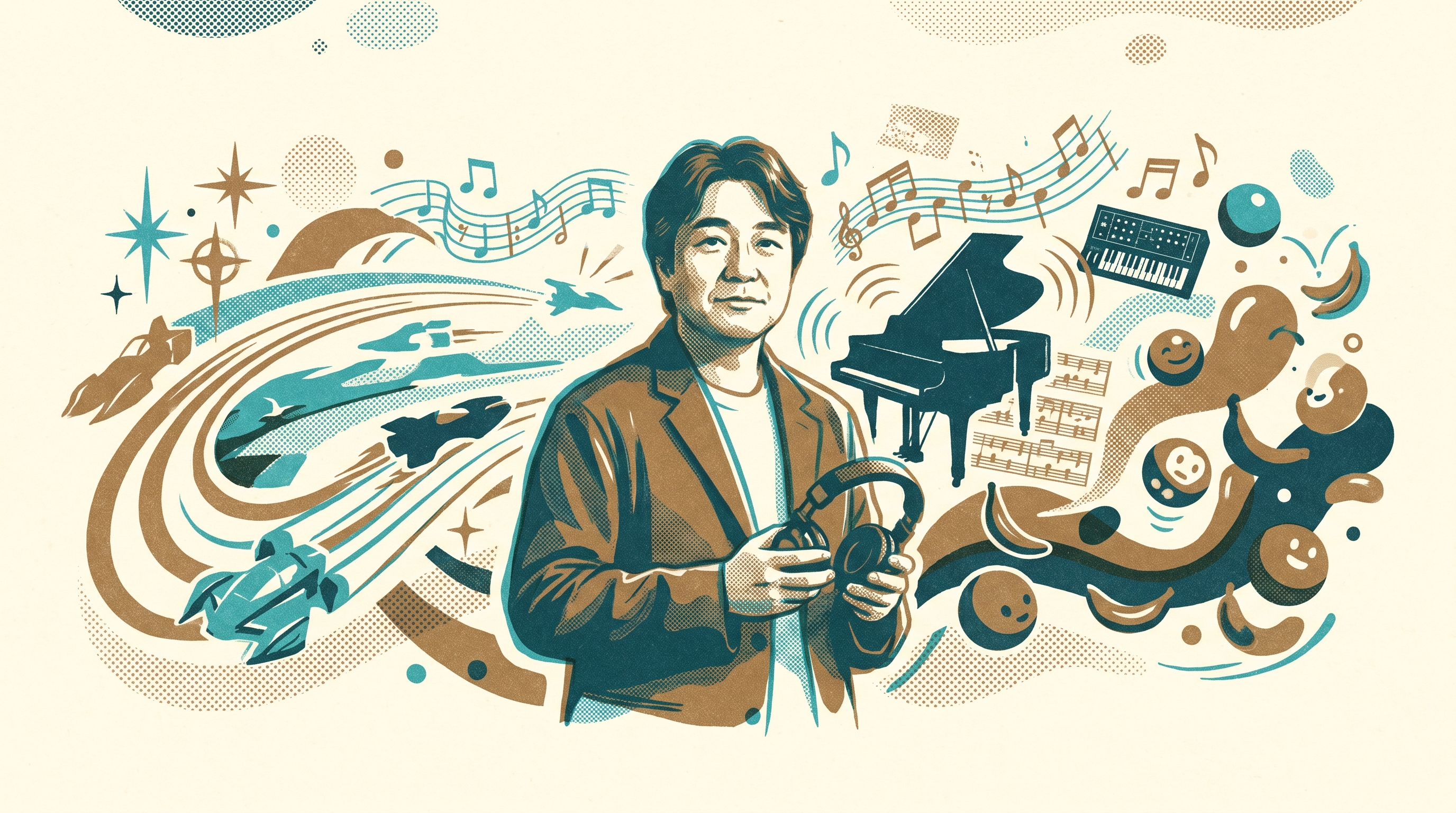
Hidenori Shoji is a Japanese video game composer, guitarist, and sound designer, born January 7, 1975, in Mito, Ibaraki. He joined Sega in 1996 and has contributed music to Fighting Vipers 2, F-Zero GX, the Super Monkey Ball series, and served as music director of the Yakuza series and its Judgment spin-off. A defining feature of his work is the practice of crafting distinct musical endings for soundtrack pieces rather than relying on fade-outs or loops — a discipline he adopted after feedback on F-Zero GX and carried through his later work.
History
Hidenori Shoji was born on January 7, 1975, in Mito, Ibaraki, Japan. He joined Sega in 1996 at the age of twenty-one, the year Sony's PlayStation was consolidating its dominance and arcade game centers were still a major pillar of the Japanese game industry. Shoji entered the company as a sound designer and composer during a period when Sega was developing arcade titles aggressively — coin-operated machines that needed to grab attention within seconds.
His early work included Fighting Vipers 2 in 1998, an arcade fighting game that required high-energy tracks to match the speed and intensity of the combat. Arcade composition is a distinct discipline: the music must loop indefinitely without noticeable seams, yet it must not become tiresome after repeated plays. Shoji's tracks were technically competent, but at this stage he had not yet developed the signature approach that would define his later work.
In 2003, Shoji contributed to F-Zero GX, a collaboration between Sega and Nintendo for the GameCube. The game was known for its blistering speed and difficulty, and Shoji co-composed the soundtrack with Daiki Kasho, drawing from rock and techno styles. After the game's release, a graphic designer on the project gave him feedback: the tracks looped endlessly without proper resolutions, and the lack of musical endings felt incomplete. It was a small critique, easy to dismiss, but Shoji did not dismiss it.
From that point forward, he made a deliberate choice: every piece of music he wrote would have a distinct ending. Not a fade-out. Not an indefinite loop. A composed conclusion. This principle became non-negotiable in his work, a discipline he carried forward into every project that followed. It was a rule born from a single piece of feedback, internalized and applied consistently for more than two decades.
He became music director for the Yakuza series, which launched in 2005 and grew into one of Sega's most enduring franchises. The series required a wide stylistic range — from orchestral drama to nightlife jazz, from karaoke pop to tense combat themes — and Shoji's soundtracks matched that range while maintaining internal coherence. He later served as music director for the Judgment spin-off series as well. Across these projects, his commitment to writing musical endings remained intact. The soundtracks were not ambient loops; they were compositions with beginnings, middles, and ends.
Shoji is also a member of H., a band composed of Sega sound designers. The group performs live and releases music outside of game projects, another outlet for the same discipline: music as a craft that respects the listener enough to finish what it starts. As of 2026, he continues to work at Sega, having spent thirty years at the company.
His career is a quiet argument for the value of listening. One designer told him his music felt unfinished, and Shoji changed how he worked. Not because the critique was harsh, but because it was true. The willingness to hear feedback and act on it — not defensively, but structurally — is rarer than talent. Shoji had both.
Timeline & Works
Career milestones and all 2 games in the museum they worked on — in the order they happened.
- 1975 01
Birth
Hidenori Shoji was born on January 7 in Mito, Ibaraki, Japan.
people - 1996
Joined Sega
Shoji joined Sega at the age of twenty-one as a sound designer and composer.
people - 1998
Fighting Vipers 2
Contributed music to Fighting Vipers 2, an arcade fighting game.
product - 2001
- 2003
F-Zero GX soundtrack
Co-composed the soundtrack for F-Zero GX with Daiki Kasho, combining rock and techno styles.
product - 2003
- 2004
The feedback that changed everything
A graphic designer on F-Zero GX told Shoji his looping tracks lacked musical endings. He adopted a discipline of writing distinct conclusions for every piece from that point forward.
milestone - 2005
Yakuza series music director
Became music director for the Yakuza series, one of Sega's most enduring franchises, requiring a wide stylistic range from orchestral drama to nightlife jazz.
leadership - 2018
Judgment series music director
Served as music director for the Judgment spin-off series, continuing his discipline of crafted musical endings.
leadership - 2026
Thirty years at Sega
As of 2026, Shoji continues to work at Sega, having spent thirty years with the company.
milestone
Connections
- employed sega (1996–present)
Shoji joined Sega in 1996 and has remained with the company for thirty years, contributing to arcade titles, console games, and major franchises.
Explore the work
Each title has its own page — history, trivia, and collector's notes.
Rooms their games live in
Sources
- Hidenori Shoji — Wikipedia (English) — accessed 2026-06-20
- Hidenori Shoji — Video Game Music Preservation Foundation Wiki — accessed 2026-06-20
- F-Zero GX/AX – 2003 Developer Interviews — accessed 2026-06-20
- Hidenori Shōji — Sonic Wiki Zone — accessed 2026-06-20