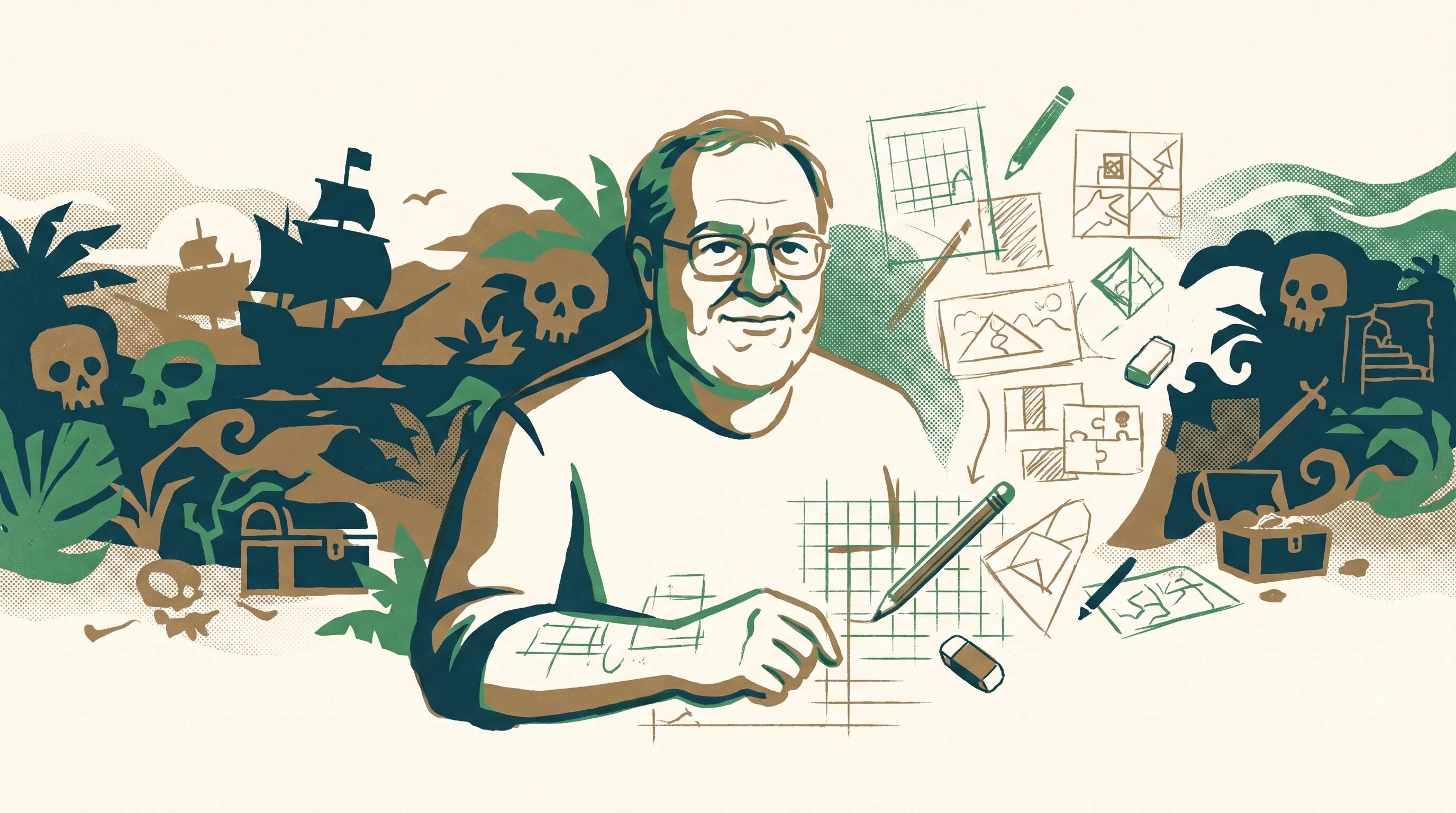
designer
Ron Gilbert
ロン・ギルバート
He built the language that let worlds talk back — then filled those worlds with puzzles nobody forgot.
About
Ron Gilbert is an American video game designer and programmer, born January 1, 1964. He invented SCUMM (Script Creation Utility for Maniac Mansion), the scripting engine that powered most LucasArts adventure games. He designed Maniac Mansion (1987) and the first two Monkey Island games (1990, 1991). After leaving LucasArts, he co-founded Humongous Entertainment (1992) and Cavedog Entertainment (1995). In 2009, IGN named him one of the top 100 game creators of all time.
History
Ron Gilbert was born on January 1, 1964. He arrived at the game industry not through film school or formal design training but through programming — writing code that could make something respond. In the mid-1980s he joined Lucasfilm Games (later LucasArts), a division of George Lucas's entertainment company that was beginning to explore interactive storytelling. At that moment the adventure game genre was dominated by Sierra On-Line's parser-based titles, where the player typed commands into a text prompt and hoped the computer understood. Gilbert looked at that system and saw a wall between the player and the world. He wanted to remove it.
In 1987 he designed and programmed Maniac Mansion, a comedy-horror adventure about teenagers exploring a mad scientist's house. The game introduced SCUMM — the Script Creation Utility for Maniac Mansion — a scripting language Gilbert invented to manage branching dialogue, object interactions, and puzzle states without hardcoding every outcome. SCUMM was not merely a technical convenience; it was a design philosophy. It allowed the world to respond intelligibly to almost any reasonable action the player might try, and it made the game's logic readable to other designers, not just engineers. Nearly every LucasArts adventure game for the next decade would be built on SCUMM or its descendants.
Maniac Mansion also pioneered a verb-based interface: a row of commands at the bottom of the screen — 'Open,' 'Pick Up,' 'Use' — that the player clicked to interact with objects. No typing, no guessing whether the parser would understand 'unlock door with key' versus 'use key on door.' The system made adventure games accessible to people who had never played one before, and it removed the friction that had made Sierra's games feel like adversarial riddles. Gilbert's design philosophy, later articulated in a 1989 article titled 'Why Adventure Games Suck,' was clear: the game should never punish the player for curiosity. You should not die for trying something, and the game should not become unwinnable because you used an item in the wrong scene three hours earlier. This was a radical departure from the genre's norms.
In 1990 Gilbert directed The Secret of Monkey Island, a pirate comedy adventure released for DOS, Amiga, and Atari ST. The game followed Guybrush Threepwood, a hapless wannabe pirate navigating insult sword-fighting, ghost ships, and a love story with the governor of Mêlée Island. The writing was sharp, self-aware, and willing to break the fourth wall; the puzzles were intricate but fair; the world felt vast and coherent. The game sold well and became a touchstone for adventure game design. A year later, in 1991, Gilbert released Monkey Island 2: LeChuck's Revenge, which expanded the world, deepened the comedy, and ended on a cliffhanger that Gilbert himself would not resolve for more than thirty years.
In 1992, shortly after Monkey Island 2 shipped, Gilbert left LucasArts and co-founded Humongous Entertainment with Shelley Day. The company made adventure games for children — Putt-Putt, Freddi Fish, Pajama Sam — built on the same SCUMM-derived technology Gilbert had pioneered at LucasArts. The games were gentle, non-violent, and designed so that a five-year-old could play without reading instructions or hitting a fail state. Humongous became commercially successful, selling millions of copies and proving that Gilbert's design principles — clarity, fairness, curiosity without punishment — worked across audiences. In 1995 he also co-founded Cavedog Entertainment, a sister company that produced the real-time strategy game Total Annihilation (1997), a title aimed at adults that pioneered 3D unit models and streaming music in the RTS genre.
After leaving Humongous in the early 2000s, Gilbert moved through several studios and projects. He worked at Hothead Games, where he designed the episodic adventure DeathSpank (2010). He joined Double Fine Productions briefly. In 2017 he co-founded Terrible Toybox and released Thimbleweed Park, a point-and-click adventure explicitly modeled after the LucasArts games of the late 1980s, funded through Kickstarter and built with a modern SCUMM-like engine. The game was both a love letter to the genre and a test: could the old design philosophy still work in an era of first-person shooters, open-world sandboxes, and live-service games? The answer, for a certain audience, was yes.
In 2022, thirty-one years after Monkey Island 2, Gilbert released Return to Monkey Island — the first Monkey Island game he had directed since 1991. The game finally addressed the cliffhanger ending of the second installment and offered closure to a story Gilbert had begun three decades earlier. Some longtime fans objected to the art style, to the story choices, to the ending itself. Gilbert, who had spent years writing publicly about game design on his blog Grumpy Gamer, stopped writing about Monkey Island entirely after the game's release. In a brief post, he noted that the criticism had made continuing the conversation unpleasant. He did not elaborate further.
What Ron Gilbert proved across four decades is that a tool shapes the kinds of stories you can tell, and the designer who builds the tool decides what is possible. SCUMM was not neutral — it encoded Gilbert's belief that games should be generous, that they should let the player try things without fear, that they should respond rather than punish. That philosophy became the foundation of an entire genre. Whether the genre itself endures is a separate question, but the lesson remains: the constraints you choose to remove are as important as the ones you choose to impose, and a well-designed system can outlive the person who built it by decades.
Timeline & Works
Career milestones and all 1 game in the museum they worked on — in the order they happened.
- 1964 01
Ron Gilbert born
Ronald David Gilbert is born on January 1, 1964.
people - 1987
Maniac Mansion — SCUMM engine debut
Gilbert designs and programs Maniac Mansion for Lucasfilm Games, introducing the SCUMM scripting engine and verb-based interface that would define LucasArts adventure games for a decade.
product - 1989
Publishes "Why Adventure Games Suck"
Gilbert publishes the influential design article "Why Adventure Games Suck," outlining his philosophy that games should never punish curiosity or become unwinnable through earlier mistakes.
milestone - 1990
The Secret of Monkey Island released
The Secret of Monkey Island launches for DOS, Amiga, and Atari ST. Gilbert directs the pirate comedy adventure that becomes a touchstone of the genre and introduces Guybrush Threepwood.
product - 1990
- 1991
Monkey Island 2: LeChuck's Revenge
Gilbert releases Monkey Island 2: LeChuck's Revenge, expanding the world and ending on a cliffhanger he would not resolve for more than thirty years.
product - 1992
Co-founds Humongous Entertainment
Shortly after Monkey Island 2 ships, Gilbert leaves LucasArts and co-founds Humongous Entertainment with Shelley Day, creating SCUMM-based adventure games for children including Putt-Putt, Freddi Fish, and Pajama Sam.
people - 1995
Co-founds Cavedog Entertainment
Gilbert co-founds Cavedog Entertainment, a sister company to Humongous that produces the RTS game Total Annihilation (1997), pioneering 3D unit models and streaming music in the genre.
people - 2009
Named one of IGN's top 100 game creators
IGN names Gilbert one of the top 100 game creators of all time, recognizing his foundational contributions to adventure game design.
milestone - 2017
Co-founds Terrible Toybox; releases Thimbleweed Park
Gilbert co-founds Terrible Toybox and releases Thimbleweed Park, a Kickstarter-funded point-and-click adventure explicitly modeled after late-1980s LucasArts games.
product - 2022
Return to Monkey Island — closing the loop
Thirty-one years after Monkey Island 2, Gilbert releases Return to Monkey Island, finally addressing the cliffhanger ending and offering closure to a story begun in 1991.
product
Explore the work
Each title has its own page — history, trivia, and collector's notes.
Sources
- Ron Gilbert — Wikipedia — accessed 2026-06-23
- Ron Gilbert on return to Monkey Island — Gamereactor — accessed 2026-06-23
- Game Dev Story: Ron Gilbert, The Secret of Monkey Island — The Twin Geeks — accessed 2026-06-23
- Interview with Ron Gilbert — The International House of Mojo — accessed 2026-06-23