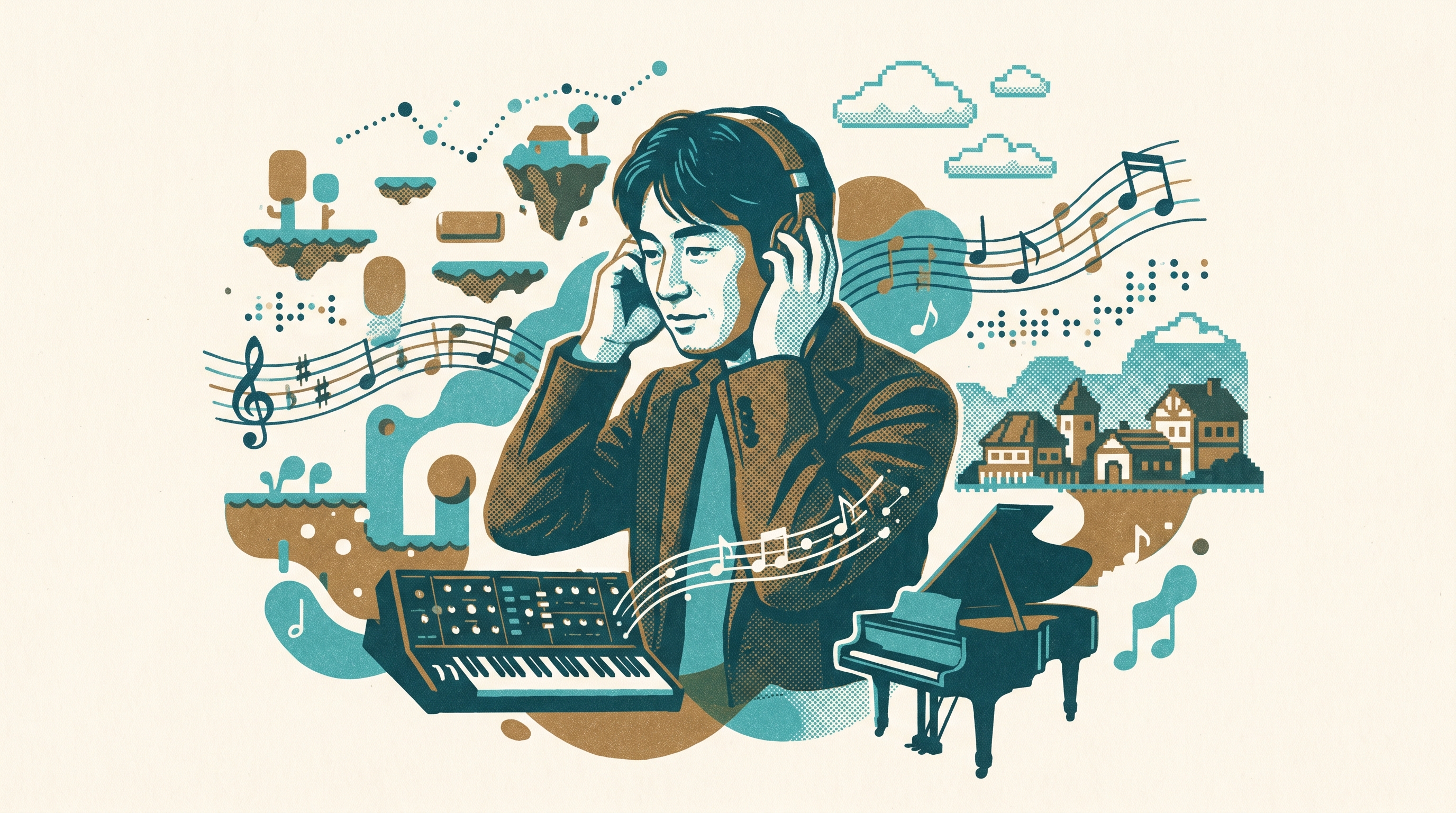
composer
Tsukasa Tawada
多和田吏
He chose to score the darker side of Pokémon — proof that even familiar worlds hold shadows worth exploring.
About
Tsukasa Tawada is a Japanese video game composer born March 24, 1965. He began his career at Jaleco in 1987, composing for Famicom titles such as Rod Land and Earth Defense Force, before moving to Genius Sonority in the early 2000s. He is best known for scoring Pokémon Colosseum (2003) and its darker, cooler atmospheres — a departure from the series' usual brightness — along with subsequent titles including Pokémon XD: Gale of Darkness (2005) and Pokémon Battle Revolution (2006).
History
Tsukasa Tawada was born on March 24, 1965, in Japan. He entered the video game industry at a time when the Famicom had established itself as the dominant console in Japan, and composers were just beginning to be recognized as distinct contributors rather than anonymous code writers. He joined Jaleco in 1987, after a brief appearance on uncredited projects in 1986. Jaleco was a mid-tier developer best known for arcade conversions and original action games, not the sort of place that attracted big names. For a composer starting out, it was simply a place to work.
At Jaleco, Tawada contributed music to dozens of titles across the late 1980s and early 1990s. His work included Rod Land (1990), a whimsical Famicom platformer with a toy-store aesthetic, and Earth Defense Force (1991), a vertically scrolling shooter that had nothing in common with the later third-person series of the same name. He also scored Keio Flying Squadron (1993) for the PC Engine, a side-scrolling shooter notable for its detailed sprite work and playful tone. The projects were varied, the deadlines constant, and the hardware constraints severe — Famicom sound chips allowed only a handful of simultaneous channels. Learning to compose within those limits became a foundational skill.
Tawada spent over a decade at Jaleco, working through the Famicom's sunset and into the era of 16-bit consoles. But by the late 1990s, Jaleco's fortunes had dimmed, and many of its composers and designers began to move elsewhere. Tawada's next major credit would not appear until 2003, when he scored Pokémon Colosseum for Genius Sonority, a small studio founded by former Nintendo programmer Manabu Yamana. The studio had secured a contract to develop console Pokémon spin-offs, and Tawada was brought in to handle the sound.
Pokémon Colosseum was set in Orre, a desert region far from the familiar routes and towns of the main series. The game's story revolved around stolen Pokémon, underground crime syndicates, and battles fought not for badges but for survival. It was darker in tone than any Pokémon title before it, and Tawada's music reflected that shift. In his own words, he aimed for a 'dry, yet cool-sounding theme' that would thread through the game's various tracks. The result was a score that felt sparse and tense, built from electric guitar riffs, synthesized percussion, and minimal melody — closer to a Western action game than a JRPG. It was not the sound people expected from Pokémon, and that was precisely the point.
Tawada continued to work with Genius Sonority on the sequel, Pokémon XD: Gale of Darkness (2005), which deepened the Orre setting and introduced Shadow Lugia, a corrupted legendary Pokémon consumed by darkness. The music followed the same restrained, atmospheric approach. He also scored Pokémon Trozei! (2006), a Match-3 puzzle spin-off for the Nintendo DS, and Pokémon Battle Revolution (2006) for the Wii, a stripped-down battle simulator that served mainly as a visual upgrade for Diamond and Pearl battles. By the end of that run, Tawada had become the defining composer of Genius Sonority's Pokémon output — the person who gave those darker spin-offs their sonic identity.
Since then, Tawada has maintained a lower public profile. He uploads piano arrangements of his Pokémon compositions to his YouTube channel, revisiting tracks from Colosseum and XD with solo performances. The arrangements are careful, unhurried, and performed without commentary. They are the work of someone who knows the music intimately and does not need to explain it. His career is a reminder that not every composer builds a massive catalog or a household name. Some carve out a small space, define it clearly, and leave a distinct mark within it.
Timeline & Works
Career milestones and all 4 games in the museum they worked on — in the order they happened.
- 1965 03
Born in Japan
Tsukasa Tawada was born on March 24, 1965, in Japan.
people - 1987
Joined Jaleco as composer
Began professional career at Jaleco, composing music for Famicom and arcade titles.
people - 1989
- 1989
- 1990
Composed Rod Land (Famicom)
One of his early notable works at Jaleco — a whimsical platformer with a toy-store aesthetic.
product - 1991
Composed Earth Defense Force (Famicom)
A vertically scrolling shooter unrelated to the later third-person series of the same name.
product - 1993
Composed Keio Flying Squadron (PC Engine)
A side-scrolling shooter notable for detailed sprite work and playful tone.
product - 2003
Composed Pokémon Colosseum
First major work at Genius Sonority. Brought a darker, cooler sound to Pokémon — sparse, tense, and built from guitar riffs and minimal melody.
product - 2003
- 2005
Composed Pokémon XD: Gale of Darkness
Sequel to Colosseum, deepening the Orre setting and introducing Shadow Lugia. Continued the restrained, atmospheric approach.
product - 2005
- 2006
Composed Pokémon Trozei! and Battle Revolution
Scored a Match-3 puzzle spin-off for DS and a battle simulator for Wii, completing his Genius Sonority run.
product
Connections
- employed genius-sonority (2003–present)
Composer for Genius Sonority's Pokémon console spin-offs, defining their darker sonic identity.
Explore the work
Each title has its own page — history, trivia, and collector's notes.
Nintendo GameCube · 2005
Pokémon XD: Gale of Darkness
Cipher built a Lugia that could never be saved. They were wrong.…
Nintendo GameCube · 2003
Pokémon Colosseum
Pokémon, but darker. Shadow Pokémon with closed hearts, snagged from trainers, p…
PC Engine / TurboGrafx-16 · 1989
PC Genjin (Bonk's Adventure)
NEC Avenue's caveman mascot for PC Engine. The headbutt attack, the rolling move…
PC Engine / TurboGrafx-16 · 1989
Super Momotaro Dentetsu
"One player miserable, two others laughing — net positive." Sakuma Akira called …
Rooms their games live in
Sources
- Tsukasa Tawada — Wikipedia — accessed 2026-06-18
- Tsukasa Tawada — Video Game Music Preservation Foundation Wiki — accessed 2026-06-18
- Tsukasa Tawada — MobyGames — accessed 2026-06-18
- Tsukasa Tawada — Bulbapedia — accessed 2026-06-18