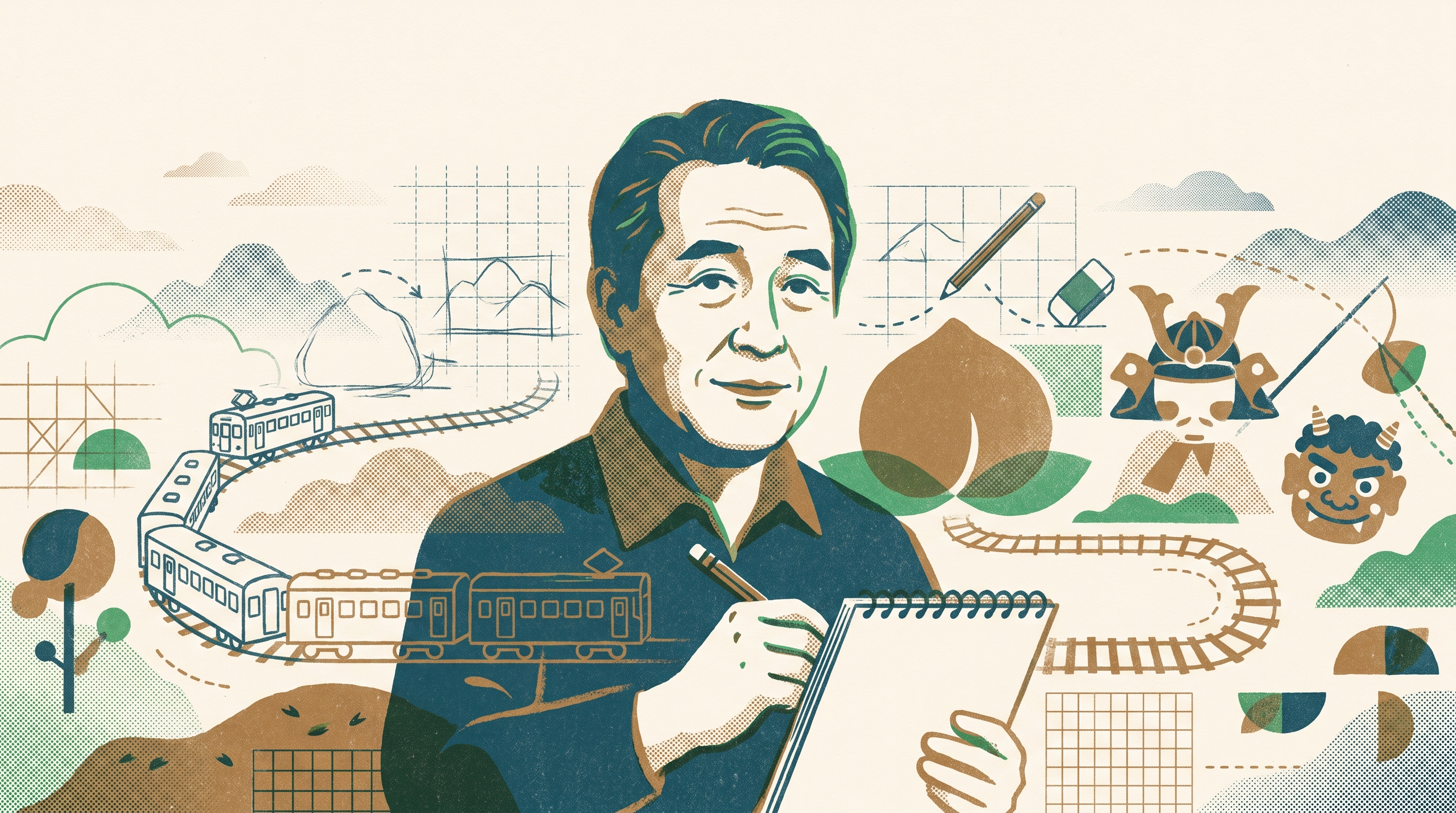
game designer
Akira Sakuma
さくまあきら
If it is not fun to make, the player will know. That was the only test he trusted.
About
Akira Sakuma (born 1952) is a Japanese game designer and writer, best known as the creator of the Momotaro Dentetsu series — a railway board game franchise set on the real map of Japan that has sold approximately 19 million copies across 25 titles. He spent thirteen years as the lead writer for the Jump Broadcasting Station (JBS), a reader-participation column in Weekly Shonen Jump, before entering game design in the late 1980s. His defining principle: a game must be so intuitive that no manual is needed, and so structured that even the player having the worst time is making everyone else laugh. He received the Agency for Cultural Affairs Media Arts Festival Distinguished Achievement Award in 2021 and the CEDEC Special Award in 2024.
History
Akira Sakuma was born on July 29, 1952, in Suginami Ward, Tokyo. His pen name, written entirely in hiragana, was chosen in homage to composer Koichi Sugiyama, who had similarly adopted a non-standard romanization of his name. Sakuma studied economics at Rikkyo University and joined the first cohort of Kazuo Koike's Gekiga Studio, an influential workshop for manga creators. He would spend much of his early career orbiting manga — writing, editing-adjacent roles, and an abortive attempt to run his own publishing business — before a debt-driven turn into game design changed everything.
From 1982 to 1995, Sakuma served as the lead writer for the Jump Broadcasting Station (JBS), the reader-participation column inside Weekly Shonen Jump. He was not a staff editor at Shueisha; his role was that of a freelance writer. But the column reached up to six million readers per issue, and the thirteen years he spent refining short-form content for that audience became the invisible foundation of his game design philosophy. He learned, through sheer volume of reader feedback, what average Japanese audiences found funny, surprising, or unfair. He filed away every reaction. He would use all of it.
In 1985, Sakuma co-founded Hanadensa, a small publishing company, with Yuji Horii, Takayuki Doi, and others, launching a manga magazine called Manga House. The publication failed to secure proper distribution — copies sold through mail order and a handful of bookstores — and folded after seven issues. The deficit reached two hundred million yen. Sakuma has described the venture as the greatest failure of his life. He now needed income, and Horii — already established in game design as the creator of Dragon Quest — offered a path forward. 'Games pay well,' Horii told him. 'You could cover those debts.' Sakuma took the offer.
He entered game design as a practical necessity and transformed it through obsessive craft. For Momotaro Densetsu (1987), a Famicom RPG built around the Japanese folk hero, he delivered a commercial hit selling over one million copies. But it was in designing the first Momotaro Dentetsu (1988) that he found his true form. He drew the map of Japan on paper with a marker, placed tokens on the stations, and rolled physical dice for months — testing rule after rule before a single line of code was written. Entire mechanics were discarded for adding one extra button press without adding joy. His standard was simple and absolute: if it adds a button and does not add delight, cut it.
The design insight that defines the entire Momotaro Dentetsu series came from an argument about fairness. His collaborator Masuda Shoji pointed out that the Binbo-gami — the poverty god who attaches to the leading player and drains their wealth — felt cruel to the person targeted. Sakuma disagreed. 'If one of three players is miserable and the other two are laughing,' he replied, 'that is a net positive.' He was designing not for individual victory but for the total experience of everyone at the table. The poverty god stayed. It became the most beloved element in the series, and the argument that produced it became the defining philosophy of Sakuma's career.
The PC Engine entry Super Momotaro Dentetsu (1989) locked in the modern form of the franchise: shared destination goals, the card system, and the poverty god fully integrated into the loop. Sakuma carried this formula across 25 titles and four decades, moving through every major platform from Famicom to Nintendo Switch. The series sold approximately 19 million copies in Japan. The 2020 entry, released during the COVID-19 pandemic, sold over four million copies — proof that a game designed for families crowded around a single screen retained its hold even in the years when families were forbidden from gathering.
Sakuma suffered a cerebral hemorrhage in 2012 and a heart attack in 2019, each requiring emergency care. By 2025 he was living in an assisted care facility and using a wheelchair. He continued attending biweekly project meetings with Konami by video call. In 2021, the Agency for Cultural Affairs Media Arts Festival gave him its Distinguished Achievement Award. In 2024, CEDEC awarded him a Special Award for lifetime contributions to the industry. The man who entered game design to repay a two-hundred-million-yen publishing debt left it as one of the most decorated designers in Japanese game history. He repeated the same lesson in every interview, unchanged from the paper-map years: if you are not having fun making it, the player will know. It was the only test he trusted.
Timeline & Works
Career milestones and all 1 game in the museum they worked on — in the order they happened.
- 1952 07
Born in Suginami, Tokyo
Akira Sakuma was born on July 29, 1952, in Suginami Ward, Tokyo.
people - 1982
Jump Broadcasting Station — 13-year run begins
Sakuma becomes the lead writer for the Jump Broadcasting Station (JBS) reader-participation column in Weekly Shonen Jump, a role he holds until 1995. The column reaches up to six million readers per issue.
career - 1985
Co-founds Hanadensa — 200 million yen deficit
Sakuma co-founds Hanadensa with Yuji Horii, Takayuki Doi, and others, launching the manga magazine Manga House. The venture fails after seven issues with a deficit of 200 million yen — an experience Sakuma calls the greatest failure of his life, and the direct motivation for entering game design.
founding - 1987
Momotaro Densetsu — one million copies
Momotaro Densetsu, a Famicom RPG based on the Japanese folk hero, is released by Hudson Soft. The title sells over one million copies, establishing Sakuma as a credible game designer.
product - 1988
Momotaro Dentetsu — the series begins
Sakuma releases the first Momotaro Dentetsu on the Famicom, built through months of paper-map testing with physical dice before any code was written. The game introduces the railway board game format and the design principle that collective experience matters more than individual victory.
product - 1989
Super Momotaro Dentetsu (PC Engine) — modern formula established
The PC Engine version establishes the definitive Momotaro Dentetsu formula: shared destination goals, the card system, and the fully integrated Binbo-gami poverty god. This is the foundation the series carries through 25 titles.
product - 2012
Cerebral hemorrhage — hospitalization
Sakuma suffers a cerebral hemorrhage and is hospitalized, the first of two serious health episodes in his later years.
people - 2019
Heart attack — emergency care
Sakuma suffers a heart attack and is transported to hospital by emergency vehicle.
people - 2020
Showa, Heisei, Reiwa mo Teiban! — four million copies
The Nintendo Switch entry becomes the largest-selling title in series history, surpassing four million copies during the COVID-19 pandemic.
product - 2021
Agency for Cultural Affairs Media Arts Festival Distinguished Achievement Award
Sakuma receives the Distinguished Achievement Award at the 24th Agency for Cultural Affairs Media Arts Festival, recognizing a lifetime of contribution to Japanese game culture.
milestone - 2024
CEDEC Special Award for lifetime achievement
Sakuma receives the CEDEC Special Award at CEDEC 2024, recognizing long-term contributions to computer entertainment development.
milestone
Also worked on (release year to be confirmed)
Connections
- collaborated with yuji-horii (1974–present)
Met at a university manga club alliance; co-founded Hanadensa publishing in 1985; Horii recruited Sakuma into game design and the two remained creative companions across decades.
Explore the work
Each title has its own page — history, trivia, and collector's notes.
Sources
- さくまあきら — Wikipedia(日本語) — accessed 2026-06-08
- 「どんな子供でも遊べなければいけない」桃鉄誕生秘話 — デンファミニコゲーマー — accessed 2026-06-08
- 35年間愛され続けている桃太郎電鉄制作者が語る誕生秘話 — ananweb — accessed 2026-06-08
- 超ヒット桃太郎シリーズを生んだ作家の創作哲学 — PRESIDENT Online — accessed 2026-06-08
- CEDEC AWARDS 2024 特別賞 さくまあきら — ゲームメーカーズ — accessed 2026-06-08
- マンガハウス — Wikipedia(日本語) — accessed 2026-06-08
- ジャンプ放送局 — Wikipedia(日本語) — accessed 2026-06-08