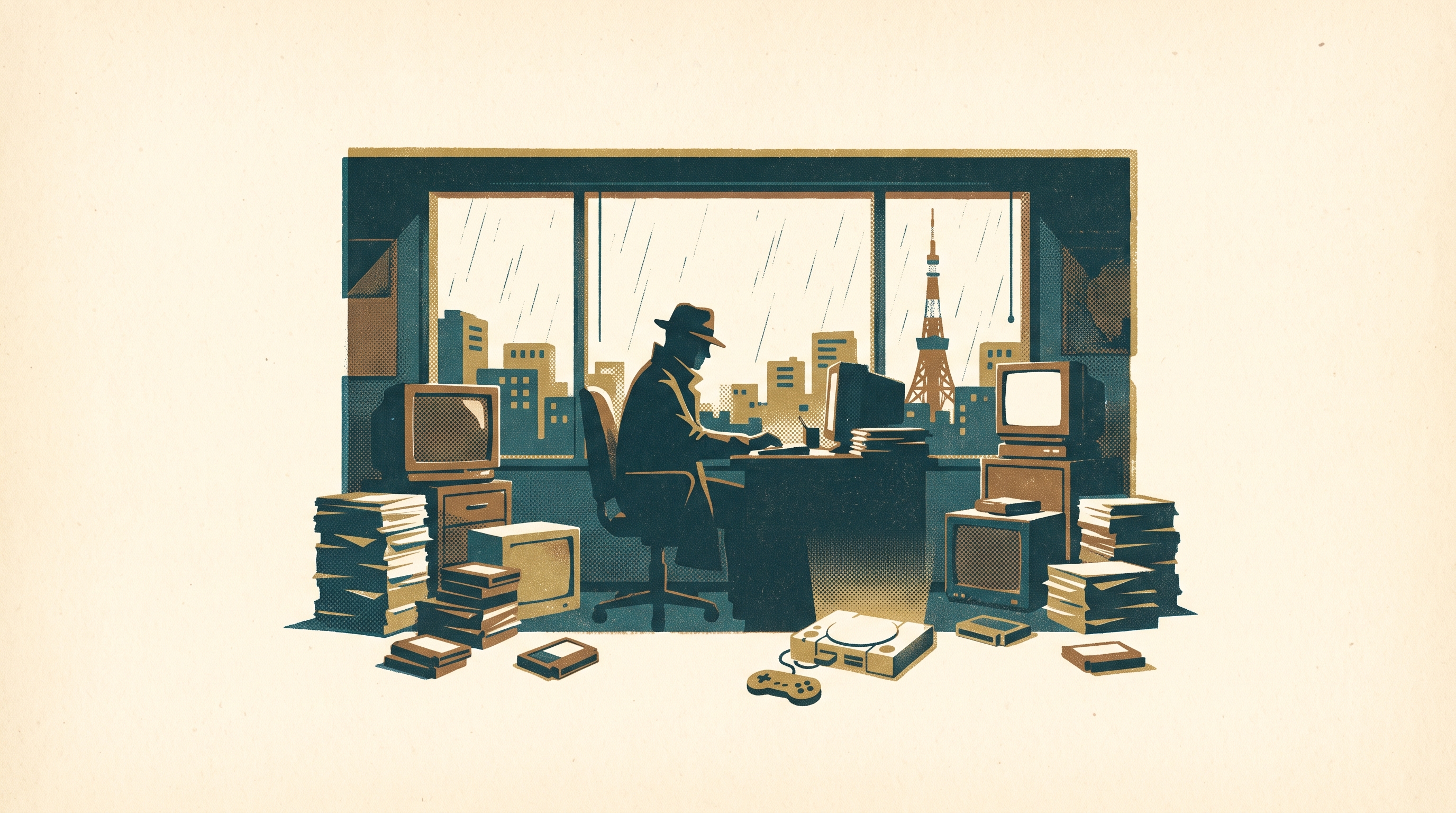
In 1985, Akira Sakuma co-founded a publishing company with Yuji Horii and others. They called it Hanadensa. They launched a magazine for new manga artists called Manga House. It was a noble goal — discovering talent that the mainstream publishers might overlook. The magazine had no official distribution code. Copies were sold through mail order and a few dozen specialty bookstores scattered across Japan. It folded after seven issues. The deficit reached two hundred million yen.
Years later, Sakuma would describe it as the greatest failure of his life. But he did not disappear. He had spent thirteen years, from 1982 to 1995, as the lead writer for the Jump Broadcasting Station — a reader-participation column in Weekly Shonen Jump that reached up to six million readers per issue. He was not an editor at the magazine. He was a freelancer. His job was simple: read forty thousand postcards a week from teenagers across Japan, and select the ones that would make the other readers laugh. Thirteen years of that work taught him a truth he carried into everything that followed: if average people do not find it fun, they will tell you. Loudly.
The debt was real. It needed to be paid. And Yuji Horii — who had already established himself as the creator of Dragon Quest — offered a way forward. 'Games pay well,' Horii told him. 'You could cover those debts.' Sakuma had never made a game. But he had spent thirteen years figuring out what made ordinary people react. He entered the game industry in 1987, not because he dreamed of it, but because he owed two hundred million yen and had no other path.
For his first game, Momotaro Densetsu, a Famicom RPG built around the Japanese folk hero, he delivered a commercial hit. Over one million copies sold. But it was in designing the first Momotaro Dentetsu in 1988 that something deeper took shape. He did not start by coding. He started with paper. He drew the map of Japan with a marker on poster board, placed tokens on the stations, and rolled physical dice for months. He tested rule after rule, movement by movement, before a single line of code was written. Entire mechanics were discarded for adding one extra button press without adding joy. His standard was simple: if it adds a button and does not add delight, cut it.

The defining insight came from an argument. His collaborator Masuda Shoji pointed out that the Binbo-gami — the poverty god who attaches to the leading player and drains their wealth — felt cruel to the person targeted. Sakuma disagreed. 'If one of three players is miserable and the other two are laughing,' he replied, 'that is a net positive.' He was not designing for individual victory. He was designing for the total experience of everyone at the table. The poverty god stayed. It became the most beloved element in the series. The argument that produced it became the philosophy that defined his career.
The 1989 PC Engine entry, Super Momotaro Dentetsu, locked in the modern form: shared destination goals, the card system, and the poverty god fully integrated into the loop. Sakuma carried this formula across twenty-five titles and four decades, moving through every major platform from Famicom to Nintendo Switch. The series sold approximately nineteen million copies in Japan. The 2020 entry, released during the COVID-19 pandemic, sold over four million copies — proof that a game designed for families crowded around a single screen retained its hold even in the years when families were forbidden from gathering.
Sakuma suffered a cerebral hemorrhage in 2012 and a heart attack in 2019. By 2025 he was living in an assisted care facility and using a wheelchair. He continued attending biweekly project meetings with Konami by video call. In 2021, the Agency for Cultural Affairs Media Arts Festival gave him its Distinguished Achievement Award. In 2024, CEDEC awarded him a Special Award for lifetime contributions to the industry. The man who entered game design to repay a publishing debt left it as one of the most decorated designers in Japanese game history.
He repeated the same lesson in every interview, unchanged from the paper-map years: if you are not having fun making it, the player will know. It was the only test he trusted. The poverty god was still there, still draining the leader's money, still making two players laugh while one screamed at the screen. Sakuma never changed the formula. The formula was tested with dice and poster board in a room where a man owed two hundred million yen and had no choice but to make something that worked. — The thing you are building now, under pressure you did not choose — is that pressure crushing it, or is it making you test every piece until only the real ones remain?