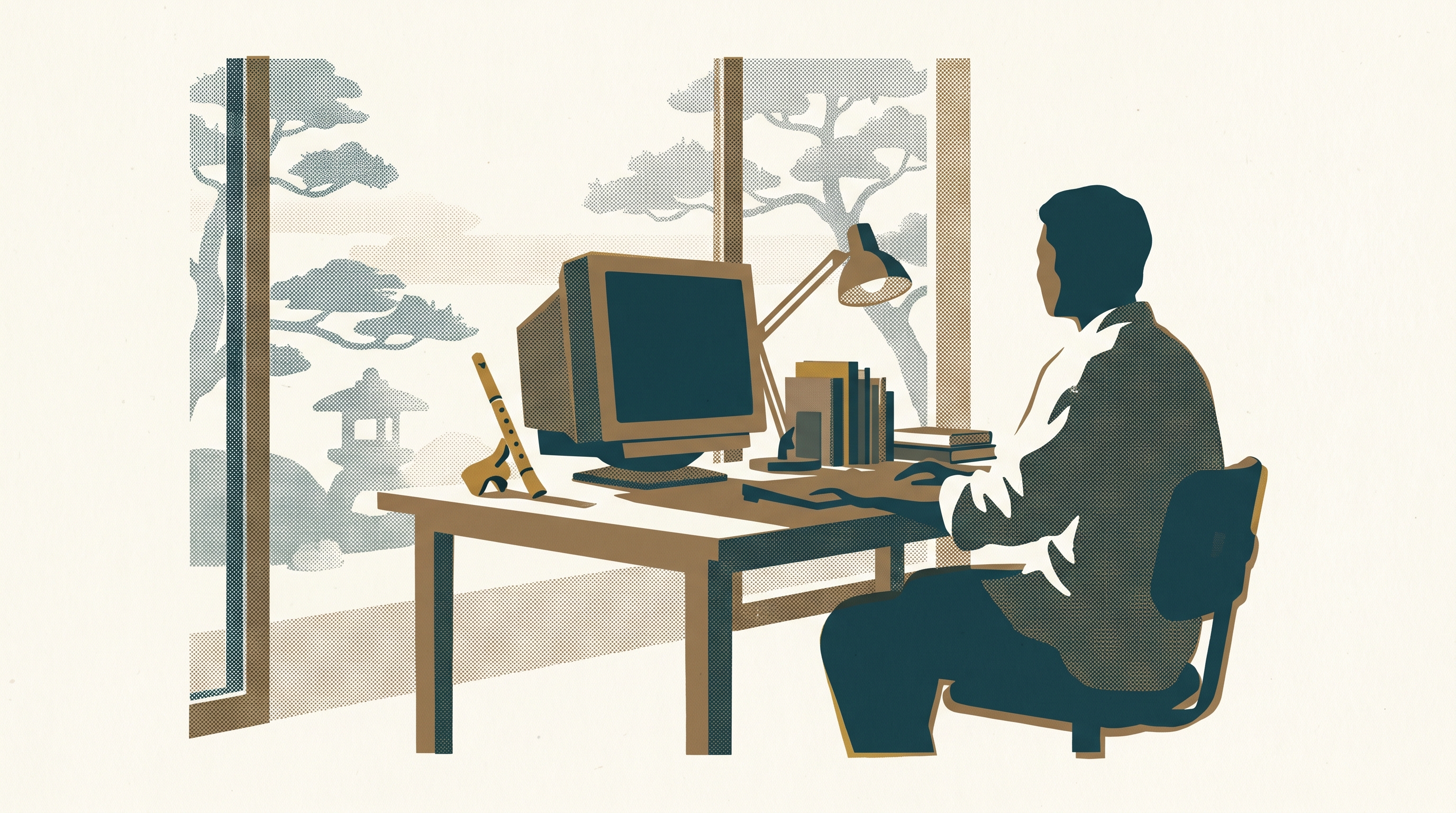
Eiji Aonuma graduated from the Tokyo National University of Fine Arts and Music in 1988 with a degree in design, specializing in mechanical puppets and moving figures. He joined Nintendo the same year as a graphic designer in the R&D2 department. In later interviews, he mentioned that he had barely played video games before working at Nintendo. He was hired to design, not to play.
His first project as director was Marvelous: Mōhitotsu no Takarajima, released for the Super Famicom in 1996. It was a puzzle-adventure game with four playable characters and a structure partly inspired by The Legend of Zelda: A Link to the Past. Shigeru Miyamoto saw it. Miyamoto asked Aonuma if he would like to work on The Legend of Zelda: Ocarina of Time, the most ambitious project Nintendo had undertaken at that time. Aonuma said yes.
On Ocarina of Time, Aonuma served as dungeon designer and game system director. He designed six of the game's dungeons, including the Water Temple — inspired by his own hobby of scuba diving, where managing oxygen and pressure felt similar to managing keys and water levels in a puzzle space. The game was released in November 1998 and became one of the most critically acclaimed games ever made.
Immediately after, Miyamoto asked Aonuma to work on Ura Zelda, a rearranged version of Ocarina of Time with redesigned dungeons, planned as a bonus disc for the Nintendo 64DD peripheral. Aonuma was unenthused. He did not want to simply rearrange what he had already built. Miyamoto offered him a deal: if Aonuma could lead a team to create an entirely new Zelda game in one year, they would not have to make Ura Zelda. Aonuma accepted.
The challenge was extreme. One year to build a sequel to the most celebrated 3D adventure game of its time. Aonuma and his team reused Ocarina of Time's engine and character models to save time. For the game's central concept, Aonuma recruited designer Yoshiaki Koizumi, who had been prototyping a time-loop game inspired by the 1998 German film Run Lola Run. They adapted that idea into a three-day cycle — a world that would end and reset every seventy-two in-game hours. The player would relive the same three days repeatedly, changing outcomes through accumulated knowledge and items that persisted across loops.
The Legend of Zelda: Majora's Mask was finished in fifteen months and released in April 2000. It was darker, stranger, and more emotionally complex than any Zelda game before it. There were fewer dungeons than Ocarina of Time — only four — but the world was denser, the sidequests were more personal, and the tone was melancholic in a way the series had never attempted. Some players loved it. Some found it claustrophobic and oppressive. It did not sell as well as Ocarina of Time. But it became a cult classic, remembered for taking risks that no sequel to a beloved game would normally take.
Aonuma went on to direct The Wind Waker, which replaced the realistic art style players expected with cel-shaded cartoon graphics, and The Twilight Princess, which brought back a darker tone but transformed Link into a wolf for half the game. He became the series producer, overseeing Breath of the Wild — a game that removed almost every structural convention The Legend of Zelda had established over thirty years. No prescribed dungeon order. No sequence of items that unlock new areas in a fixed progression. The player could walk to the final boss immediately after the tutorial if they chose. It was the biggest commercial and critical success in the series' history.
In a 2015 interview, Aonuma reflected on the Majora's Mask development and said that the one-year deadline had forced the team to make a smaller, more concentrated experience — and that this had revealed a philosophy he still believed in: that deep, compact play was more valuable than vast, shallow worlds. In retrospect, the constraint had not been a burden. It had been a filter that clarified what mattered.
Eiji Aonuma still works at Nintendo as of 2025, now serving as Deputy General Manager of the Entertainment Planning and Development division. The designer who barely played games before joining the company has spent nearly forty years redefining what one of the most beloved game series in history is allowed to be. Every time a Zelda game is released, someone asks whether it is still a Zelda game. Aonuma's career has been the answer: a Zelda game is whatever is worth making next — even if that means breaking the rules the last one left behind.
The road you are on now, where the map does not tell you where to go — is that carelessness, or did someone decide to trust you?