designer
Yoshiaki Koizumi
小泉歓晃
If it doesn't feel right, it affects the whole game — so go watch real people move, and start there.
About
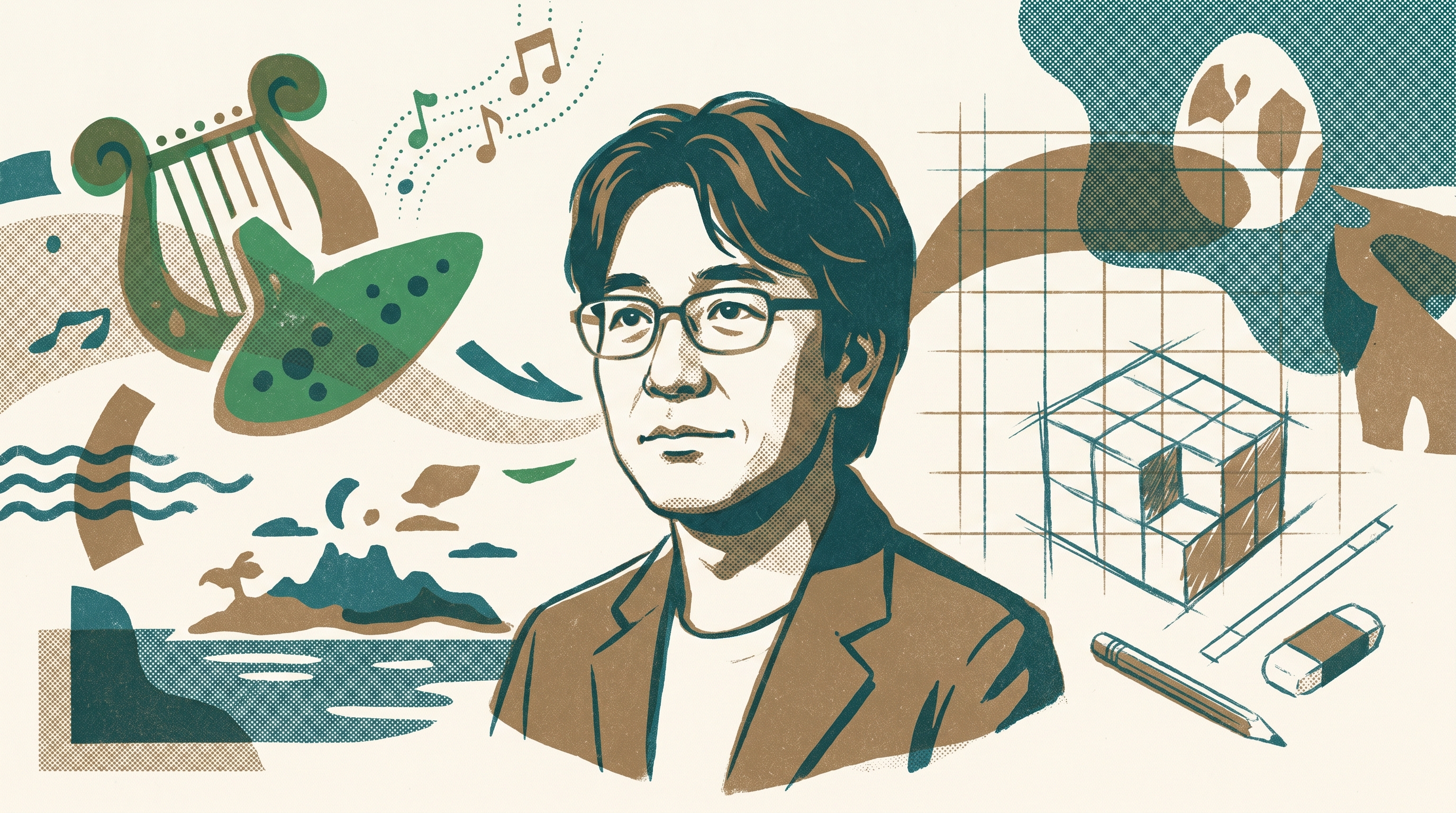
Yoshiaki Koizumi is a Nintendo game director and producer. He served as scenario and story designer on The Legend of Zelda: Link's Awakening (1993), creating the game's central concept — that the island of Koholint is a dream — and scripting the interactions with its eccentric villagers. He later served as producer on Super Mario Odyssey (2017), which was directed by Kenta Motokura, and has produced numerous other Nintendo titles.
History
Yoshiaki Koizumi was born on April 29, 1968, in Mishima, Shizuoka Prefecture, a small city flanked by mountains and coastline in the shadow of Mount Fuji. As a young man he did not want to make games; he wanted to make films. He enrolled at Osaka University of Arts to study film, drama, animation, and storyboarding, imagining himself becoming a movie director. But in 1991, the year he graduated, cinema was not the future he walked into. Nintendo was. He joined the company in April as an artist, and his first assignment was not a game design but an illustration task: drawing the manual for The Legend of Zelda: A Link to the Past. It was unglamorous work, far from the director's chair he had pictured. But it was also an introduction to a world where story and spatial design overlapped in ways film never allowed. He was no longer making something people watched. He was helping make a place people lived.
In 1993, director Takashi Tezuka was assembling a team for The Legend of Zelda: Link's Awakening, the first portable Zelda for the original Game Boy. Tezuka gave the writing team — Koizumi and scenario co-writer Kensuke Tanabe — a short list of things not to include: no Hyrule, no Triforce, no Princess Zelda. The directive was both a constraint and a gift. Without the weight of established lore, Koizumi and Tanabe were free to build something stranger. What Koizumi proposed was that the entire island — Koholint, with its talking animals, eccentric villagers, and impossible geography — was a dream. Waking the Wind Fish at the end of the game would erase the island and everyone on it. It was a story about saying goodbye to a world you loved, knowing that leaving was the only way forward. Koizumi shouldered the majority of the scenario work: he designed the event sequences, scripted the dialogue with the owl and the Wind Fish, imagined the behavioral patterns of the bosses, and threaded narrative into every corner of the island. He later reflected that he came up with the entire scenario and backstory for Link on his own, and that nobody seemed to care. But the players cared. Link's Awakening became a quiet landmark — not for what it included, but for what it dared to leave out.
In 1996 Koizumi joined the core team for Super Mario 64, serving as assistant director under Shigeru Miyamoto. His role was to translate Miyamoto's spatial ideas into something players would actually encounter: how the camera followed Mario, how a jump felt in three dimensions, where to place a platform so exploration felt rewarding instead of punishing. Miyamoto had taught him a principle that became the foundation of Koizumi's design philosophy: if the movement of the character doesn't feel right, it affects the player's appreciation for the whole game. So Koizumi spent his time studying real motion. He went to Toei Kyoto Studio Park and watched a staged swordfight between actors. He realized there was a trick to how the blade moved through space — deliberate, theatrical, but grounded in real physics. That observation would later shape the swordplay in The Legend of Zelda: Ocarina of Time (1998), where Koizumi served as co-director. Along with Toru Osawa, he helped translate the two-dimensional combat of earlier Zelda games into a three-dimensional lock-on system, a spatial grammar that let players circle, dodge, and strike with intent. Ocarina became one of the most celebrated games of its generation. The storytelling Koizumi had refined in Link's Awakening now had the depth and presence of full 3D space behind it.
In 2002, Koizumi was given his first solo directorial role: Super Mario Sunshine for the GameCube, co-directed with Kenta Usui. The game centered on FLUDD, a water-spraying backpack that let Mario hover, dash, and clean paint from the tropical island of Isle Delfino. The mechanic was polarizing inside Nintendo — some questioned whether adding a tool would dilute the purity of Mario's jump. But Koizumi had taken inspiration from something simple: the tactile memory of the GameCube controller's L and R buttons reminded him of the water pistols he used to play with as a kid. He wanted the act of spraying water to feel physical and playful, not just functional. The debate was serious, but the mechanic stayed. Sunshine was released to mixed critical reception — some praised its ambition, others felt it diverged too far from Mario 64's template — but it marked Koizumi as a director willing to follow his instincts even when the path was uncertain.
Super Mario Galaxy (2007) for the Wii became Koizumi's defining work as a director. The game placed Mario on planetoids with their own centers of gravity, letting him run upside-down, leap between floating spheres, and navigate space as something sculptural rather than flat. It was a technical and conceptual achievement, but what surprised people most was a storybook hidden inside the game: Rosalina's Storybook, a melancholy fairy tale about a girl who leaves home and becomes the adoptive mother of the stars. Koizumi wrote it late at night, alone, when no one was around. The next morning he presented it to Miyamoto. For a long time, he later explained, it had felt like telling a story in a Mario game was something that wasn't allowed. But he believed games could hold more than mechanics — they could hold sadness, wonder, the weight of a goodbye. Rosalina's story was his proof. Galaxy was both a critical and commercial success, and it remains one of the most artistically cohesive entries in the Mario series.
In the years that followed, Koizumi moved into broader production and leadership roles. He served as producer on Super Mario 3D World, Super Mario Odyssey (which he also co-directed), and many other Nintendo EPD titles. In 2015, he was named General Producer of the Nintendo Switch hardware project, helping shape not just the games but the platform they would run on. By 2026, he holds the position of Senior General Manager of Nintendo EPD and Senior Executive Officer — a role once held by Miyamoto himself, overseeing software development across Nintendo's core teams in Japan. His involvement in day-to-day game design has decreased, but his influence has not. He remains a mentor to younger designers, a guardian of the principles he learned from Miyamoto and refined across three decades.
Koizumi once said that games are not just something to interact with — you are missing out if you do not immerse yourself in them. For him, plot and feeling are just as important as the jump button. That conviction has guided him from the dream island of Koholint to the gravity-bent planetoids of Galaxy, from storyboards in an Osaka classroom to the executive corridors of Nintendo EPD. He came to the company wanting to be a film director and became something different: someone who builds places where people feel things they didn't expect to feel. He never stopped being the young artist who drew Link's manual. He just learned to draw worlds instead of scenes, and taught a generation of designers that the best gameplay comes from watching how real things move — and then making the unreal move the same way.
Timeline & Works
Career milestones and all 4 games in the museum they worked on — in the order they happened.
- 1968 04
Born in Mishima, Shizuoka
Yoshiaki Koizumi was born in Mishima, a small city in the shadow of Mount Fuji. He would later study film and animation at Osaka University of Arts, aspiring to become a movie director.
people - 1991 04
Joined Nintendo as an artist
Graduated from Osaka University of Arts and joined Nintendo. His first assignment was creating manual illustrations for The Legend of Zelda: A Link to the Past.
people - 1993
Co-wrote Link's Awakening scenario
Served as scenario designer and writer for The Legend of Zelda: Link's Awakening. He conceived the game's central concept — that Koholint Island exists inside a dream — and wrote most of the character dialogue and event sequences.
product - 1993
- 1996
Assistant Director, Super Mario 64
Served as assistant director under Shigeru Miyamoto on Super Mario 64, working on camera systems, character movement feel, and spatial design in 3D.
product - 1998
Co-Director, The Legend of Zelda: Ocarina of Time
Co-directed Ocarina of Time alongside Toru Osawa, helping design the Z-targeting lock-on combat system and translating 2D Zelda combat into 3D space.
product - 1998
- 2000
Co-Director, The Legend of Zelda: Majora's Mask
Co-directed Majora's Mask, continuing his role in shaping 3D Zelda storytelling and game structure alongside the core team.
product - 2000
- 2002
Director, Super Mario Sunshine
Made his solo directorial debut with Super Mario Sunshine (co-directed with Kenta Usui). Introduced the FLUDD water mechanic, inspired by childhood memories of water pistols and the GameCube controller's tactile L/R buttons.
product - 2004
- 2007
Director, Super Mario Galaxy
Directed Super Mario Galaxy for the Wii, featuring planetoid-based gravity gameplay. Secretly wrote Rosalina's Storybook late at night, presenting it to Miyamoto the next morning — a rare narrative element in a Mario game.
productsuper-mario-galaxy - 2015
Named General Producer of Nintendo Switch
Appointed General Producer of the Nintendo Switch hardware project, shaping not just games but the platform they would run on.
leadershipswitch - 2017
Producer & Co-Director, Super Mario Odyssey
Served as producer and co-director on Super Mario Odyssey, the flagship launch-window title for the Nintendo Switch.
product - 2026
Senior General Manager, Nintendo EPD
Currently serves as Senior General Manager of Nintendo EPD and Senior Executive Officer, overseeing software development across Nintendo's core teams in Japan — a role once held by Shigeru Miyamoto.
leadership
Connections
- employed nintendo (1991–present)
Joined Nintendo in 1991 as an artist and grew into one of the company's most influential directors and producers, eventually becoming Senior General Manager of Nintendo EPD.
- mentored shigeru-miyamoto (1991–present)
Worked closely under Shigeru Miyamoto as a protégé, learning spatial design and movement philosophy that became the foundation of his own directorial approach.
- collaborated with takashi-tezuka (1993–1993)
Worked as scenario designer under director Takashi Tezuka on The Legend of Zelda: Link's Awakening, given the freedom to create a Zelda story without Hyrule, Triforce, or Princess Zelda.
Also connected to
- Koji Kondo co-created The Legend of Zelda: Majora's Mask / co-created The Legend of Zelda: Ocarina of Time / same employer (Nintendo, since 1991)
- Toru Minegishi co-created The Legend of Zelda: Majora's Mask / same employer (Nintendo, since 1999)
- Eiji Aonuma co-created The Legend of Zelda: Majora's Mask
Explore the work
Each title has its own page — history, trivia, and collector's notes.
Nintendo GameCube · 2004
Donkey Kong Jungle Beat
Miyamoto's platformer controlled entirely with bongo drums. The design forced pl…
Nintendo 64 · 2000
The Legend of Zelda: Majora's Mask
Given one year and old, borrowed parts, they made a world with only three days l…
Nintendo 64 · 1998
The Legend of Zelda: Ocarina of Time
They gave you a childhood you could return to — because someone insisted on putt…
Game Boy · 1993
The Legend of Zelda: Link's Awakening
No Hyrule. No Triforce. No Zelda. And nothing before it or since has asked the s…
Rooms their games live in
Sources
- Yoshiaki Koizumi — Wikipedia (English) — accessed 2026-06-15
- Yoshiaki Koizumi — Super Mario Wiki — accessed 2026-06-15
- Iwata Asks - The History of Handheld Zelda Games - Page 2 — accessed 2026-06-15
- Super Mario Sunshine – 2002 Developer Interviews — shmuplations.com — accessed 2026-06-15
- User Centered Designer Yoshiaki Koizumi — Medium — accessed 2026-06-15
- The Power of Fun: Super Mario Odyssey Developer Interview — GeekDad — accessed 2026-06-15