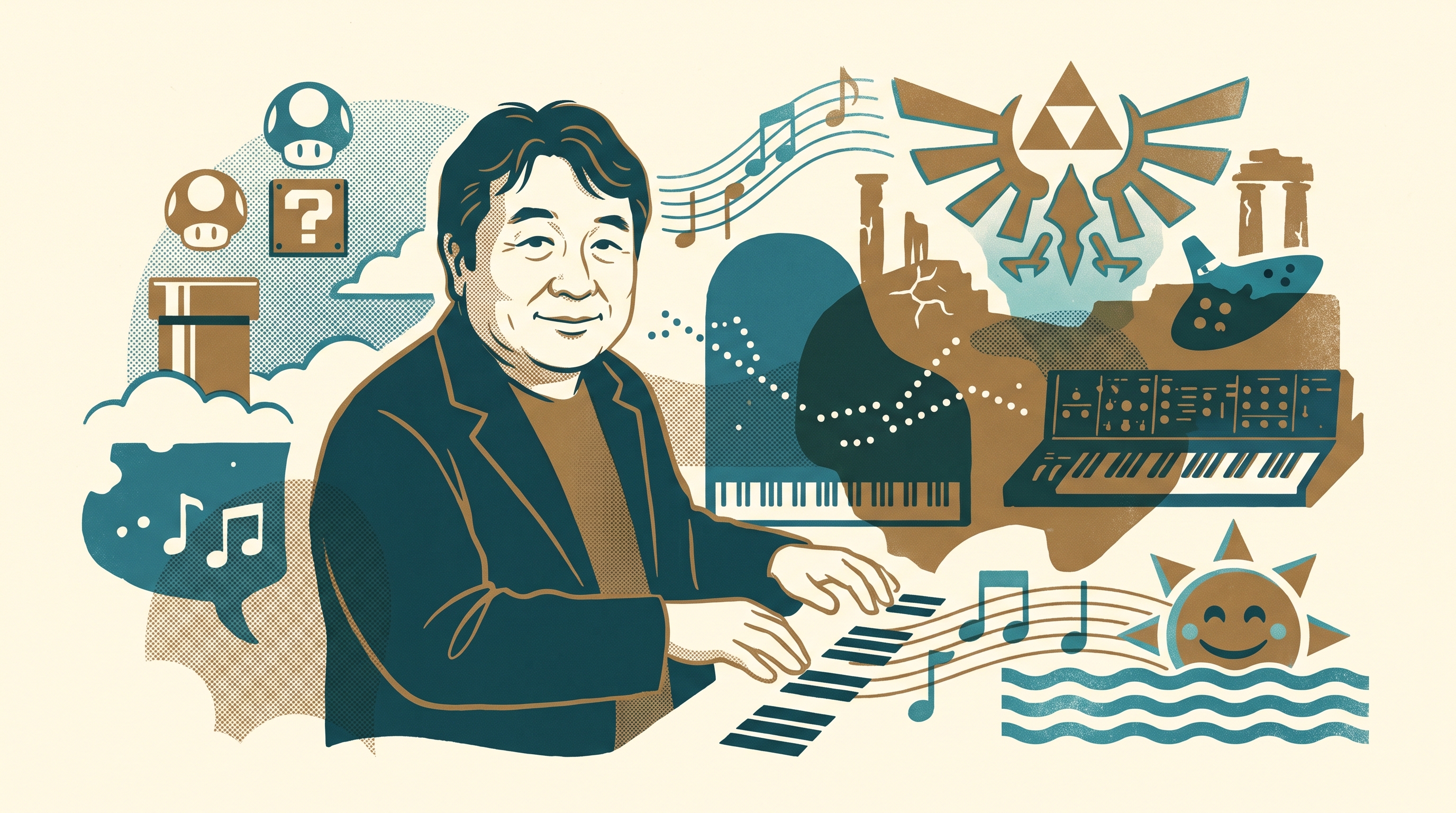
composer
Koji Kondo
近藤浩治
Three simultaneous notes — and somehow, the whole world rang.
About
Koji Kondo is a Nintendo composer who created some of the most recognised video game music in history. He composed the original scores for Super Mario Bros. (1985), The Legend of Zelda (1986), and many subsequent entries in both series. His themes have been performed by orchestras worldwide and are among the most culturally significant compositions in gaming history.
History
Koji Kondo was born on August 13, 1960, in Nagoya, Aichi Prefecture. He studied electronic organs at Osaka University of Arts, developing a musical fluency grounded in the physical mechanics of sound production. In 1984 he joined Nintendo — becoming the company's first dedicated staff composer, a function that had not previously existed as a formal role. At that moment Nintendo's Famicom had been on sale for just one year. The hardware engineers had designed a sound chip capable of producing four audio channels: two square waves, one triangle wave, and one noise channel. No more. A melody could be played, a bass line could walk beneath it, a simple percussion sound could mark the beat. That was the full palette. Kondo sat down at the instrument.
The Famicom sound chip's limitations were not merely technical inconveniences — they were compositional decisions forced on every note. With only three pitched channels, there was no room for chords in the conventional sense, no possibility of lush arrangement. Every instrument in a full orchestra had to give way to a melodic line, a counter-melody, and a harmonic support. Kondo's training on electronic organs, where the organist must voice multiple parts simultaneously with limited resources, turned out to be precise preparation. He had spent years learning to imply fullness from thinness. Now the machine asked exactly that of him — and he already knew how.
For Super Mario Bros. in 1985, Kondo delivered what would become the most recognised piece of video game music ever written. An early plan to license an existing jazz composition fell through when the rights proved unobtainable, and Kondo was required to write an original score. The result — a syncopated, rhythmically propulsive theme whose melody skips and lunges in exact alignment with the act of running and jumping — was designed not simply to accompany the game but to merge with it. The tempo could be perceived as slow or fast depending on the player's own pace of movement; the music and the motion formed a single continuous experience. Over forty million copies of the game were sold worldwide, stamping that melody onto the childhood memories of a generation.
The Legend of Zelda, released in 1986, demanded a different solution. Where Mario's world was a colourful, kinetic, daylight space requiring momentum and joy, Zelda offered an open landscape of mystery, danger, and solitary exploration. Kondo composed a title-screen theme built around a nine-note phrase of such structural economy that it simultaneously suggests heroism, loneliness, and the promise of adventure. Inside the dungeons he used atonal dissonance and irregular pulse to manufacture a sense of enclosed threat. The above-ground overworld theme — later given the informal name 'Hyrule Overture' — was written for a game that had no precedent in the medium: an open-world adventure whose geography the player was expected to explore and memorise without instruction. The music had to guide attention without directing it; to imply direction without prescribing it.
Through the 1990s Kondo moved with Nintendo from the Famicom to the Super Famicom and then to the Nintendo 64, each platform offering new sonic territory. Super Mario World (1990) introduced the yoshi-drum — a percussive element generated by the Super Famicom's sample-based audio chip, made from a recording of a bongo struck with a mallet, that became inseparable from the game's identity. Super Mario 64 (1996) presented an entirely new problem: music for three-dimensional space. In a flat, scrolling game the music can define the energy of a single environment because the camera does not move relative to the world; in 3D, the player's perspective rotates continuously, and the emotional context shifts second by second. Kondo's response was to write themes that were simultaneously specific in mood and elastic in tempo — music that could feel like foreground or background depending on what the player was currently doing.
Kondo has spoken, in rare interviews, of what he considers the essential challenge of game music: it must sustain repetition. In film, a theme plays once and the scene ends; in a game, the same ninety-second loop may play unbroken for an hour. The music cannot grow boring, or the player will mute it — and a muted game is a broken experience. His answer was to write melodies with what he called 'depth' — structures that reveal new things on repeated hearing, harmonic relationships that the ear absorbs gradually, inner voices that emerge from the texture only after many passes. This is a specifically compositional ambition, one that connects him to Bach and Ravel more than to the film composers who otherwise dominated mid-twentieth-century popular music.
In the 2010s and beyond, Kondo shifted increasingly toward an executive and supervisory role, overseeing Nintendo's sound teams while younger composers took on primary authorship of new titles. He contributed supervision and select compositions to entries in the Mario and Zelda series, and his themes — largely unaltered from their original Famicom versions — were heard at live orchestral concerts around the world, including performances by the Kyoto Philharmonic, the Sydney Symphony, and at the Proms in the Royal Albert Hall. In 2021 he was listed among the nominees for the Ivor Novello Award for Outstanding Contribution to Music — a recognition unusual for a composer primarily identified with interactive media.
What Koji Kondo proved, three notes at a time, is that a constraint answered honestly does not diminish a creative act — it sharpens it. He was given an instrument that could do almost nothing, and he wrote music that forty years later still plays in the minds of millions of people who have not touched a controller in decades. The choice that produced that outcome was not heroic or anguished; it was patient and precise. He studied the hardware, understood what it could actually produce rather than what a composer might wish it could produce, and then wrote music that was exactly that hardware's greatest possible version of itself. The lesson is portable far beyond music: find the real constraint, not the imagined one, and then do the most honest thing it will allow.
Timeline & Works
Career milestones and all 22 games in the museum they worked on — in the order they happened.
- 1960 08
Born in Nagoya, Aichi Prefecture
Koji Kondo is born on August 13, 1960, in Nagoya, Aichi Prefecture. He would later study electronic organs at Osaka University of Arts.
people - 1984
Joins Nintendo as the company's first dedicated composer
Kondo joins Nintendo in 1984, becoming the company's first staff member hired specifically to compose music for video games. The Famicom had been on sale for just one year.
people - 1985 09
Super Mario Bros. — a melody that outlasts the hardware
Super Mario Bros. launches on September 13, 1985. Kondo composes the score after a plan to license existing jazz music fell through. The main theme becomes the most recognised piece of video game music ever written.
product - 1985
- 1986 02
The Legend of Zelda — music for an unmapped world
The Legend of Zelda launches on February 21, 1986. Kondo composes distinct themes for the overworld, dungeons, and title screen — music designed to guide attention without directing it.
product - 1986
- 1986
- 1986
- 1986
- 1986
- 1987
- 1987
- 1988
- 1988
- 1990 11
Super Mario World — the Yoshi drum and new hardware
Super Mario World launches with the Super Famicom. Kondo exploits the new sample-based sound chip to introduce the distinctive Yoshi percussion sound, created from a recording of a bongo mallet strike.
product - 1990
- 1990
- 1991
- 1993
- 1995
- 1996 06
Super Mario 64 — composing for three-dimensional space
Super Mario 64 launches on June 23, 1996. Kondo faces the new challenge of writing music for a 3D environment where the emotional context shifts as the player's perspective rotates. His solution: themes that are mood-specific but tempo-elastic.
product - 1996
- 1996
- 1997
- 1998
- 2000
- 2002 07
Super Mario Sunshine — tropical palette under a new challenge
Super Mario Sunshine launches for the Nintendo GameCube on July 19, 2002. Kondo continues as lead composer, creating a distinctly tropical and jazz-inflected soundtrack reflecting the game's Mediterranean island setting.
product - 2002
- 2002
- 2021
Ivor Novello Award nomination — recognition beyond gaming
Kondo is listed among the nominees for the Ivor Novello Award for Outstanding Contribution to Music — an unusual recognition for a composer primarily identified with interactive media.
milestone
Connections
- employed nintendo (1984–present)
Kondo joined Nintendo in 1984 as its first dedicated music composer and has remained with the company throughout his career, eventually moving into a senior supervisory role overseeing Nintendo's sound teams.
Also connected to
- Shigeru Miyamoto co-created Mario Bros. / co-created Mario Kart 64 / co-created Pilotwings / co-created Super Mario 64 / co-created Super Mario All-Stars Nintendo Super Famicom Japan Tested NTSC-J / co-created Super Mario Bros. 3 / co-created Super Mario Bros. 3 / co-created Super Mario Bros. / co-created Super Mario Bros.: The Lost Levels / co-created Super Mario Bros. / co-created Super Mario Sunshine / co-created Super Mario World 2: Yoshi's Island / co-created Super Mario World / co-created The Legend of Zelda: Ocarina of Time / co-created The Legend of Zelda / co-created Super Mario World 2: Yoshi's Island / co-created The Legend of Zelda: A Link to the Past / co-created The Legend of Zelda: Majora's Mask / co-created The Legend of Zelda: Ocarina of Time / co-created The Legend of Zelda: The Wind Waker / same employer (Nintendo, since 1984)
- Takashi Tezuka co-created Super Mario All-Stars Nintendo Super Famicom Japan Tested NTSC-J / co-created Super Mario All-Stars / co-created Super Mario Bros. 3 / co-created Super Mario Bros. 3 / co-created Super Mario Sunshine / co-created Super Mario World 2: Yoshi's Island / co-created Super Mario World 2: Yoshi's Island / co-created Super Mario World / co-created The Legend of Zelda: A Link to the Past / co-created The Legend of Zelda / co-created Super Mario World 2: Yoshi's Island / co-created The Legend of Zelda: A Link to the Past / co-created The Legend of Zelda: The Wind Waker
- Eiji Aonuma co-created The Legend of Zelda: Majora's Mask / co-created The Legend of Zelda: Majora's Mask / co-created The Legend of Zelda: The Wind Waker
- Hajime Wakai co-created Star Fox 64 / co-created The Legend of Zelda: The Wind Waker / same employer (Nintendo, since 1996)
- Soyo Oka co-created Pilotwings / co-created Super Mario All-Stars Nintendo Super Famicom Japan Tested NTSC-J / same employer (Nintendo, 1987–1995)
Explore the work
Each title has its own page — history, trivia, and collector's notes.
Nintendo GameCube · 2002
Super Mario Sunshine
The designer said play and vacation are the same thing — so he built the island.…
Nintendo GameCube · 2002
The Legend of Zelda: The Wind Waker
They drew instead of rendered, and the drawing outlasted everything that tried t…
Nintendo 64 · 2000
The Legend of Zelda: Majora's Mask
Given one year and old, borrowed parts, they made a world with only three days l…
Nintendo 64 · 1998
The Legend of Zelda: Ocarina of Time
They gave you a childhood you could return to — because someone insisted on putt…
Nintendo 64 · 1997
Star Fox 64
The N64 game that shipped with the Rumble Pak. Voice acting, branching routes, a…
Nintendo 64 · 1996
Super Mario 64
Before they built a single world, they spent months just making it feel good to …
Rooms their games live in
Sources
- Koji Kondo — Nintendo.co.jp — accessed 2026-06-08
- Koji Kondo — Wikipedia — accessed 2026-06-08
- Super Mario Bros. (1985) — Wikipedia — accessed 2026-06-08
- The Legend of Zelda (1986) — Wikipedia — accessed 2026-06-08
- SNES SPC700 sound chip — Wikipedia — accessed 2026-06-08
From the Museum's Screening Room
Main Theme (The Legend Of Zelda) — The Sound of the Machines