composer
Toru Minegishi
峯岸徹
He wrote fifty different genres for a dog playing guitar in a video game — proof that range is built one unlikely assignment at a time.
About
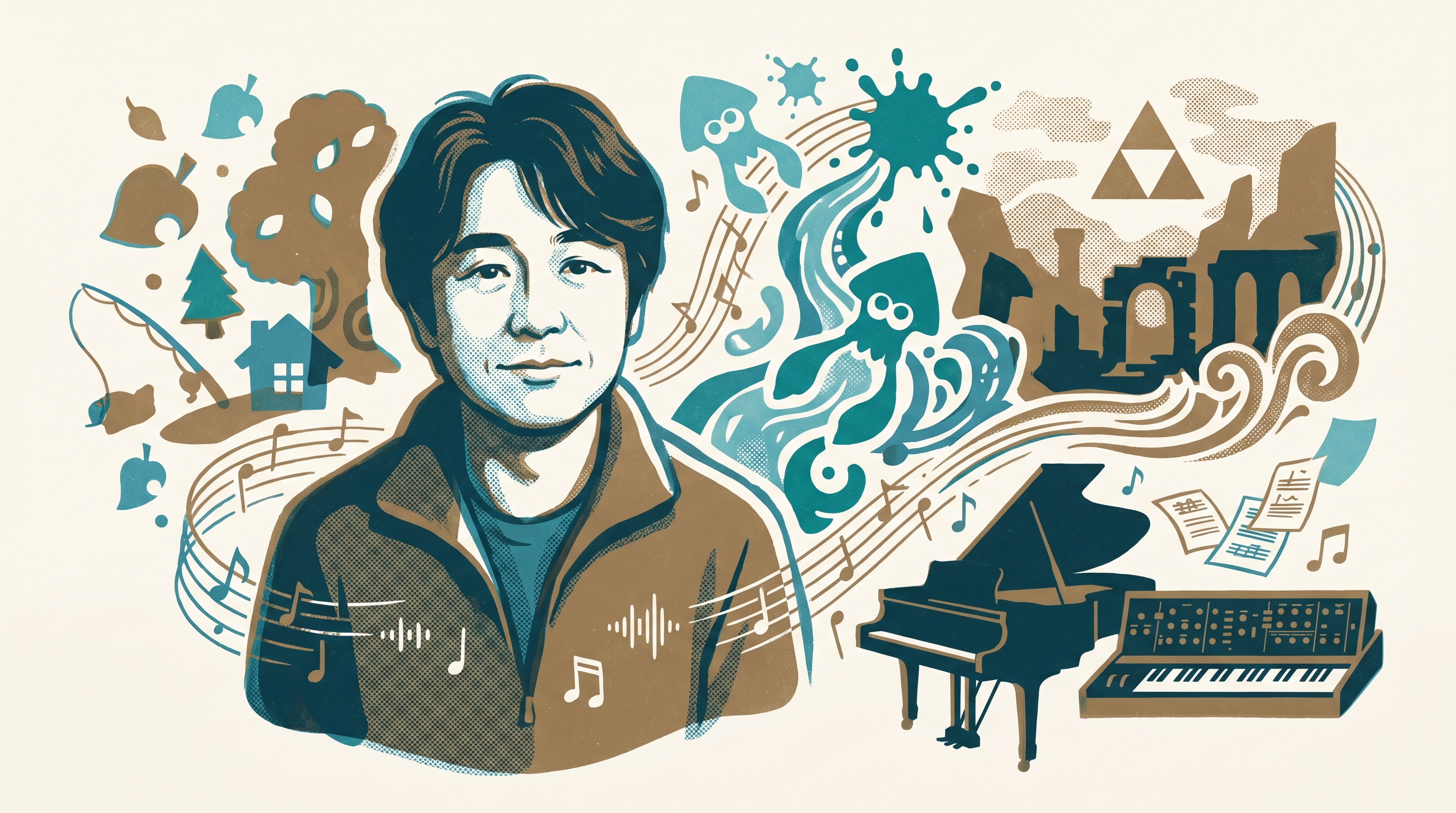
Toru Minegishi is a Japanese video game composer who joined Nintendo in 1999. He became known for his versatility across musical genres, composing battle themes for The Legend of Zelda: Majora's Mask, serving as main composer for Twilight Princess, creating over 50 songs in different styles for K.K. Slider in Animal Crossing, and directing the sound for the Splatoon series with its fictional in-universe bands.
History
Toru Minegishi was born in 1975 into a musical household. His parents listened to Latin music and tango at home, and the sounds stayed with him. At age ten he saw a television commercial for The Legend of Zelda. He asked his parents for the game. They agreed on a condition: improve your swimming school performance first. He did. They bought him a Family Computer Disk System with The Legend of Zelda. A year later he heard Modest Mussorgsky's Pictures at an Exhibition for the first time — a suite of ten movements inspired by paintings, each piece answering a different image with sound. That structure, translating one medium into another, would shape the way he thought about composition.
Minegishi did not attend a music conservatory. He gained experience as a musician during his school and college years, playing and listening broadly. In 1999 he passed Nintendo's composition and music tests and joined Nintendo Entertainment Analysis and Development as a composer and sound effects designer. His debut project was Pokémon Stadium for the Nintendo 64. Early in his career he also worked on the GameCube startup sound — a short musical signature composed without instruments, built entirely from the constraints of the hardware.
One of his formative assignments came with Animal Crossing. The game featured a wandering musician named K.K. Slider — a dog who played guitar and took requests from players. Minegishi was tasked with writing more than fifty songs, each in a different genre. Jazz, bossa nova, salsa, rock, ballads, folk — genres he had not necessarily written in before. He later cited this project as one of his greatest learning experiences, not because it was easy but because it forced him to stretch across styles he had only listened to, never composed.
His first work on The Legend of Zelda series came with Majora's Mask, where he composed three battle themes. By the time The Legend of Zelda: Twilight Princess began development in the mid-2000s, he was assigned as the main composer. The score he wrote was noted for its melancholic tone and Eastern European influences — one of the largest soundtracks in the series' history at the time. Minegishi cited Alan Menken, whose music had influenced The Wind Waker's sound team, and composers like Maurice Ravel and Sting as inspirations. He also considered Koji Kondo, the manager of Nintendo's sound group, as a master whose work set the standard.
In 2015 Nintendo released Splatoon, a multiplayer game set in a world of anthropomorphic squids and octopuses. Minegishi served as sound director and lead composer. The game featured fictional in-universe bands — Squid Squad, Hightide Era, Turquoise October, Wet Floor — each with a distinct musical identity. Rather than composing a single soundtrack, Minegishi and his team built what felt like a music scene, as if these bands actually existed and had their own styles. He returned in the same role for Splatoon 2 and continued to compose for Splatoon 3. In interviews about the series, he discussed coordinating the sound team and establishing the musical voices of each fictional group, treating them as real artists rather than background elements.
Minegishi's career is a quiet argument that a composer's range is not something you are born with. It is built by accepting assignments you do not yet know how to complete — fifty genres for a dog with a guitar, a melancholy score for a fantasy kingdom, punk rock for squids who do not exist. The breadth comes from the willingness to try, not the certainty that you already can.
Timeline & Works
Career milestones and all 3 games in the museum they worked on — in the order they happened.
- 1975
Born
Toru Minegishi was born into a musical household where his parents listened to Latin music and tango.
people - 1985
First encounter with The Legend of Zelda
At age ten, Minegishi saw a commercial for The Legend of Zelda and asked his parents for the game. After improving his swimming school performance, they bought him a Family Computer Disk System with the game.
people - 1999
Joined Nintendo
Minegishi passed Nintendo's composition and music tests and joined Nintendo Entertainment Analysis and Development (EAD) as a composer and sound effects designer. His debut project was Pokémon Stadium for the Nintendo 64.
people - 2000
Majora's Mask battle themes
Composed three battle themes for The Legend of Zelda: Majora's Mask, his first work on the Zelda series.
product - 2000
- 2001
Animal Crossing — K.K. Slider songs
Composed over fifty songs in different musical genres for K.K. Slider, the wandering musician in Animal Crossing. Minegishi later cited this as one of his greatest learning experiences, forcing him to work across styles he had only listened to before.
product - 2002
Super Mario Sunshine sound effects
Worked on sound effects for Super Mario Sunshine, another formative learning experience early in his career.
product - 2002
- 2003
- 2006
Main composer for Twilight Princess
Served as the main composer for The Legend of Zelda: Twilight Princess, creating a score noted for its melancholic tone and Eastern European influences — one of the largest soundtracks in the series at the time.
productzelda-twilight-princess - 2015
Sound director for Splatoon
Served as sound director and lead composer for Splatoon, creating music for fictional in-universe bands like Squid Squad and establishing distinct musical identities for each group.
productsplatoon - 2017
Sound director for Splatoon 2
Returned as sound director and lead composer for Splatoon 2, continuing to develop the musical world of the series with new fictional bands and styles.
productsplatoon-2 - 2022
Continued composition for Splatoon 3
Continued to compose music for Splatoon 3, maintaining his role in shaping the series' distinctive musical identity. Participated in "Ask the Developer" interview in September 2022.
productsplatoon-3
Connections
- employed nintendo (1999–present)
Joined Nintendo Entertainment Analysis and Development in 1999 as a composer and sound effects designer, and has remained with the company throughout his career.
- collaborated with koji-kondo (1999–present)
Worked under Koji Kondo, the manager of Nintendo's EAD sound group, whom Minegishi regarded as a master and major inspiration.
Also connected to
- Shigeru Miyamoto co-created The Legend of Zelda: Majora's Mask / co-created The Legend of Zelda: The Wind Waker / same employer (Nintendo, since 1999)
- Eiji Aonuma co-created The Legend of Zelda: Majora's Mask / co-created The Legend of Zelda: The Wind Waker
- Takashi Tezuka co-created Animal Crossing: Doubutsu no Mori e+ / co-created The Legend of Zelda: The Wind Waker
- Hajime Wakai co-created The Legend of Zelda: The Wind Waker / same employer (Nintendo, since 1999)
Explore the work
Each title has its own page — history, trivia, and collector's notes.
Nintendo GameCube · 2003
Animal Crossing: Doubutsu no Mori e+
The GameCube Animal Crossing, Japan's definitive version. E-Reader card support …
Nintendo GameCube · 2002
The Legend of Zelda: The Wind Waker
They drew instead of rendered, and the drawing outlasted everything that tried t…
Nintendo 64 · 2000
The Legend of Zelda: Majora's Mask
Given one year and old, borrowed parts, they made a world with only three days l…
Rooms their games live in
Sources
- Toru Minegishi — Wikipedia — accessed 2026-06-19
- Toru Minegishi | Nintendo | Fandom — accessed 2026-06-19
- Toru Minegishi — Animal Crossing Wiki (Nookipedia) — accessed 2026-06-19
- Toru Minegishi — Inkipedia (Splatoon wiki) — accessed 2026-06-19
- Tôru Minegishi — Video Game Music Preservation Foundation Wiki — accessed 2026-06-19