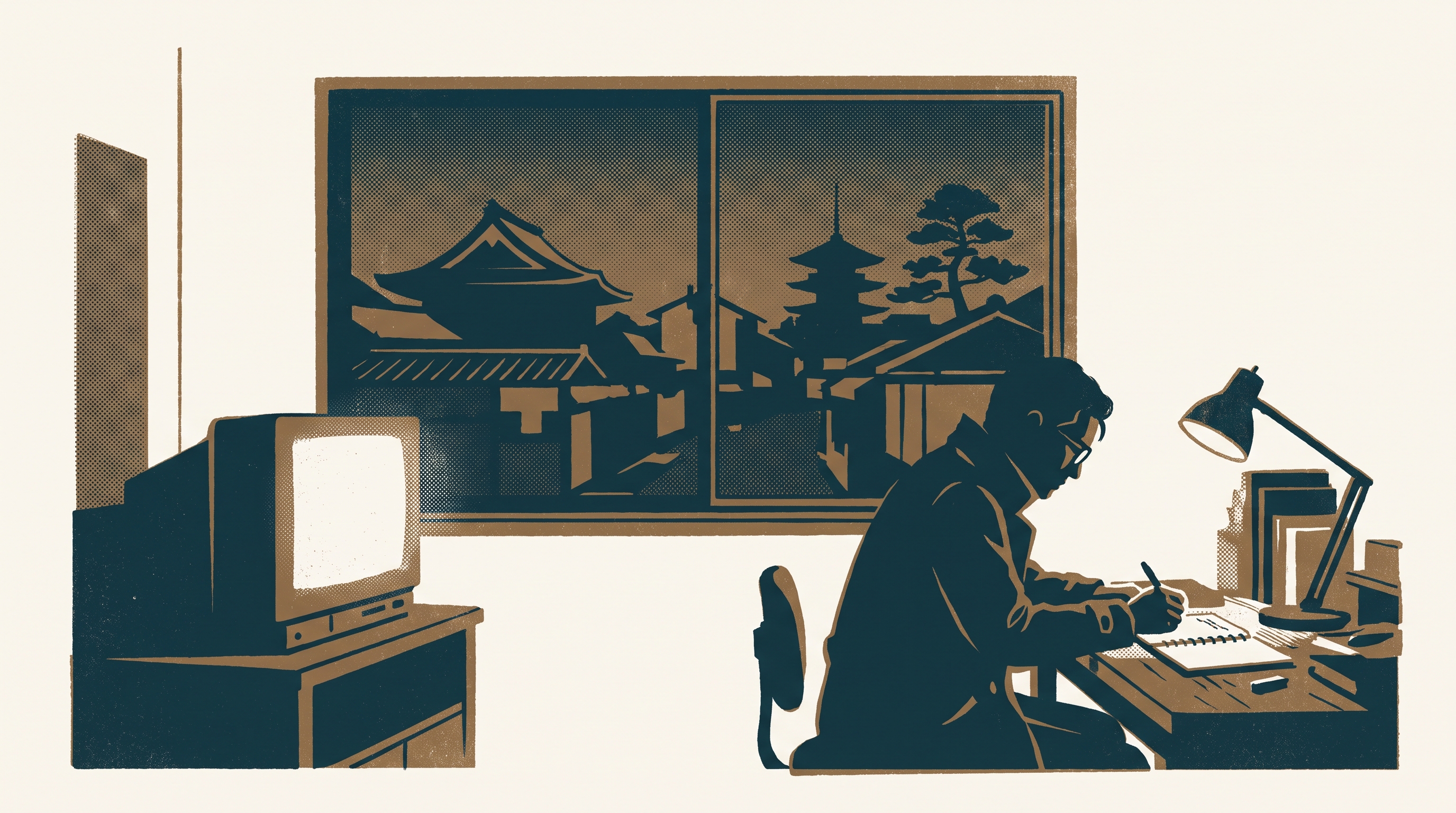
Late at night, when the office was empty, Yoshiaki Koizumi sat at his desk and wrote. He was working on Super Mario Galaxy. The game was nearly finished. The planetoids spun. Gravity bent. Mario could leap upside-down across spheres, and it felt right. The core mechanics were locked. But Koizumi had been thinking about something else — a short story, hidden inside the game, that no one had asked for.
He had joined Nintendo in April 1991, fresh from Osaka University of Arts, where he had studied film. He wanted to be a film director. His first job was drawing the manual for The Legend of Zelda: A Link to the Past. Not filmmaking. Not even game design. Just instructional illustrations. But it was close enough to storytelling that he stayed.
Two years later, in 1993, he was given a rare opening. Director Takashi Tezuka was assembling a team for a portable Zelda game — Link's Awakening for the Game Boy. Tezuka told the writing team: no Hyrule, no Triforce, no Princess Zelda. Just make something different. Koizumi proposed that the entire island was a dream. Koholint, with its talking animals and impossible geography, existed only in the mind of a sleeping god called the Wind Fish. To wake the Wind Fish was to erase the island and everyone on it. It was a story about leaving a place you loved, knowing that staying was not an option. He wrote most of it himself. According to his later reflections, he came up with the whole scenario and backstory for Link on his own, and nobody seemed to care. But the players cared. Link's Awakening became the first Zelda game that people remembered not for its dungeons but for its goodbye.
The years that followed were built on mechanics, not narrative. He worked on Super Mario 64 as assistant director, studying how players moved in three-dimensional space. He co-directed The Legend of Zelda: Ocarina of Time, designing the lock-on combat system after watching a staged swordfight at Toei Kyoto Studio Park. He directed Super Mario Sunshine, where cleaning tropical paint with a water-spraying backpack was somehow the central mechanic. These were not games known for their plots. They were known for how they felt to play. And Koizumi was good at making them feel right.
But in 2007, while directing Super Mario Galaxy, he found himself thinking about a girl who leaves home. She becomes the adoptive mother of the stars. She watches over the cosmos from a quiet observatory at the edge of space, waiting for someone to arrive. The character's name was Rosalina. Koizumi wrote her story late at night, when no one else was around. He later said that for a long time, it really felt like telling a story in a Mario game was something that wasn't allowed. So he wrote it in secret. The next morning, he presented it to Shigeru Miyamoto. Miyamoto was surprised — not disapproving, just surprised. The storybook stayed in the game.

Rosalina's Storybook became one of the quietest, saddest pieces of writing ever hidden inside a platformer. It was written in simple sentences, illustrated with crayon-like drawings, and narrated in a soft voice. It told the story of a girl who left her mother to help a lost Luma find its own mother, and who never made it home. The tone was gentle, but the sadness was real. Players who found it were not prepared for what it made them feel. Neither was Nintendo.
Koizumi had wanted to be a film director. He became something else: someone who learned to tell stories inside the gaps of gameplay, during the moments when no one was expecting a story at all. He wrote Link's goodbye to Koholint in 1993, when the industry assumed portable games were too small for narrative weight. He wrote Rosalina's quiet grief in 2007, when Mario games were not supposed to carry emotional stakes. Both times, he wrote in the margins — not because he was told to, but because he believed games could hold more than mechanics. That belief cost him nothing and gave him everything.
By 2026, Koizumi holds the position of Senior General Manager of Nintendo EPD and Senior Executive Officer, the role once held by Miyamoto himself. His involvement in day-to-day game design has decreased, but his influence has not. The stories he wrote in the dark are still there, still being found by people who were not looking for them. That is the nature of a story told quietly: it does not announce itself, but it does not disappear either. It waits. And when you are ready, it is still there, just where he left it — in the margins, in the night, in the space between jumps where a platformer is allowed to grieve.
The question Koizumi never answered aloud was whether he believed those stories were allowed, or whether he simply decided to write them anyway. The distance between those two answers is the width of a career. It is also the width of the gap between what a medium is and what it could be. He spent thirty years learning how real things move so that unreal things could move the same way. But the other lesson he taught was quieter: that permission is not always given. Sometimes it is taken, late at night, when no one is looking — and what you write in that silence becomes the thing people remember most.