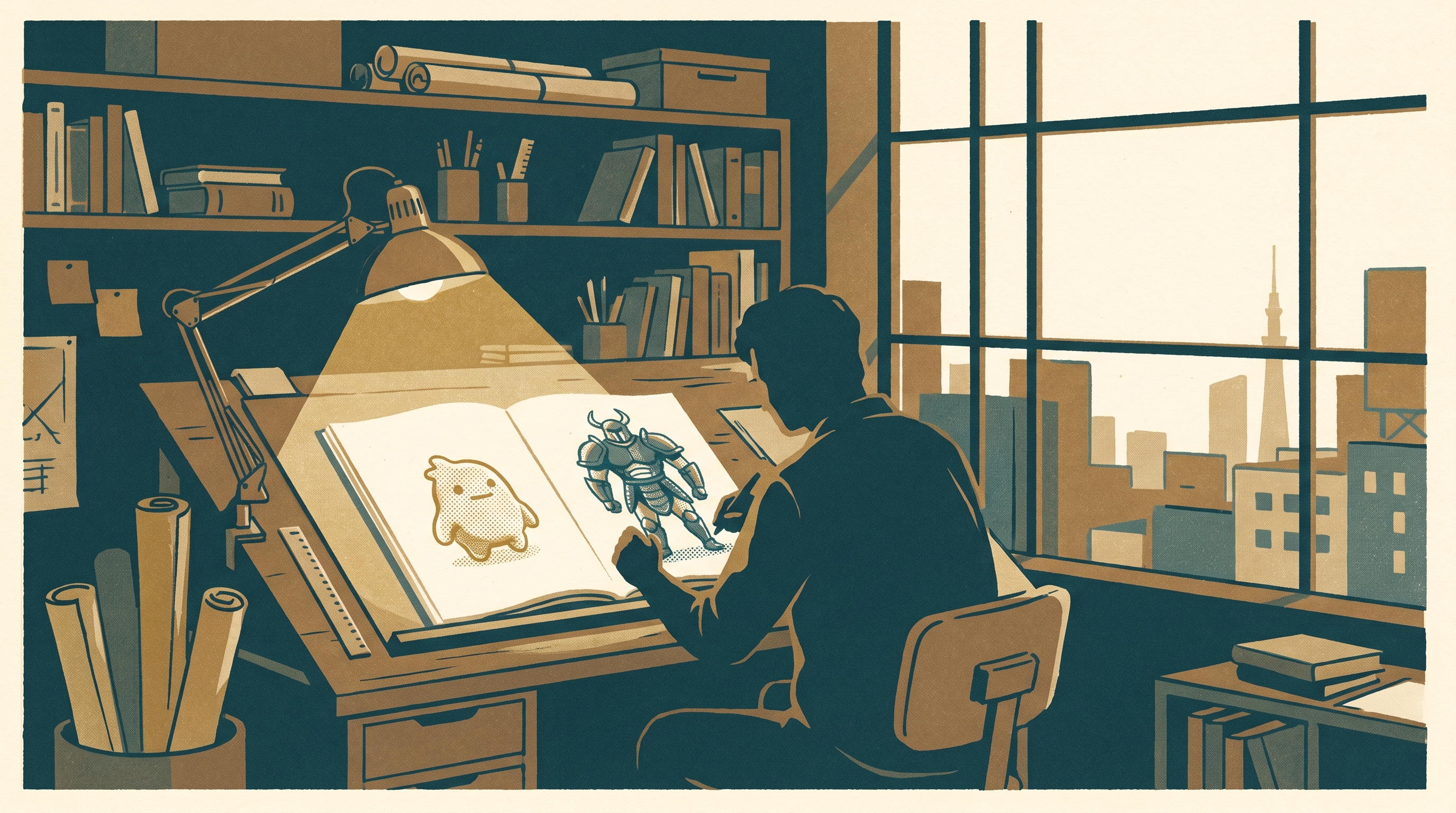
In 1985, Akira Toriyama was one year into Dragon Ball, the martial arts adventure series that was beginning to gain a following in Weekly Shōnen Jump. He had already survived his first major serialization — Dr. Slump, a gag manga about an android girl with superhuman strength, had run for four and a half years and sold tens of millions of copies across Japan. His drawing style was recognizable at a glance: round expressive faces, clear silhouettes, action that read without words. That year, an editor from the same magazine introduced him to a game designer named Yuji Horii.
Horii was developing Dragon Quest, a console RPG for the Famicom. He needed an artist whose work was already familiar to children, warm rather than threatening, and simple enough to be recognized at the low resolution of 8-bit hardware. Toriyama agreed. He was given a list of characters and monsters to design. Among them was the weakest enemy in the game — a creature that players would defeat in a single hit on their first turn. Toriyama drew it as a blue teardrop shape with two dot eyes and a curved mouth. He gave it a face. The face was friendly.
The Slime was not designed to be an icon. It was designed the same way Toriyama designed everything else: with care, with clarity, with the assumption that even the smallest thing on the page deserved a face and a personality. Dragon Quest I was released on May 27, 1986. It sold over two million copies in Japan. The Slime appeared in the first area, died easily, and was forgotten by most players within minutes. But it stayed in the game, and it stayed in the series.
What happened next was not something Toriyama intended. The Slime began appearing in promotional materials. It was printed on merchandise. It became the mascot of the series. By the 1990s it was appearing on the covers of strategy guides, in the opening cinematics of numbered entries, in theatrical releases, in theme parks. It became the most recognized game character in Japan — not because it was strong, not because it was rare, but because Toriyama had drawn it with the same sincerity he gave the hero.

Toriyama's collaboration with Dragon Quest continued for the rest of his life. Every numbered entry in the series — from Dragon Quest III in 1988, which brought over a million people into the winter cold to queue for its release, to Dragon Quest XII, still in development at the time of his death — carried his character designs and monster art. The visual grammar he established in 1985 scaled across hardware generations without changing its fundamental character. Monsters were round and expressive. Heroes had body language that communicated their personality in a single frame. Villains looked like villains without requiring a caption.
He brought the same grammar to other projects. In 1995, he joined what Shōnen Jump called a Dream Team: Yuji Horii on game design, Hironobu Sakaguchi as producer, Nobuo Uematsu and Yasunori Mitsuda on music. The project was Chrono Trigger, a time-travel RPG for the Super Famicom. His designs for the game — the protagonist Crono, the princess Marle, the knight Frog, the sorcerer Magus — were recognizably his work while being distinct from his Dragon Quest designs. The game sold over 2.65 million copies in Japan and received Famitsu's first-ever Perfect Score. Toriyama's visual language was flexible enough to serve dramatically different narrative registers without losing its clarity.
Akira Toriyama died on March 1, 2024, from acute subdural hematoma. He was sixty-eight years old. He had been working on Dragon Quest XII and the Dragon Ball Daima anime at the time of his death. The response from the game industry was not simply grief for a name — it was the recognition that the visual vocabulary players had used to understand Japanese RPGs for forty years had been built, almost entirely, by one person. The Slime is still the weakest enemy in Dragon Quest XII. That game is not yet released. When it is, the round blue shape with the curved smile will be in the first area, waiting to be defeated by a player who has never played Dragon Quest before.
The question the Slime poses is not a riddle. It is something quieter. When you design something — anything — do you give the smallest piece the same care you give the centerpiece? Do you assume that even the thing no one will remember deserves to be drawn well? Toriyama answered that question every time he picked up a pen. The weakest enemy in the game became the face of the series. That was not a strategy. It was the result of treating every design, no matter how minor, as though it mattered.