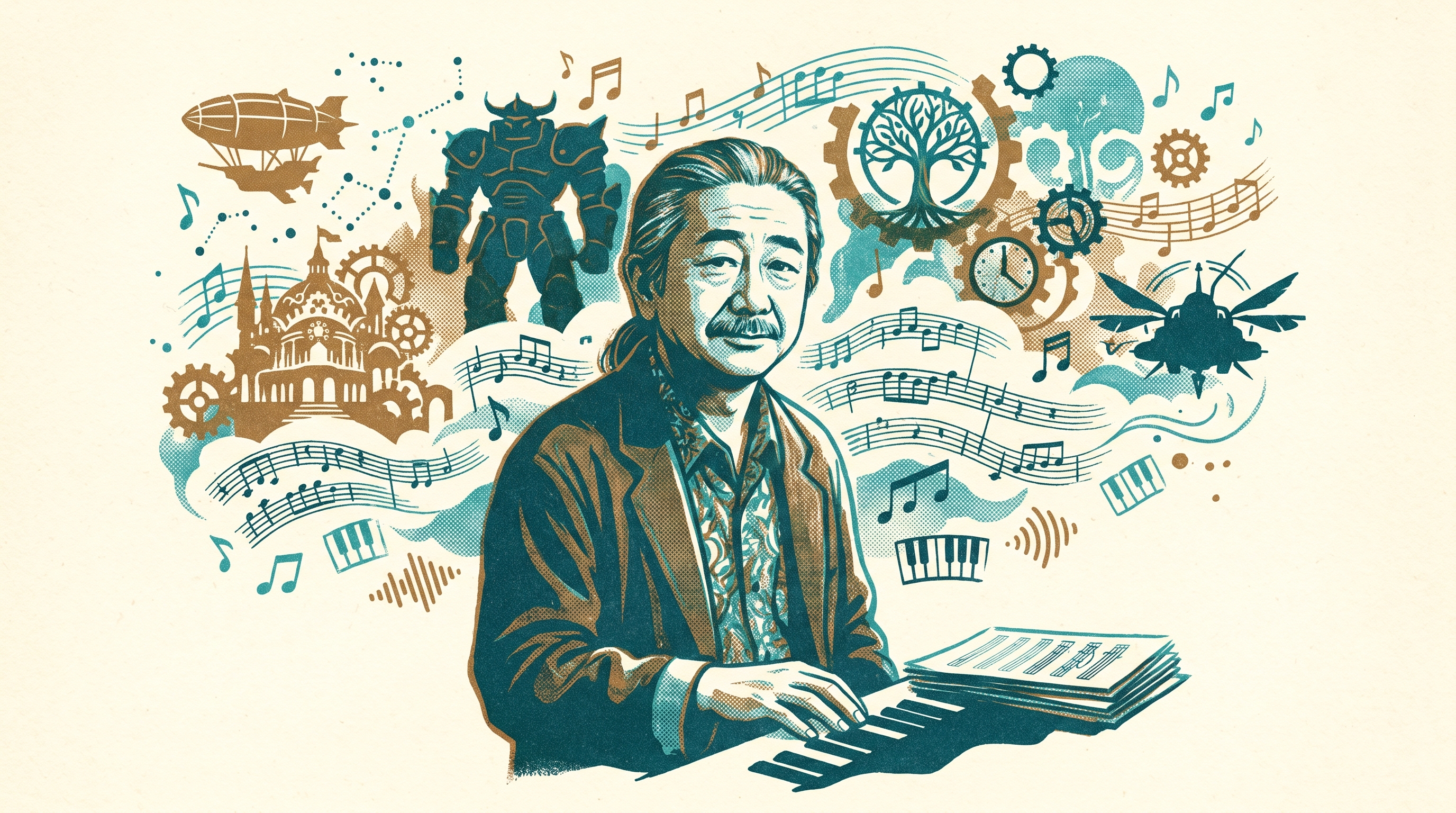
composer
Nobuo Uematsu
植松伸夫
Self-taught, with no formal training — and that absence became his signature sound.
About
Nobuo Uematsu is a Japanese composer best known for his work on the Final Fantasy series. He composed the music for Final Fantasy I through IX and contributed additional music to Chrono Trigger (1995). His orchestral and emotionally resonant scores helped define the JRPG soundtrack genre. His opera sequence "Maria and Draco" in Final Fantasy VI is widely cited as a landmark moment in game music history.
History
Nobuo Uematsu was born on March 21, 1959, in Kochi City, Kochi Prefecture, Japan. His first encounter with music came in elementary school when a Vienna Boys' Choir performance left him awestruck — a moment he has described as physically stopping him in his tracks. He taught himself guitar from sheet music printed in his sister's idol magazines, then moved on to piano entirely by ear, idolizing Elton John and playing in bands throughout middle and high school. No teacher, no conservatory: every note he learned, he learned himself.
Uematsu studied English literature at Kanagawa University — not music. He graduated without a single formal composition credit to his name and worked part-time at a music equipment shop before being introduced to Square through a personal connection with Hironobu Sakaguchi. He joined the company in 1986. The absence of classical training was something he was acutely aware of; he has openly admitted that he could not write a fully proper score and that his background in early digital music tools meant he lacked the formal vocabulary of a conservatory composer. He stepped into the role of sole composer for a fledgling RPG series with no guarantee it would last.
From Final Fantasy I (1987) through Final Fantasy VI (1994), Uematsu composed alone, building an entire sonic universe on hardware with severe technical constraints. The limitations of the Famicom and Super Famicom forced him to think in pure emotion rather than orchestral texture — and that constraint became a signature. The peak of this era arrived with FFVI's in-game opera scene, 'Aria di Mezzo Carattere,' which stunned players by staging something approaching genuine operatic drama inside a 16-bit cartridge. Critics and players alike recognized it as a landmark moment: a game had made them feel something they associated only with the concert hall. The man who 'couldn't write a proper score' had composed what many consider the most moving sequence in SNES history.
Final Fantasy VII (1997) brought Uematsu to a new level of ambition. For the game's climactic boss theme, 'One-Winged Angel,' he fused the jagged rhythmic language of Igor Stravinsky with hard rock guitars and a live choir singing lyrics drawn from medieval Latin poetry — the first vocal track in the mainline Final Fantasy series. Uematsu has described the composition process as assembling dozens of disconnected short phrases over two weeks and then connecting them, almost like solving a puzzle without a picture on the box. The result is a piece that feels simultaneously ancient and violent, sacred and chaotic. It became one of the most performed and recognized compositions in video game history, and it was built from fragments by a self-taught guitarist who had never studied orchestration.
Final Fantasy VIII (1999) introduced 'Eyes on Me,' a full pop ballad performed by Hong Kong singer Faye Wong, which won the Japan Gold Disc Award — the first time a piece of video game music had ever received that honor. By Final Fantasy X (2001), Uematsu for the first time shared the compositional duties with Masashi Hamauzu and Junya Nakano, a transition that signaled both the growing scale of the franchise and his own evolving sense of what he wanted to create. He remained involved through Final Fantasy XI (2002) before departing Square in October 2004. His stated reason was characteristically direct: Final Fantasy had become too large, too established — and he needed to start from zero again.
After founding SMILEPLEASE in 2004 and the Dog Ear Records label in 2006, Uematsu pursued music on his own terms. The Black Mages, a hard rock band he had formed in 2002 to arrange Final Fantasy tracks for electric guitar and drums, became a live vehicle for the harder edge of his musical personality. In 2007 he launched the Distant Worlds concert series — a full orchestral touring program dedicated to Final Fantasy music — with its inaugural performance in Stockholm on December 4, 2007; the series went on to sell out more than 250 concerts worldwide. He also continued collaborating with Hironobu Sakaguchi's Mistwalker studio, scoring Blue Dragon (2006), Lost Odyssey (2007), and Fantasian (2021), proving that the creative partnership forged at Square remained one of the most productive in Japanese game history.
In September 2018, Uematsu announced a health-related hiatus, writing publicly that years of overwork had resulted in several overlapping illnesses. He returned to the stage in January 2019 at Tokyo Metropolitan Theatre alongside the Tokyo Symphony Orchestra — a comeback that felt, to his fanbase, like a plotline from one of the games he had scored. In 2020, the Final Fantasy VII Remake soundtrack earned him a The Game Awards nomination for Best Score/Soundtrack. In 2012, 'Aerith's Theme' had already entered the Classic FM Hall of Fame at No. 16, the first video game music ever to appear on that chart. The arc of Uematsu's career is a sustained argument against the idea that credentials determine quality. He built one of the most recognized bodies of music in popular culture without a single formal lesson in composition — and it is precisely the gaps in his training, the places where he had to feel his way forward instead of following a map, that gave his music its emotional directness. The lesson he leaves is not that education is unnecessary, but that an absence, honestly inhabited, can become the most distinctive thing about you.
In Nobuo's Own Words
Real interview footage, not paraphrase. Each line links back to the exact moment in the video so you can hear it for yourself.
“I would read the scenario, look at the character artwork, and read over and over again how the characters would speak.”
Timeline & Works
Career milestones and all 17 games in the museum they worked on — in the order they happened.
- 1959 03
Born in Kochi City, Japan
Nobuo Uematsu was born on March 21, 1959, in Kochi City, Kochi Prefecture.
people - 1986
Joined Square
Uematsu joined Square through a personal connection with Hironobu Sakaguchi, without any formal music education.
people - 1986
- 1987
Final Fantasy I — debut as game music composer
Uematsu composed the entire soundtrack for the original Final Fantasy, launching one of the most celebrated bodies of work in video game music.
product - 1987
- 1987
- 1987
- 1988
- 1988
- 1989
- 1990
- 1990
- 1991
- 1992
- 1994
Final Fantasy VI — "Aria di Mezzo Carattere"
The in-game opera scene "Aria di Mezzo Carattere" demonstrated that video game music could achieve genuine operatic emotion within the constraints of 16-bit hardware.
milestone - 1994
- 1995
- 1997
Final Fantasy VII — "One-Winged Angel"
"One-Winged Angel" fused Stravinsky-influenced rhythms, hard rock, and a live choir singing medieval Latin poetry — the first vocal track in the mainline Final Fantasy series.
milestone - 1997
- 1999
Final Fantasy VIII — "Eyes on Me" wins Japan Gold Disc Award
"Eyes on Me," performed by Faye Wong, became the first video game music track ever to win the Japan Gold Disc Award.
milestone - 1999
- 2000
- 2001
- 2002
The Black Mages formed
Uematsu formed The Black Mages, a hard rock band dedicated to rearranging Final Fantasy music for electric guitar and drums.
milestone - 2004
Departed Square; founded SMILEPLEASE
Uematsu left Square in October 2004, citing the need to start from scratch away from the towering legacy of Final Fantasy, and immediately founded his own company, SMILEPLEASE.
founding - 2007
Distant Worlds concert series launched
The Distant Worlds orchestral concert series dedicated to Final Fantasy music launched with its inaugural performance in Stockholm on December 4, 2007, going on to sell out more than 250 concerts worldwide.
milestone - 2021
Fantasian (Apple Arcade) — Mistwalker collaboration
Uematsu scored Fantasian for Hironobu Sakaguchi's Mistwalker studio, continuing a creative partnership stretching back to the original Final Fantasy.
product
Connections
- collaborated with hironobu-sakaguchi (1986–present)
Long-term creative partner across the entire Final Fantasy series (FFI–FFX) and subsequent Mistwalker titles including Blue Dragon, Lost Odyssey, and Fantasian.
- collaborated with yasunori-mitsuda (1995–1995)
Uematsu composed approximately 10 tracks for Chrono Trigger after Mitsuda fell ill with a stomach ulcer during development, helping complete the landmark RPG soundtrack.
Also connected to
- Kazuhiko Aoki co-created Chrono Trigger / co-created Final Fantasy IX / co-created Final Fantasy VII / co-created Hanjuku Hero
- Yoshinori Kitase co-created Chrono Trigger / co-created Final Fantasy VI / co-created Final Fantasy VII / co-created Final Fantasy X
- Hiroyuki Ito co-created Final Fantasy IX / co-created Final Fantasy VI
- Masafumi Miyamoto co-created Final Fantasy / co-created Hanjuku Hero
Explore the work
Each title has its own page — history, trivia, and collector's notes.
PlayStation 2 · 2001
Final Fantasy X
The first Final Fantasy where a face could break before the voice did.…
PlayStation · 2000
Final Fantasy IX
The team made it as a love letter to everything Final Fantasy had been. Uematsu …
PlayStation · 1999
Final Fantasy VIII
The Draw system divided players. The music was written for two people slow-danci…
PlayStation · 1997
Final Fantasy VII
They gave her to you first, so losing her would be real.…
Super Famicom / SNES · 1995
Chrono Trigger
They traveled to the ends of time — to find out what you can still change today.…
Super Famicom / SNES · 1994
Final Fantasy VI
They let the world break — then asked who you'd go back for.…
Rooms their games live in
Sources
- 植松伸夫 — Wikipedia(日本語) — accessed 2026-05-29
- Nobuo Uematsu — Wikipedia (English) — accessed 2026-05-29
- Red Bull Music Academy — Nobuo Uematsu Interview (2014) — accessed 2026-05-29
- JASRAC インタビュー「植松伸夫」(2025) — accessed 2026-05-29
- Distant Worlds — About — accessed 2026-05-29
From the Museum's Screening Room
Nobuo Uematsu
Prelude (Final Fantasy) — The Sound of the Machines
Aerith's Theme — The Sound of the Machines