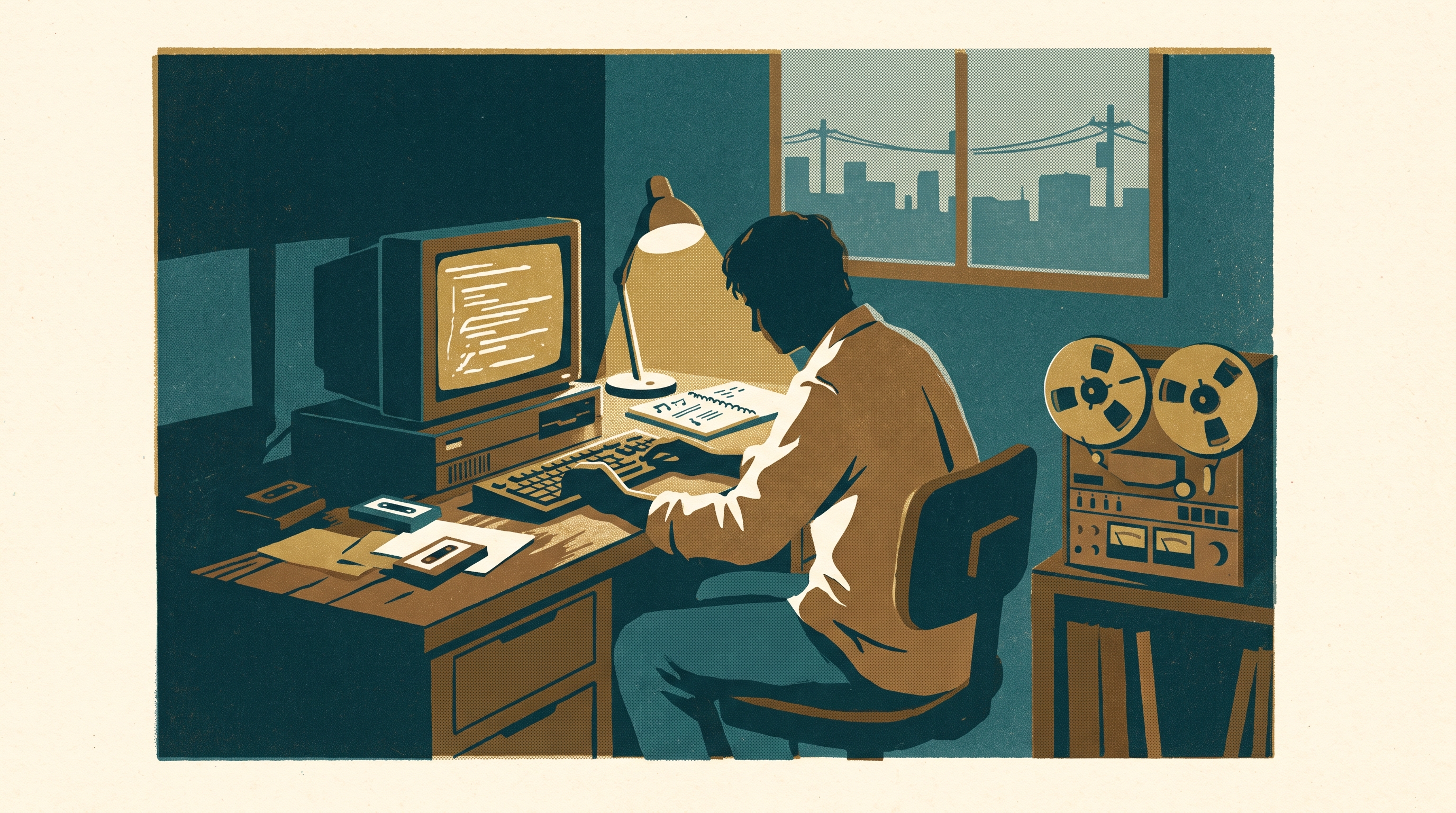
Yasunori Mitsuda was born on January 21, 1972, in Tokuyama, Japan. As a child he took piano lessons but never cared much for them — he was more interested in sports. What changed was the sound of two film scores: Vangelis's Blade Runner and Henry Mancini's The Pink Panther. In high school, he rediscovered music through them, the way you rediscover a room when someone turns on a light you did not know was off.
After high school, he moved to Tokyo to attend the Junior College of Music, a school not known for prestige. His professors were practicing musicians who took him to gigs to help carry and set up equipment. The music instruction was solid. The connections were real. While there, a senior composer named Nobuo Uematsu showed him a job advertisement for Square Co., a small game developer that was expanding its sound team. Mitsuda sent in a demo. The interview, by his own account, was disastrous. He was hired anyway in April 1992.
His official job title was 'composer,' but the work he was given was not composition. For two years, he worked as a sound engineer — implementing other people's music, tuning sound effects, watching other composers write the scores. In 1994, frustrated, he walked into the office of Hironobu Sakaguchi, the company's vice president, and delivered an ultimatum: let me compose, or I quit.
Sakaguchi assigned him to Chrono Trigger, a project that was already carrying the weight of three studios' reputations — Square, Enix staff, and the Dragon Ball artist Akira Toriyama. Mitsuda would compose the majority of the soundtrack under the supervision of Nobuo Uematsu, who had recommended him in the first place. Mitsuda composed fifty-four tracks. Uematsu composed ten. The release was scheduled for March 1995.
Mitsuda drove himself without measure. He worked late into the night and frequently until he passed out at his desk. He would wake with melodies already formed — the ending theme came to him that way. He developed a cough that would not stop. The cough began to bring up blood. He continued working. He developed stomach ulcers. He went to the hospital in the morning, worked through the night, and returned to the hospital the next morning. His boss asked Uematsu to step in and finish the remaining tracks. Mitsuda was hospitalized. The game released on schedule. It sold over two million copies in Japan alone and is widely considered one of the greatest role-playing games ever made.
In 1998, Mitsuda composed the soundtrack for Xenogears, his most ambitious work at Square — forty tracks incorporating Bulgarian choirs, Celtic instrumentation, and the first vocal ballad in a Square game, 'Small Two of Pieces,' sung by Joanne Hogg. The development schedule was grueling. During the final mastering of the soundtrack, his health collapsed again.
In July 1998, shortly after Xenogears released, Mitsuda left Square. He cited ongoing health problems from overwork and a desire for creative autonomy. He was the first of several Square composers to leave and work independently. He founded his own music production company, Procyon Studio, in 2001.
As a freelancer, he composed for Chrono Cross (1999), the sequel to the game that had nearly killed him. He has since composed for Xenoblade Chronicles, Shadow Hearts, and dozens of other projects across three decades. His music is performed in concert halls. He is regarded as one of the defining voices of game music in the 1990s.
The work that put him in the hospital is the work people remember. Chrono Trigger's soundtrack — the harp arpeggios of 'Corridors of Time,' the melancholy piano of 'To Far Away Times' — has been performed, remixed, and cited as influence by musicians who were children when it released. Mitsuda has said in interviews that he does not recommend the way he worked. He has also said he does not regret it. The music is still here. — So is the cost. Are the two separable, or did the cost write the music?