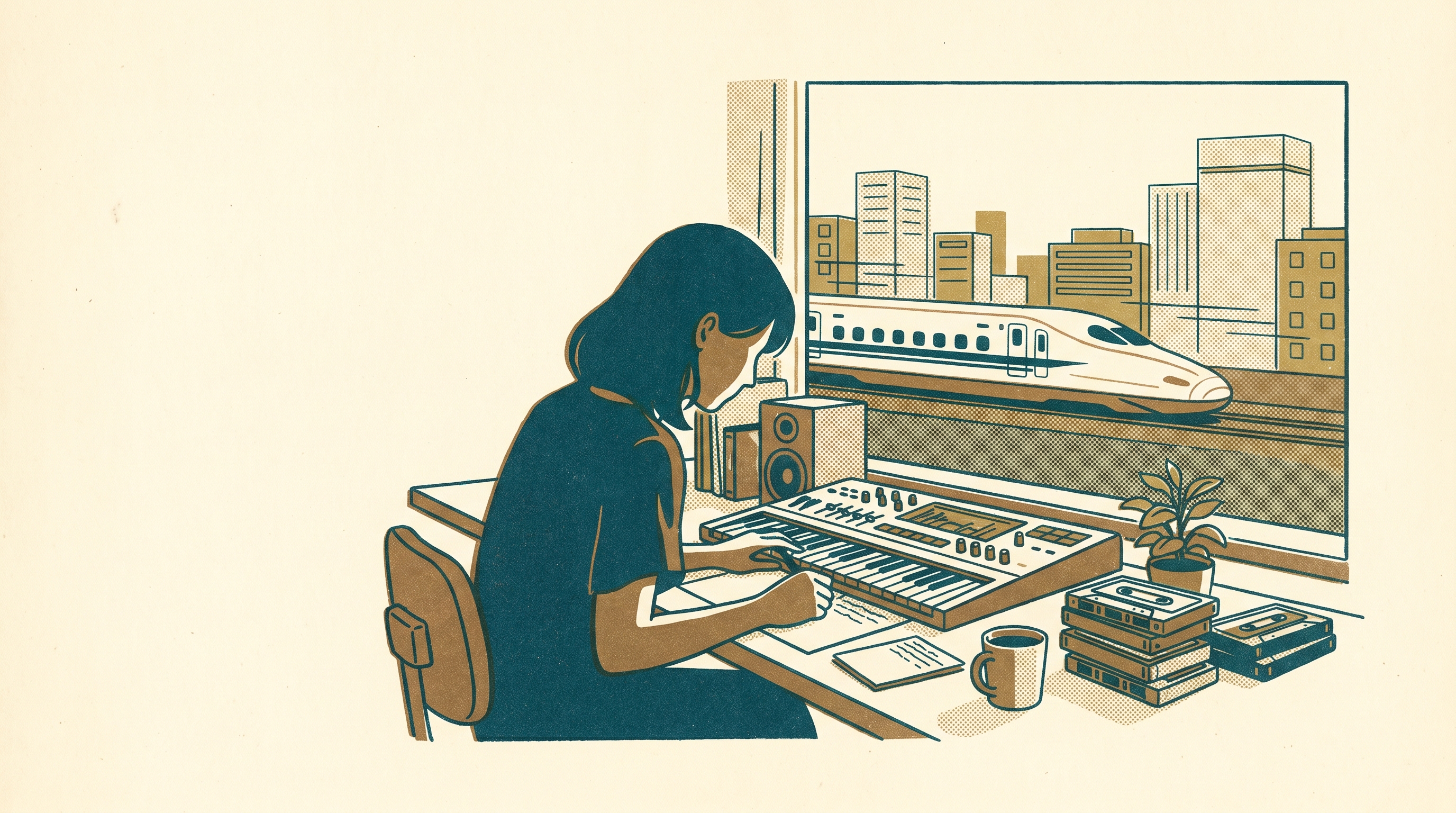
Yoko Shimomura was born on October 19, 1967, in Hyōgo Prefecture. She started taking piano lessons at four years old. The lessons continued through school. She graduated from Osaka College of Music in 1988 with training in classical composition. What she did next surprised some of her instructors. She did not pursue concert performance or teaching. She applied to a video game company.
The company was Capcom. She joined in 1988, and her first assignment came quickly: sound for an arcade beat-em-up called Final Fight. The work was not glamorous. She composed inside the constraints of early arcade hardware — three-voice PSG chips, limited memory, sound effects competing with music for attention. Her role was listed in the credits under an alias, 'Pii♪', as was the custom at Capcom for junior composers. She wrote music. The arcade machine played it back in loops. Players punched through levels and moved on.
In 1991, Capcom assigned her to a project that had already become an internal phenomenon. Street Fighter II was meant to be a modest sequel to an arcade game that had not sold particularly well. The development team expanded the roster from two playable characters to eight, each with their own fighting style and stage. Someone had to write music for each stage — music that would loop for the duration of a match, sometimes two minutes, sometimes five, and would need to remain listenable after the hundredth repetition. Shimomura composed all but three pieces for the game. She wrote Guile's theme. She wrote Chun-Li's theme. She wrote themes for stages set in India, Brazil, China, the Soviet Union, and the United States. The game was released in March 1991 and became the most influential fighting game of its generation. Shimomura had written the soundtrack to what many players around the world would remember as the sound of the arcade itself.

In 1993, she left Capcom and joined Square, a company known at the time for the Final Fantasy series. Her first project there was Live A Live, a Japanese RPG that moved between seven different time periods — prehistory, feudal Japan, the Wild West, near-future science fiction, and others. Each era had a different tone, a different visual style, and required music that could support the shift. She composed for all of them. The game sold modestly in Japan and was not released overseas at the time. But it established something about the way she worked: she did not write in one style and apply it everywhere. She adapted. She rebuilt the vocabulary for each world.
Over the next nine years at Square, she composed for Legend of Mana, Parasite Eve, Super Mario RPG (a collaboration with Nintendo), and several other titles. Then in 2002, Square gave her a project with an unusual premise: a collaboration between Square and Disney, combining Final Fantasy characters with Mickey Mouse, Donald Duck, and a cast from animated films. The game was called Kingdom Hearts. She composed the score. The music needed to work for both a Disney audience and a Japanese RPG audience — two constituencies that had never overlapped in this way before. She wrote battle music, exploration music, emotional cues, and a main theme that was performed with a full orchestra and vocalist. The game was released in Japan in March 2002 and became a commercial and critical success. It was her last project as a Square employee.
She left Square Enix later in 2002, around the time of her maternity leave, and became a freelance composer under the name Midiplex Co., Ltd. From that point forward, she chose her own projects. She continued to write for Kingdom Hearts sequels. She composed for the Mario & Luigi RPG series. She wrote music for the Street Fighter series again — this time as a returning collaborator, not a junior alias. She composed for smaller indie games and for large-budget productions. She worked for clients in Japan, the United States, and Europe. She received a BAFTA Fellowship in 2024 for lifetime achievement in game music — the first game composer to receive that honor.
What runs through her career is not a signature sound but a signature approach. She did not write the same music twice. A fighting game is not a role-playing game. A Disney collaboration is not a survival horror score. A platformer is not an action RPG. She treated each project as a new territory to be mapped from the beginning. The work was not about finding her voice. The work was about finding the voice of the thing she was writing for.
Shimomura is still composing. The catalog continues to grow. The map continues to be redrawn. — And if you are working on something now that does not resemble anything you have made before, the question is not whether you can do it. The question is whether you are willing to start with nothing and build it from there.