composer
Yoko Shimomura
下村陽子
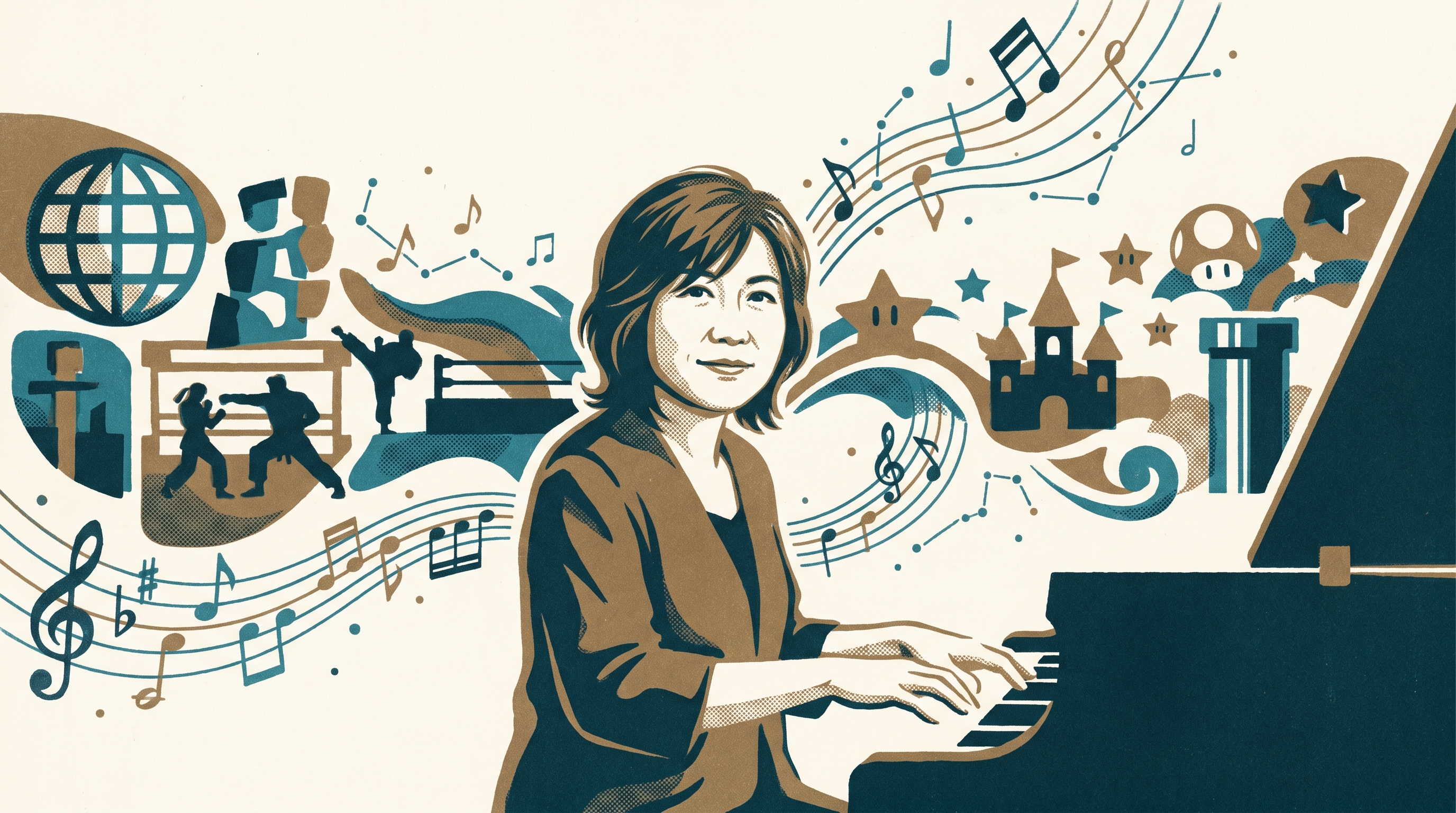
Every genre, every emotion — she treats each assignment as a new landscape to map from scratch.
About
Yoko Shimomura is a Japanese composer known for her versatility across wildly different musical idioms — from the driving rock rhythms of Street Fighter II (1991) to the orchestral sweep of Kingdom Hearts (2002) and the intimate piano textures of Final Fantasy XV (2016). She studied classical piano at the Osaka College of Music, joined Capcom in 1988, and in 1993 moved to Square (now Square Enix), where she found the full range of her voice. Her music is characterized by its emotional intelligence: each score finds its own interior logic rather than defaulting to generic genre conventions.
History
Yoko Shimomura was born on October 19, 1967, in Hyogo Prefecture, Japan. She began piano lessons at the age of four and pursued classical training seriously enough to enroll at the Osaka College of Music, where she concentrated on piano performance. The path she was on was academic and traditional — she graduated with a degree in music and held every credential one might expect of a concert pianist in training. Then she took a job writing music for video games.
In 1988, Shimomura joined Capcom. The assignment that defined her entry into game music was Street Fighter II: The World Warrior (1991), for which she composed the soundtrack. The score was unusual: fighting game music was expected to be loud, aggressive, and interchangeable, but Shimomura wrote character-specific themes that gave each fighter a distinct cultural and emotional identity. Guile's stage theme, built on a looping two-note figure over hard rock rhythm, became one of the most recognized short melodies in the medium — and decades later it remained an internet meme, appearing in edited videos as an ironic commentary on tense situations. The joke endured because the music was genuinely good.
In 1993, Shimomura left Capcom for Square, where she composed the music for Live A Live (1994), an experimental anthology JRPG that required her to work in dramatically different styles for each of its eight chapters — feudal Japan, prehistoric times, the Wild West, science fiction. For a composer whose instinct was to treat every assignment as a new landscape to explore, the project was an ideal proving ground. She followed it with Super Mario RPG: Legend of the Seven Stars (1996), a Nintendo and Square collaboration that demanded she balance the tonal memory of the Mario universe with the narrative needs of a full role-playing game. The result demonstrated that she could honor an established sonic tradition while adding genuine compositional depth.
Her most transformative project arrived with Kingdom Hearts (2002), the collaboration between Square and Disney that seemed, on paper, almost impossible to score. The soundtrack needed to serve both Disney's emotional vernacular — a tradition built on full orchestral expression and decades of recognizable themes — and the darker narrative ambitions of a Kingdom Hearts-specific storyline. Shimomura wrote the principal theme 'Dearly Beloved,' a solo piano piece of unusual delicacy, which became the emotional signature of the entire franchise. Over the course of the series she developed a compositional vocabulary that moved between orchestral grandeur, synthesizer textures, and intimate piano writing depending on what each moment required. The franchise, which grew into one of the best-selling Japanese RPG series in the world, is inseparable from her sound.
In 2009, Shimomura went independent, founding her own company and continuing to compose for Square Enix on a freelance basis. The freedom of that position gave her the space to take on Final Fantasy XV (2016), one of the largest and most technically complex scoring projects in JRPG history. The soundtrack included orchestral compositions performed by the Philharmonia Orchestra in London, chamber pieces, and a vocal piece — 'Somnus' — that she wrote in a constructed fictional language. Final Fantasy XV was simultaneously one of the most ambitious games ever produced and a project that went through almost a decade of development; the fact that the score retained its coherence and emotional consistency across that span is a testament to Shimomura's ability to hold a large musical idea in focus over time.
Parallel to her work in the Kingdom Hearts and Final Fantasy lines, Shimomura has also composed music for the Mario & Luigi RPG series — a Nintendo franchise that required a very different voice from her Square work, one lighter, more playful, and rhythmically infectious. Her ability to move between these worlds without losing the specificity of either is the trait her peers most commonly cite when discussing what makes her exceptional. She has spoken in interviews about the discipline required to resist generic solutions and to listen to each project for its own internal demands. That discipline — along with the classical training that gave her the technical fluency to execute whatever the project required — is the foundation of a body of work that spans fighting games, Disney films, epic fantasy, and children's adventures, each with its own logic and its own sound.
Timeline & Works
Career milestones and all 7 games in the museum they worked on — in the order they happened.
- 1967 10
Born in Hyogo Prefecture, Japan
Yoko Shimomura was born on October 19, 1967. She began piano lessons at age four.
people - 1990
- 1991
Street Fighter II — character-specific themes
Her soundtrack for Street Fighter II gave each fighter a culturally distinct theme. Guile's stage music became one of the most recognized short melodies in game history.
product - 1992
- 1993
Joined Square
Shimomura left Capcom for Square, beginning a period of remarkable compositional range.
career - 1994
Live A Live — eight genres in one game
Each of the eight chapters required a completely different musical style, testing her ability to write in any idiom from scratch.
product - 1994
- 1995
- 1996
Super Mario RPG — balancing two sonic worlds
Shimomura balanced the existing Mario sonic identity with the narrative demands of a full RPG, demonstrating she could honor tradition while adding depth.
product - 1996
- 1998
- 1999
- 2002
Kingdom Hearts — "Dearly Beloved"
Her solo piano theme "Dearly Beloved" became the emotional signature of the entire Kingdom Hearts franchise, one of the best-selling Japanese RPG series in the world.
milestone - 2009
Went independent
Shimomura founded her own company and continued composing for Square Enix as a freelancer, gaining the creative freedom to take on larger projects.
career - 2016
Final Fantasy XV — Philharmonia Orchestra recording
The score included orchestral recordings with the Philharmonia Orchestra in London and a vocal piece in a constructed fictional language — one of the largest scoring projects in JRPG history.
milestone
Also connected to
- Takashi Tokita co-created Live A Live / co-created Parasite Eve
- Akira Yasuda co-created Street Fighter II: The World Warrior
- Koichi Ishii co-created Legend of Mana
- Shigeru Miyamoto co-created Super Mario RPG: Legend of the Seven Stars
- Toshiro Tsuchida co-created Front Mission
Explore the work
Each title has its own page — history, trivia, and collector's notes.
PlayStation · 1999
Legend of Mana
No fixed world map. Players built the world themselves by placing artifacts. No …
PlayStation · 1998
Parasite Eve
Square set their survival horror in New York City and gave the composer one inst…
Super Famicom / SNES · 1996
Super Mario RPG: Legend of the Seven Stars
The last game Square and Nintendo made together, before the N64's cartridge deci…
Super Famicom / SNES · 1995
Front Mission
The executives said "no robots." Tsuchida built a prototype instead of an argume…
Super Famicom / SNES · 1994
Live A Live
Seven stories, seven eras, one mechanic. Japan played it in 1994. The rest of th…
Super Famicom / SNES · 1992
Street Fighter II: The World Warrior
The players found something the designers didn't plan. The designers looked at i…
Rooms their games live in
Sources
- Yoko Shimomura Interview — Nintendo Everything
- Kingdom Hearts Original Soundtrack — 2002
From the Museum's Screening Room
Shimomura Piano Came Back — Feature