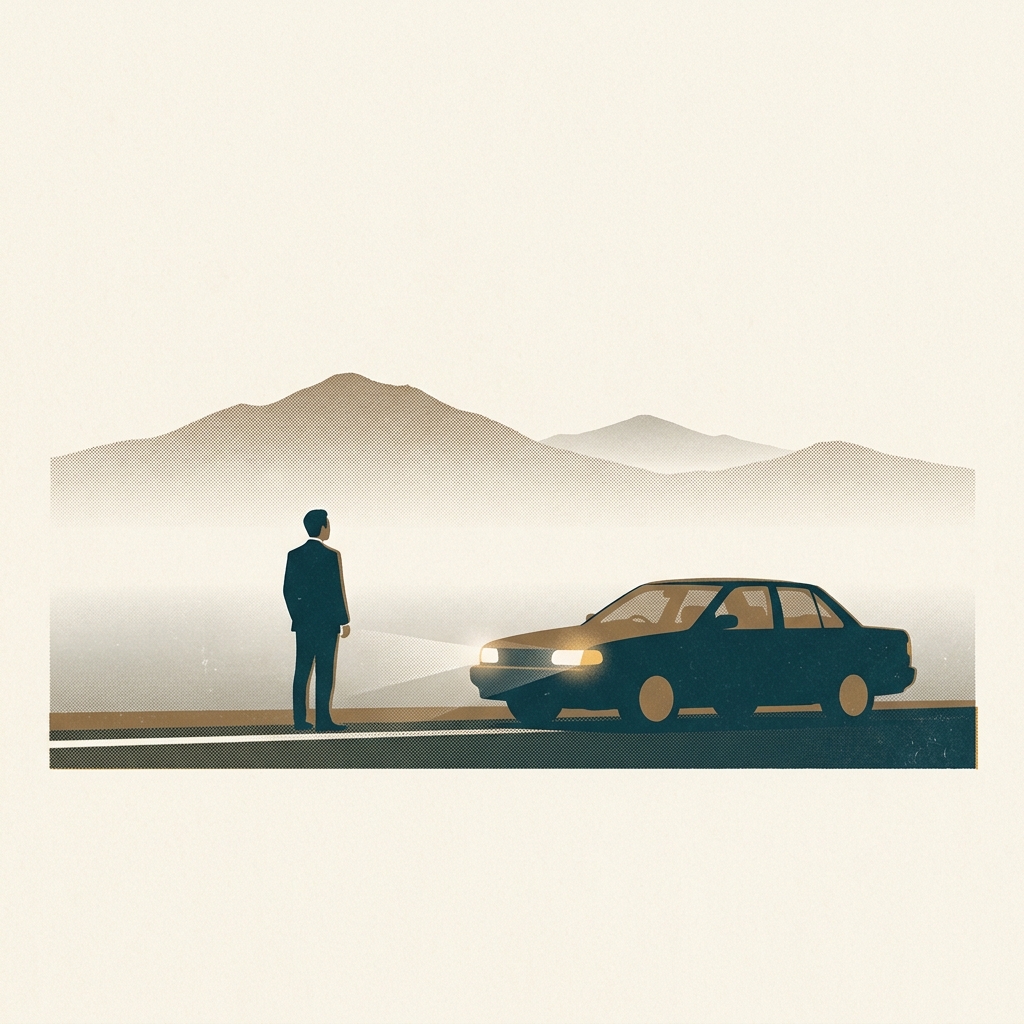
On a Friday afternoon in October 1997, Gunpei Yokoi left his small office and said something to a young colleague on his way out. 'I'm going golfing tomorrow,' he said. He sounded happy. He was fifty-six years old.
Thirty-two years earlier, Yokoi had arrived at Nintendo by something close to accident. It was 1965, and the major electronics firms had turned him down. He graduated from Doshisha University with a degree in electrical engineering, but the big companies were not interested. So he walked into a small Kyoto playing-card manufacturer he could commute to from home and was hired as a maintenance worker. His job was to keep the hanafuda production lines running.
The work was not glamorous. He repaired machines and kept things moving. But Yokoi had always made things with his hands out of habit, and in the quiet hours between tasks, he built a small toy — a lattice of plastic that stretched and contracted, extending a grip across a room. He was just passing the time. He did not think anyone was watching.
Nintendo's president, Hiroshi Yamauchi, walked past and saw it. That toy became the Ultra Hand, sold across Japan in 1966. More than a million units. Yokoi was no longer a maintenance worker. He was now, in some sense, a product designer — though Nintendo had no such job title at the time and no real playbook for what came next.

What came next was thirty years of work. The Love Tester. The Beam Gun series. Game and Watch, one of the first portable gaming devices many children ever held, which also introduced the cross-shaped directional pad that would define game controllers for decades. He supervised Donkey Kong and, through it, introduced a young designer named Shigeru Miyamoto to the world. He oversaw Metroid and Kid Icarus. And in 1989, the Game Boy — a grey, thick, battery-hungry machine with a blurry screen that critics called underpowered the day it launched. It sold over one hundred million units over its lifetime.
In 1995, he released the Virtual Boy. It was meant to show something new — a portable system of true three-dimensional depth, played with red light against darkness. Players complained of headaches. Sales were poor. It was discontinued in Japan after about half a year. In his own words, published in a 1996 interview, Yokoi said he had intended to leave Nintendo around the age of fifty-five regardless. He said there was no ill feeling toward the company or toward anyone there. Whether his departure and the Virtual Boy's failure were connected is something sources describe differently, and he himself did not confirm a direct link.

On August 15, 1996, Yokoi left Nintendo after thirty-one years. He founded a small company called Koto the same year. With Bandai, he began designing a new handheld system — something thin and horizontal, built on simple technology, targeted at the Japanese market. The project was moving forward. There was still work to do.
On October 4, 1997, the car Yokoi was riding in — driven by an acquaintance — was involved in a collision on the Hokuriku Expressway in Ishikawa Prefecture. The car had struck a light truck. Yokoi stepped out to help move the truck. A following vehicle struck him. He was taken to Komatsu City Hospital. He died that evening, around two hours after arriving. The cause was traumatic shock. He was fifty-six years old.
The Wonderswan was released on March 4, 1999. Yokoi did not see it. The last game he worked on was a puzzle game for that system, built from rising panels of diagonal lines that needed to be connected. The game was called GUNPEY. The name came from his own.