designer
Gunpei Yokoi
横井軍平
Don't wait for better tools. Make what's already in your hand say something.
About
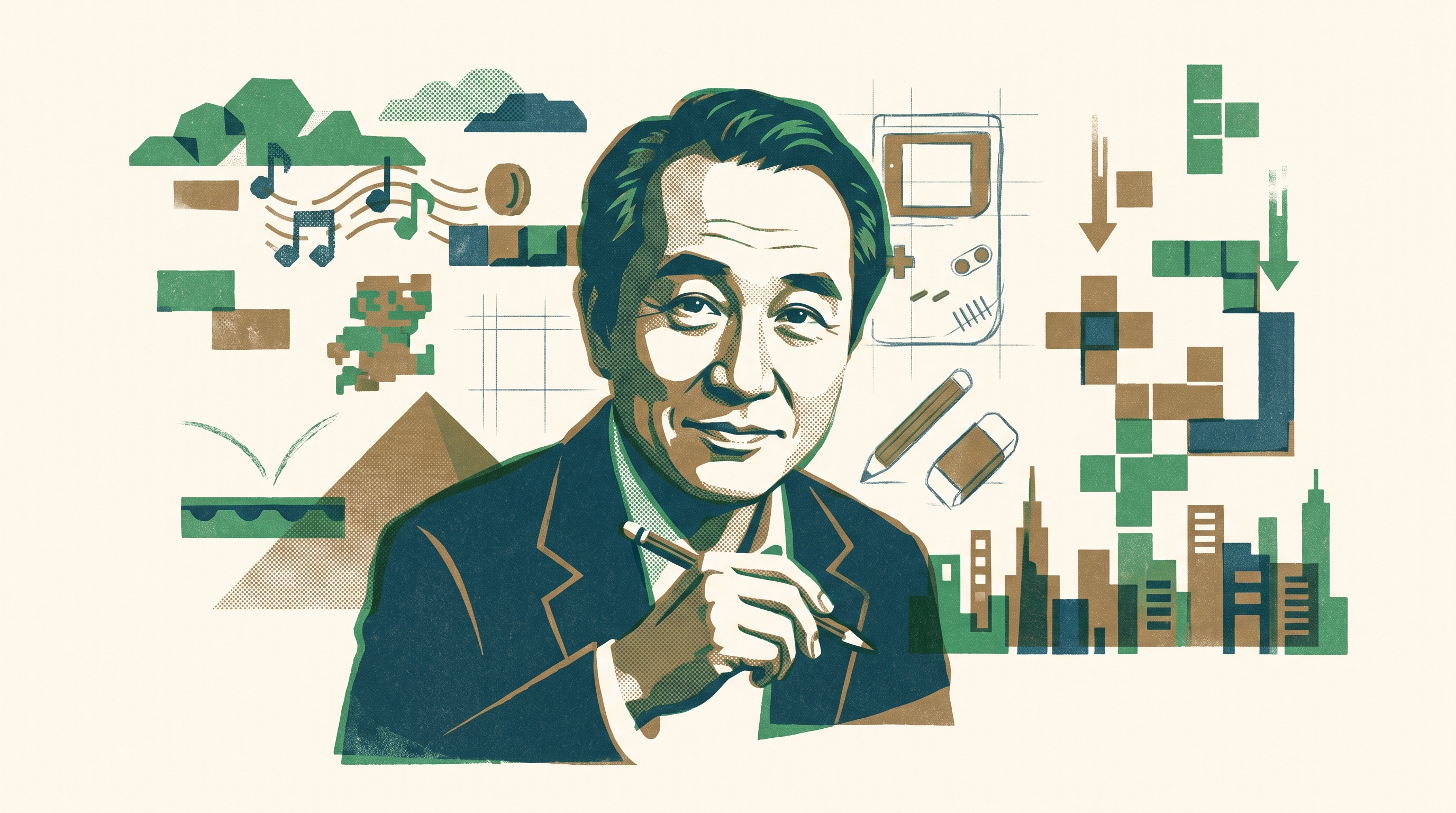
Gunpei Yokoi (1941–1997) was a game designer and hardware engineer at Nintendo's Research & Development 1 division. He created the Game & Watch handheld series (1980), designed the original Game Boy (1989) and the Virtual Boy (1995), and co-created the Metroid series. His guiding philosophy — "lateral thinking with withered technology" — held that mature, affordable technology applied creatively produces more enduring products than raw performance. He left Nintendo in 1996 and founded Koto Laboratory. He died in 1997 in a traffic accident.
History
Gunpei Yokoi was born on September 10, 1941, in Kyoto City, Kyoto Prefecture. He studied electrical engineering at Doshisha University, graduating in 1965 — but his academic record was not strong enough to secure a position at any of the large consumer electronics companies he applied to. All of them rejected him. It was a quiet, almost accidental turn that shaped the course of gaming history: the one employer that said yes was Nintendo, a playing-card company that had recently begun experimenting with toys, located conveniently close to his home. Yokoi joined as a maintenance engineer, responsible for the electrical equipment and assembly-line machinery on the factory floor. He was not hired to invent anything.
The invention came anyway. During slow hours at the factory, Yokoi built himself a small toy — an extending mechanical arm with accordion-like joints that could reach across a room to pick up objects. One day in 1966, Nintendo president Hiroshi Yamauchi walked through the factory floor, spotted the contraption, and issued a direct order: put it into production. The Ultra Hand went on sale in 1967 and sold over one million units. Yokoi was transferred out of maintenance and into product development, a man who had stumbled through the wrong door and found exactly the room he was supposed to be in. The lesson embedded in that origin story — that the act of tinkering, without any commercial purpose in mind, is itself a form of research — would structure every major invention that followed.
In 1969, Yokoi released the Love Tester, a toy that repurposed a galvanometer — a sensitive electrical current meter ordinarily used in laboratory equipment — as a party device that measured 'romantic compatibility' between two people holding its electrodes. It was nonsense science and perfect product design: a mature, inexpensive instrument transplanted from one world into another. This habit of mind — taking technology that engineers had already perfected and solved, and asking what else it could do — became the core of Yokoi's creative method. He eventually gave it a name: 'lateral thinking with withered technology.' Withered, or 'kareru' in Japanese, referred to technology that had aged past its novelty, shed its premium price, and settled into a kind of dependable, affordable maturity. Yokoi believed that this was not the end of a technology's useful life. It was the beginning of its most interesting chapter.
The clearest demonstration of the method came from a train ride. On a bullet train in the late 1970s, Yokoi watched a businessman idly pressing the buttons of a pocket calculator to pass the time. The image did not leave him. He reasoned that people wanted something small enough to carry, engaging enough to play with anywhere, and powered by something reliable. Working in Nintendo's Research & Development 1 division, which he headed from 1978 onward, he combined the calculator's LCD display technology with a simple electronic game format and built the Game & Watch. The first unit, Ball, went on sale on April 28, 1980. The series ran for twelve years and sold a cumulative 43.4 million units worldwide. The d-pad — the cross-shaped directional controller that Yokoi invented for the Game & Watch's Donkey Kong edition — was quietly one of the most consequential pieces of industrial design of the twentieth century, later standardized across the Famicom, the Game Boy, and nearly every gamepad that followed.
In 1981, when Nintendo of America needed a new arcade title to rescue a warehouse full of unsold Radar Scope cabinets, Yokoi made a decision that reveals more about his character than any invention. He looked at the problem and concluded that the best person for the job was not a hardware engineer but a young artist in the planning department named Shigeru Miyamoto. 'If we let someone from the software side make it,' Yokoi reasoned, 'something new will come out of it.' Miyamoto had never designed a video game. The resulting game was Donkey Kong. Yokoi's willingness to pass the torch — to see a talent he had not produced and put it where it could do the most good — defined his relationship with the generation of designers who came after him, and seeded the creative culture that Nintendo still draws from today.
Yokoi's most celebrated hardware was the Game Boy, released in Japan on April 21, 1989. He chose a monochrome LCD screen and standard AA batteries when competitors were moving toward color displays and rechargeable power. The Sega Game Gear, launched the following year, offered a color screen and a backlit display. It also drained six AA batteries in roughly three to five hours. The Game Boy ran for approximately thirty-five hours on four AA batteries. 'Color is a concept you can perceive,' Yokoi once explained. 'If you draw a snowman on a blackboard in chalk, everyone sees it as white.' He was not arguing that color was unimportant. He was arguing that the game, not the screen, was the product. The Game Boy and its successor models sold a combined 118.69 million units worldwide. Tetris, bundled with the system, became the single best-selling Game Boy title of all time. Yokoi had built the world's living room out of parts that everyone else had already moved past.
The Virtual Boy, released in Japan on July 21, 1995, did not work the same way. It was Yokoi's attempt to deliver stereoscopic 3D without the cost of true VR hardware, using a pair of red LED arrays and a parallax-barrier display mounted in a tabletop visor. The concept was audacious and the execution was uncomfortable: the red-on-black visuals caused eye strain, the hardware required a stand to use, and the library of games was thin. It sold approximately 770,000 units worldwide against a target of three million. At the product launch, Yokoi reportedly murmured to a colleague: 'This is nerve-wracking…' He was right. In August 1996, he left Nintendo. In the magazine Bungei Shunju, published in November of that year, he was explicit: 'I did not, in reality, resign to take responsibility for the failure of Virtual Boy. I had been thinking for a long time about becoming independent once I turned fifty-five.' He added: 'Nintendo is both the parent that raised me and the homeland of my creative spirit.' There was no bitterness in the words. There was only the honest accounting of a man who had decided, at fifty-four, that there was more he still wanted to build.
After leaving Nintendo, Yokoi founded Koto Laboratory (株式会社コト) and entered a partnership with Bandai to develop a new handheld game system. The project became the WonderSwan — a monochrome, battery-efficient portable that would launch in 1999. He was also working on a puzzle game called GUNPEY, its title a phonetic play on his own name. He did not live to see either product reach the public. On October 4, 1997, Yokoi was involved in a traffic collision on the Hokuriku Expressway. After stepping out of the vehicle, he was struck by a passing car and died from traumatic shock. He was fifty-six years old. WonderSwan launched in March 1999. GUNPEY was released later that same year — a small, elegant game whose name would always carry its maker's signature. What Yokoi left behind is not simply a list of successful products. It is a method: look at the tools you already have, not the tools you wish you had; ask not what is impressive, but what is necessary; and trust that a mature technology, released into the right hands with the right question, still has one more extraordinary life ahead of it.
Timeline & Works
Career milestones and all 13 games in the museum they worked on — in the order they happened.
- 1941 09
Gunpei Yokoi born in Kyoto City
Gunpei Yokoi is born on September 10, 1941, in Kyoto City, Kyoto Prefecture.
people - 1965
Joins Nintendo as maintenance engineer
After graduating from Doshisha University (electrical engineering) and failing to secure positions at major electronics firms, Yokoi joins Nintendo as an electrical maintenance engineer responsible for factory equipment. He is not hired to develop products.
people - 1967
Ultra Hand released — over one million units sold
Yokoi's self-built extending mechanical arm toy, assembled during idle hours on the factory floor, is discovered by president Hiroshi Yamauchi and ordered into production. The Ultra Hand sells over one million units and earns Yokoi a transfer into product development.
product - 1969
Love Tester released — galvanometer repurposed as party toy
Yokoi releases the Love Tester, which repurposes a laboratory galvanometer as a device that measures "romantic compatibility" between two people. The product demonstrates his core method: taking mature, proven technology and applying it to an entirely new context.
product - 1978
Appointed head of Research & Development 1 (R&D1)
Yokoi is appointed head of Nintendo's Research & Development 1 division, formalizing his leadership of the hardware and handheld development team that would create the Game & Watch and, later, the Game Boy.
leadership - 1980 04
Game & Watch "Ball" launches — handheld gaming begins
Game & Watch "Ball" goes on sale on April 28, 1980, inspired by Yokoi's observation of a businessman pressing calculator buttons on a bullet train. The series runs for twelve years and sells 43.4 million units worldwide. Yokoi also invents the d-pad directional controller in this era, later standardized across all Nintendo platforms.
hardware - 1981
Recommends Shigeru Miyamoto for Donkey Kong
When Nintendo of America needs a new arcade game to replace unsold Radar Scope cabinets, Yokoi recommends the young designer Shigeru Miyamoto — who had never created a game — reasoning that a fresh perspective would produce something new. The result is Donkey Kong.
people - 1983
- 1983
- 1986
- 1989 04
Game Boy released in Japan
Game Boy launches in Japan on April 21, 1989. Yokoi chooses a monochrome LCD screen and standard AA batteries over color displays favored by rivals, prioritizing battery life — approximately thirty-five hours versus the three to five of the color Game Gear. The Game Boy and its successor models sell a combined 118.69 million units worldwide.
hardware - 1989
- 1989
- 1990
- 1990
- 1990
- 1990
- 1991
- 1991
- 1992
- 1995 07
Virtual Boy released in Japan
Virtual Boy launches in Japan on July 21, 1995. The stereoscopic 3D tabletop headset sells approximately 770,000 units worldwide against a target of three million, due to eye strain, an awkward form factor, and a thin software library. Yokoi reportedly murmured at the product launch: "This is terrifying."
hardware - 1996 08
Leaves Nintendo; founds Koto Laboratory
Yokoi leaves Nintendo in August 1996 and founds Koto Laboratory. In the November 1996 issue of Bungei Shunju, he states that he did not resign to take responsibility for the Virtual Boy — he had long planned to become independent at age fifty-five. He describes Nintendo as "both the parent that raised me and the homeland of my creative spirit."
milestone - 1997 10
Gunpei Yokoi passes away, aged 56
On October 4, 1997, Yokoi is involved in a traffic collision on the Hokuriku Expressway. After stepping out of the vehicle, he is struck by a passing car and dies from traumatic shock at the age of fifty-six. He was in the middle of developing WonderSwan and the puzzle game GUNPEY.
people - 1999
WonderSwan and GUNPEY released posthumously
WonderSwan, the monochrome handheld Yokoi developed in partnership with Bandai, launches in March 1999. The puzzle game GUNPEY — its title a phonetic play on Yokoi's given name — is released later the same year, carrying its creator's signature in every copy sold.
product
Also worked on (release year to be confirmed)
Connections
- employed nintendo (1965–1996)
Yokoi joined Nintendo in 1965 as a maintenance engineer and rose to head Research & Development 1, the division responsible for the Game & Watch, Game Boy, and Virtual Boy. He left in August 1996 after thirty-one years.
- collaborated with shigeru-miyamoto (1977–1996)
Yokoi recognized Miyamoto's talent when the young designer joined Nintendo in 1977 and recommended him for the Donkey Kong project in 1981. Their collaboration defined the foundational design culture of Nintendo's most important creative era.
- collaborated with hiroshi-yamauchi (1965–present)
Hiroshi Yamauchi pulled Yokoi off the factory floor — where he was a maintenance engineer — after noticing a toy he had made in his spare time, the Ultra Hand. It was Yamauchi's instinct for talent over credentials that set Yokoi's career in motion.
- collaborated with genyo-takeda (1972–present)
Takeda consulted Yokoi before joining Nintendo in 1972, and the two built the company's earliest electronic hardware — light-gun and arcade systems — side by side.
Also connected to
- Hirokazu Tanaka co-created Balloon Kid / co-created Dr. Mario / co-created Dr. Mario / co-created Dr. Mario / co-created Metroid / co-created Super Mario Land / co-created Tetris / same employer (Nintendo, 1980–1996)
- Yoshio Sakamoto co-created Balloon Kid / co-created Metroid / same employer (Nintendo, 1982–1996) / same employer (Nintendo R&D1, 1982–1996)
- Satoru Iwata co-created Super Mario Land / co-created Tetris
- Hiroji Kiyotake co-created Metroid / same employer (Nintendo R&D1, 1983–1996)
Explore the work
Each title has its own page — history, trivia, and collector's notes.
Game Boy · 1992
Super Mario Land 2: 6 Golden Coins
They were tired of fighting for someone else's hero — so they built a villain, a…
Game Boy · 1991
Metroid II: Return of Samus
They could show you so little — so they put the darkness to work.…
Game Boy · 1991
Kid Icarus: Of Myths and Monsters
The forgotten wing that kept the flame alive.…
Game Boy · 1990
Dr. Mario
He built the instrument, then wrote the music — and the constraints became the v…
Game Boy · 1990
Solar Striker
They built it quietly, on someone else's hardware, and it worked.…
Family Computer (Famicom) / NES · 1990
Dr. Mario
Mario had been a carpenter, a plumber, and a referee. In 1990, Nintendo made him…
Rooms their games live in
Sources
- 横井軍平 — Wikipedia(日本語) — accessed 2026-05-29
- Gunpei Yokoi — Wikipedia (English) — accessed 2026-05-29
- 「私はなぜ任天堂を辞めたか」横井軍平(文藝春秋1996年11月号) — 文春オンライン — accessed 2026-05-29
- 株式会社コト 横井軍平について — accessed 2026-05-29
- 社長が訊く「ゲーム&ウォッチ」Vol.1 — Nintendo — accessed 2026-05-29
- 横井軍平インタビュー・関連記事 — 4Gamer.net — accessed 2026-05-29
From the Museum's Screening Room
Yokoi Game Boy The Gray Screen That Won — Feature
Yokoi Gameboy The Machine He Never Finished — Feature