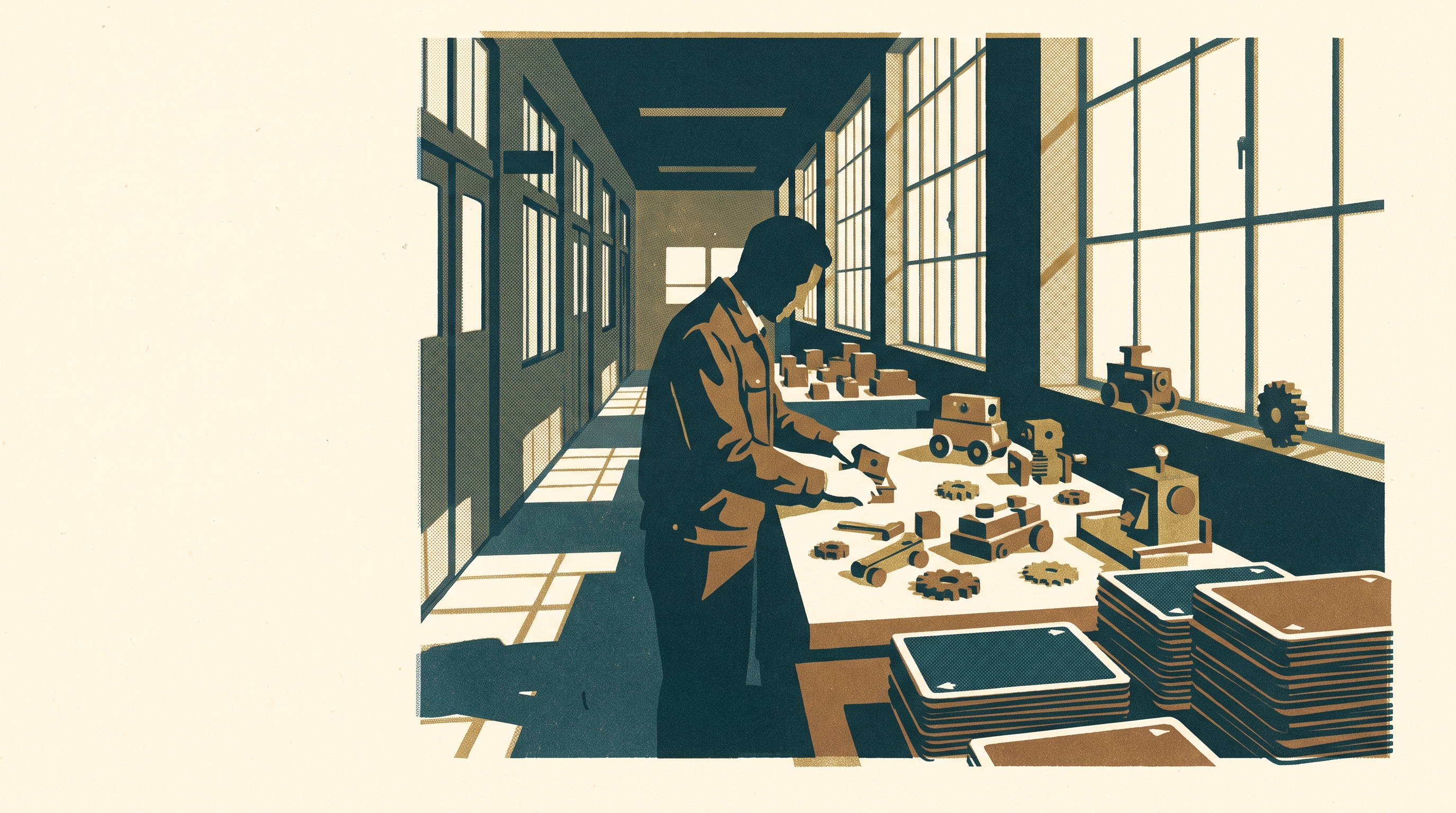
In 1964, Nintendo was the largest playing card company in Japan. It had held that position for decades. But playing cards had a ceiling. The market was saturated. Sales were plateauing. Hiroshi Yamauchi, the third-generation president who had taken over the company at age twenty-two after his grandfather's sudden retirement, saw the writing on the wall. If Nintendo stayed a playing card company, it would slowly wither. He began looking for other businesses.
He tried instant rice. The packages sat on store shelves for months and were eventually pulled. The rice venture lost money. He tried opening a love hotel with hourly rentals. That too was unprofitable. He launched a taxi company called Daiya. It survived a few years and closed. He tried everything from vacuum cleaners to a baby carriage rental service. Almost all of them failed. By the late 1960s, Nintendo was financially stable from its playing card sales, but strategically adrift. Each failure narrowed the window for another attempt.
In 1965, a young man named Gunpei Yokoi joined Nintendo as a maintenance engineer. He had graduated from Doshisha University with a degree in electrical engineering, but the major electronics firms had turned him down during recruitment season. Nintendo offered him a job maintaining the hanafuda production lines. It was not glamorous work. His job was to keep machines running and fix what broke. But Yokoi had a habit of making things when his hands were idle.
One afternoon in late 1965 or early 1966, Yokoi built something in a factory hallway. It was a simple toy — a lattice of plastic that could extend and contract like an accordion, with a small grip at each end. Pull it, and the arm stretched across the room. He had made it to pass the time. He did not expect anyone to notice. Yamauchi walked past and saw it.
What happened next changed the company. Instead of dismissing it as a distraction, Yamauchi asked Yokoi to turn it into a product. It was manufactured and released in late 1966 under the name Ultra Hand. The toy became a hit during the 1966–1967 holiday season. Over one million units sold. Yokoi was moved out of maintenance and into product development — a role that did not formally exist at Nintendo before that moment.
The Ultra Hand did not save Nintendo financially; the playing card business still paid the bills. But it proved something else. It showed that a small idea, built quickly from cheap parts, could move a million units if it had the right shape. This was not a strategy that required large capital or infrastructure. It was a strategy of noticing — of seeing what someone made for fun and asking: could this sell? Yamauchi began developing other toys under Yokoi's direction. The Love Tester followed. The Ten Billion Barrel puzzle followed. Nintendo slowly became a toy company.
But the 1973 oil crisis struck Japan hard. Bowling alleys across the country shut down, which killed Nintendo's laser shooting range business overnight. The toy ventures stumbled. The company nearly collapsed under debt. Yamauchi later recalled that period as one where the company was on the verge of dissolution. But the toy division, and the habit of iterating quickly on small, clever ideas, had already taken root. When the economy recovered, Nintendo pivoted again — this time toward electronic games.
The Ultra Hand itself was eventually discontinued. But the person who made it stayed. Yokoi went on to design Game & Watch, the cross-shaped directional pad that would define controllers for decades, and the Game Boy, which sold over one hundred million units in its lifetime. Yamauchi stayed on as president until 2002. The playing card company that nearly died in the 1960s became the company that defined the grammar of play for two generations. That hallway toy was where the path bent.
This is the chapter Nintendo does not tell often. There was no master plan in 1965. There were failed ventures, mounting pressure, and a maintenance engineer with idle hands. The question the story leaves is not whether you can see opportunity when it appears. It is whether you will notice it before the window closes — and whether you can tell the difference between a distraction and the thing that will save you.