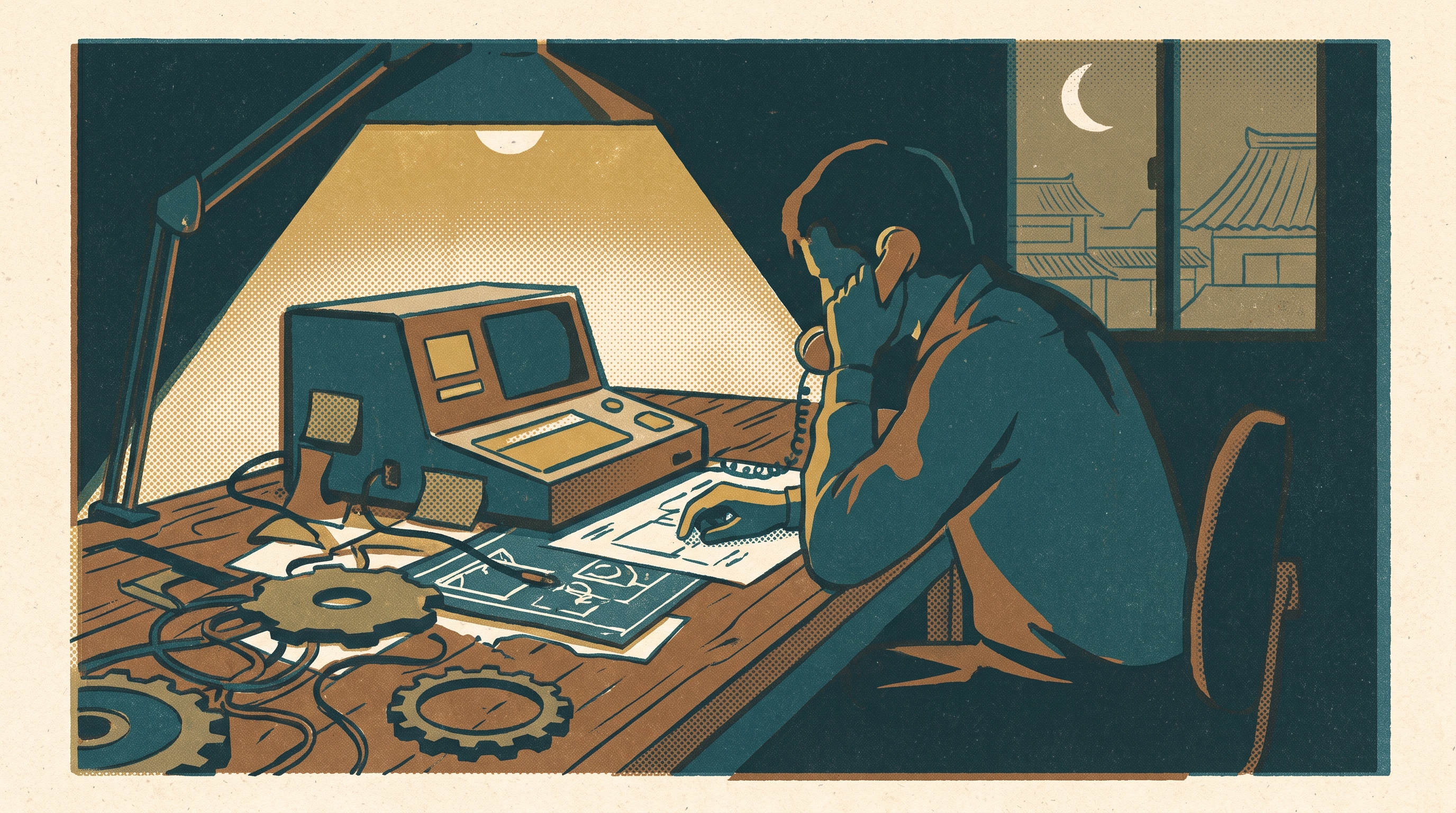
The phone rang one evening in November 1981. Masayuki Uemura picked it up and heard his president's voice. Hiroshi Yamauchi did not spend time on pleasantries. He said: make a machine that can play our arcade games at home. Use cartridges so people can swap the games. Price it so cheap that no competitor can follow for a year.
Uemura had been an engineer at Nintendo since 1971, brought over from Sharp where he had worked on photocell technology. He was not a game designer. He built the boxes games lived in. For the past few years he had led the Color TV-Game line — simple dedicated consoles with games built directly into the circuit board. This new request was different. A machine that could play any game, as long as you could fit it on a cartridge. And it had to cost almost nothing.
The problem was not the technology. The problem was the price. To hit Yamauchi's target, every part had to be questioned. Could you make it smaller? Could you make it cheaper? Could you remove it entirely? Uemura's team began stripping things out before they had even finished designing them in.
They found a partner in Ricoh, whose semiconductor plant in Ikeda had spare capacity and an engineer named Masashi Kawaguchi who had helped Nintendo before. Together they designed custom chips — a single processor that handled both the game logic and the graphics, built cheaply in volume. No separate graphics card. No separate sound chip beyond what could be squeezed onto the main processor. Every luxury was a question: do we need this, or do we just want it?
The controller that shipped with the Famicom had a cross-shaped directional pad designed by Gunpei Yokoi years earlier, and two buttons. Not three. Not four. Two. The casing was red and white plastic, simple injection-molded shells with no ornamentation. The whole machine was an exercise in knowing what you could throw away and still have something left that worked.
On July 15, 1983, the Family Computer went on sale for 14,800 yen. Its competitors were asking 20,000 to 30,000. The first production run carried a faulty chip that could freeze the machine, and Nintendo had to recall and repair units after launch. Uemura led the response. The machine survived. It sold two and a half million units in Japan by the end of 1984. By the time it reached America as the Nintendo Entertainment System in 1985, it had become the floor the entire industry would stand on for the next decade.
Uemura did not stop there. In 1988 he began work on the Super Famicom, released in 1990 — a more powerful machine, but built on the same philosophy: find out what people actually need, then give them that and nothing else. He retired from Nintendo in 2004, joined Ritsumeikan University as a professor, and in 2011 founded its Center for Game Studies. He spent his final years asking what the thing he had built had meant to the people who grew up with it. He died on December 6, 2021, at the age of seventy-eight.
The machine he designed was built by cutting away everything that could be cut. What remained was something cheap enough that a whole generation could hold it. The question the work leaves behind is not a technical one. It is this: when you are told to remove everything that is not essential, what you choose to keep — is that not the shape of what you believe people deserve?