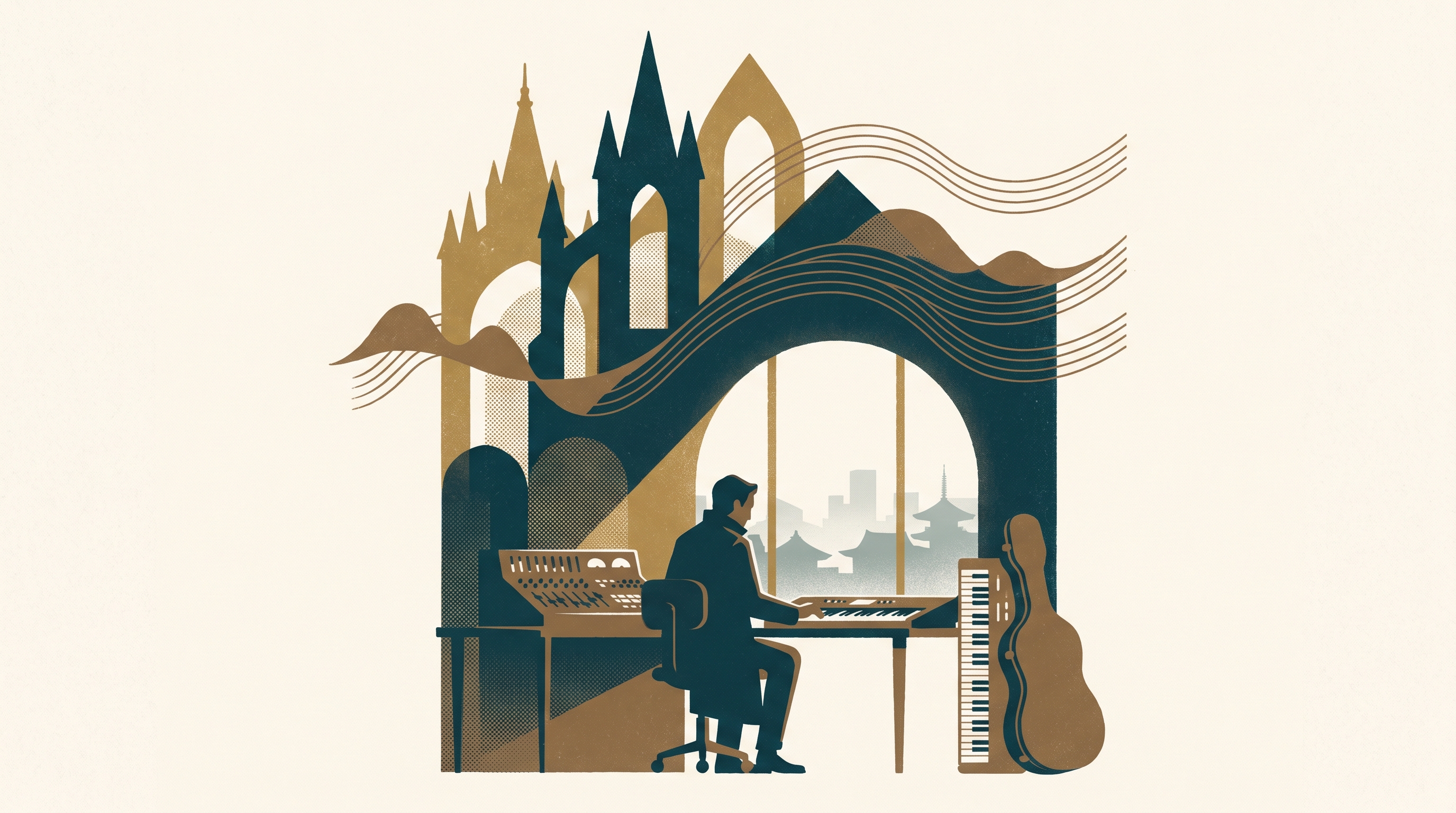
The PlayStation disc was running. Michiru Yamane watched the player character walk from the entrance hall into the castle's first corridor. The music changed — not suddenly, but the way a room's temperature changes when you cross a threshold. Baroque organ phrases gave way to something darker, more percussive. She had written both pieces. She had also written the transition that linked them, so the shift felt like crossing from one wing of a building into another rather than switching radio stations.
Yamane was born September 23, 1963, in Kagawa Prefecture. She began composing around the age of eight and studied composition at Aichi Prefectural University of the Arts, where she focused on writing for large orchestras and completed a thesis on Johann Sebastian Bach. She joined Konami in 1988, shortly before graduating. Her first assignments were the main themes for King's Valley II and Risa no Yōsei Densetsu — small projects that kept the production line moving while she learned how game music worked.
At Konami in the early 1990s, she became part of the Konami Kukeiha Club, a loose collective of in-house composers. Each composer worked on whatever project needed music that month. There was no career ladder mapped out in advance. You wrote music, the game shipped, and then you wrote more. Yamane's early Castlevania assignment was Bloodlines (1994) for the Mega Drive — a horror-action score that mixed atmospheric dread with unexpectedly lyrical passages. It worked.
When Castlevania: Symphony of the Night entered production for the PlayStation, the hardware had changed everything. The PlayStation could stream recorded audio rather than synthesizing it in real time from chip instructions. That meant Yamane could use sampled instruments — piano, strings, electric guitar — and layer them. The limitation was no longer the sound chip. The limitation was how much music she could compose before the deadline.
Symphony of the Night's castle was not a single environment. It was an architecture of different atmospheres — underground caverns, a marble gallery, a library, an inverted cathedral. Yamane decided that each area should have its own musical register. The library felt baroque. The caverns needed something primal and percussive. The outer wall, where rain fell, asked for something closer to metal. She did not try to unify them into a single style. She let each space speak in the voice that fit it.

The result was a score that did not sound like one composer's work. It sounded like a castle that had been inhabited and remodeled across centuries, each wing retaining the character of whoever had lived there. Players noticed. The music did not just accompany the exploration — it was part of what made the castle feel like a real place with a history.
After Symphony of the Night, Yamane continued composing for Konami's games — more Castlevania titles, the Suikoden RPG series, smaller projects. She left Konami in 2008 to work independently. When Koji Igarashi launched Bloodstained: Ritual of the Night more than a decade later, he brought Yamane back to compose the score. It was a reunion of the creative team most associated with Symphony of the Night, and the sound they produced together still drew the same audience.
There is a philosophy embedded in Yamane's approach to Symphony of the Night — not stated in interviews, but audible in the work itself. A place is not one thing. It is a collection of spaces, each with its own character, and the music should honor that. Consistency is not the same as uniformity. A building that has been lived in for a long time will carry many voices.