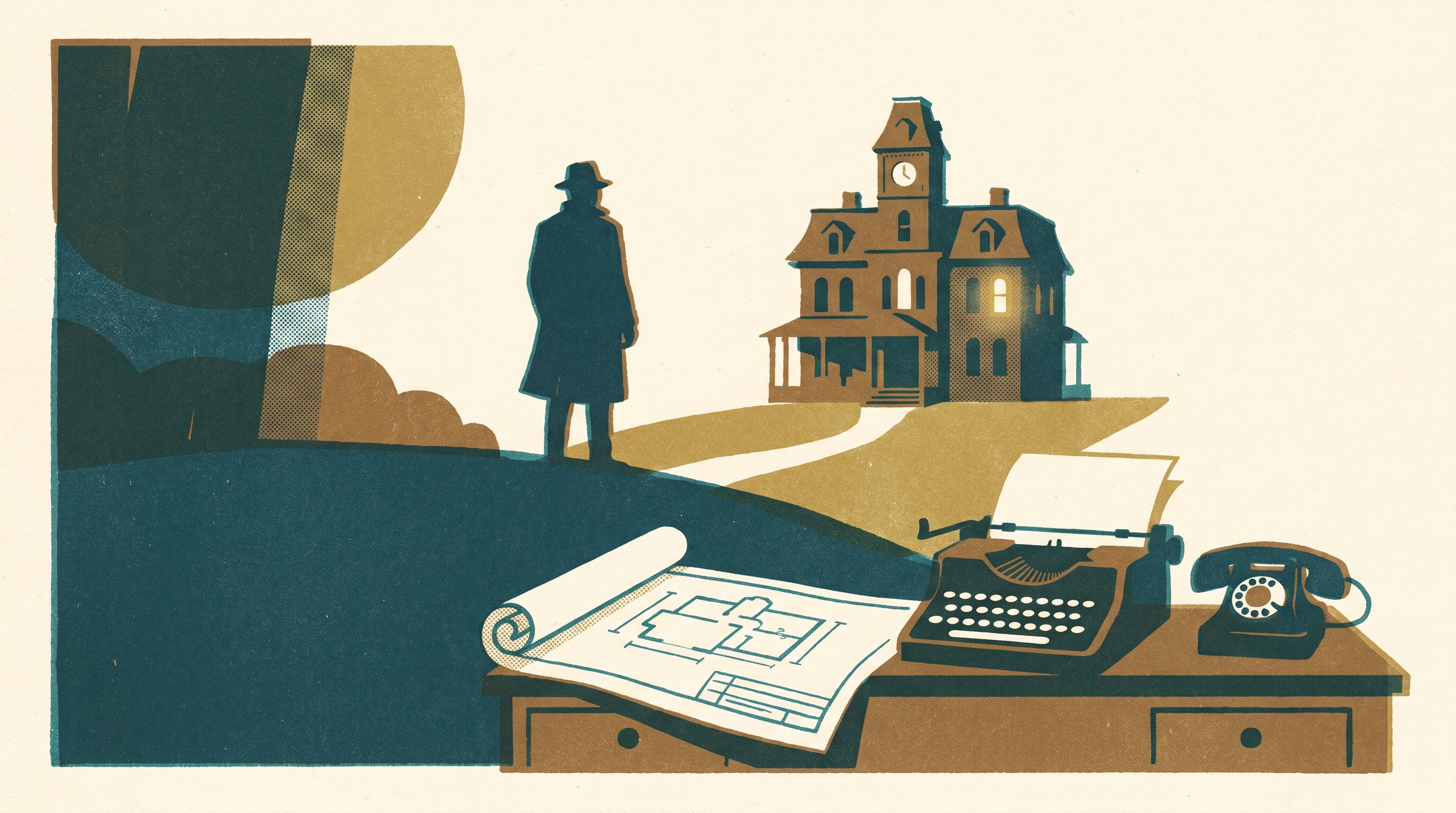
In 1993, producer Tokuro Fujiwara at Capcom's Osaka studio called in a young director named Shinji Mikami and asked him to make a horror game. Fujiwara had directed Sweet Home, a 1989 Famicom game set in a haunted mansion, and wanted to revisit that structure on newer hardware. Fujiwara asked Mikami if he liked horror. Mikami replied that he did not care for being scared. Fujiwara said that made Mikami exactly the right person for the job. 'People who aren't afraid of anything don't understand what's frightening,' Fujiwara explained later. 'You can't make a horror game if you don't have any fear.' Mikami accepted the assignment.
Mikami spent the first six months alone. No team, no schedule, just six months to figure out what the game would be. He mapped the structure of a mansion and designed systems — limited ammunition, limited saves, fixed camera angles that hid the next corner. He worked from films he had watched. He admired George Romero's Dawn of the Dead for its structure and pacing. He remembered Lucio Fulci's Zombi 2, a 1979 Italian horror film full of gore and decay but lacking in design — a film that showed him what not to do. Mikami wanted something built with care, not spectacle. After six months, the foundation was clear. The team began to form around it.
Development ran for twenty-seven months in total. About fifty people joined, most of them new to Capcom. Mikami directed all of it. The game was called Biohazard in Japan and Resident Evil internationally, and it released for PlayStation on March 22, 1996. The premise was simple: a special police unit investigates murders in the woods outside Raccoon City and becomes trapped in a mansion filled with biological experiments gone wrong. The player carried a pistol with seven bullets. Every bullet mattered. Every save cost an ink ribbon. The camera never followed the player — it watched from a fixed angle, and the player had to imagine what waited beyond the frame.
The game coined the term 'survival horror' through its marketing, and the genre carried that name forward. Critics praised the atmosphere, the tension, and the careful rationing of resources. Resident Evil became a phenomenon. It launched a franchise that would span decades and establish templates that dozens of games would follow. But the success was not immediate revelation — it was the result of what Mikami had built in those first six months alone, when he had no team to consult and no precedent to copy. He had to look at horror from the outside, as structure rather than sensation, and build a house that carried its weight in silence.
Mikami later directed Resident Evil 4 in 2005, which stripped away the fixed cameras and slow pacing in favor of faster, more aggressive combat. It was one of the finest action games ever made, and it proved that a series could abandon its founding mechanics entirely and still carry its identity forward. He left Capcom, co-founded Tango Gameworks, and returned to survival horror with The Evil Within in 2014. The genre he named still carries his mark, but the mark is not in the trappings — it is in the understanding that fear is not about what the player sees, but about what they know they cannot afford to lose.
The philosophy Mikami learned from his mentor, producer Yoshiki Okamoto, was blunt: a single flaw in a game will stand out above ten virtues, so remove every flaw. This is not perfectionism for its own sake but a recognition that players do not average their experience — they remember what hurt. Mikami's best work is defined not by what it added but by what it stripped away. The mansion on the hill was not built to impress. It was built to hold weight. And it has held that weight for nearly thirty years.
In 1993, a young director who disliked being scared was handed a project he did not ask for. He spent six months alone with a blank page and a question: what is horror when you understand it from the outside? The answer was a mansion with seven bullets, a fixed camera, and a hallway that never quite showed what was waiting at the end. The house on the hill is still standing. And it is still silent.