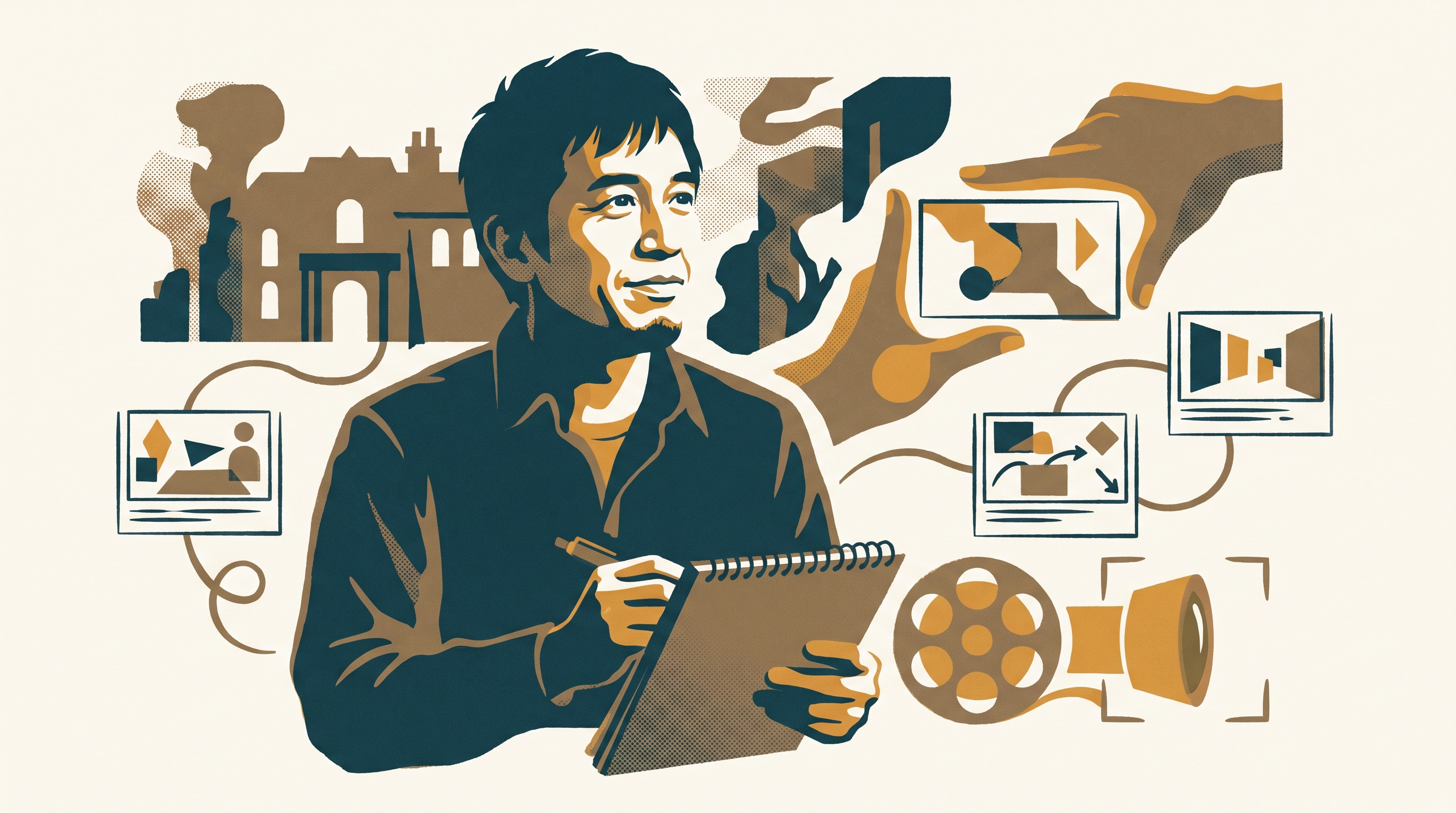
director
Shinji Mikami
三上真司
Remove every flaw before showing ten virtues — polish is the only difference between vision and noise.
About
Shinji Mikami is a Japanese game designer and director. He joined Capcom in 1990 and directed Resident Evil (Biohazard, 1996) for PlayStation — a game that coined the term "survival horror" and launched one of gaming's most enduring franchises. He later directed Resident Evil 4 (2005), widely regarded as one of the finest action games ever made. Mikami left Capcom in 2007 and co-founded Tango Gameworks in 2010, a subsidiary of Bethesda Softworks.
History
Shinji Mikami was born on August 11, 1965, in Iwakuni, a coastal city in Yamaguchi Prefecture. He enrolled at Doshisha University in Kyoto after two years of study following high school, and while there he spent much of his energy on Chinese martial arts rather than coursework. He graduated in 1990 with a degree in commerce — a subject with no obvious connection to video games. When he attended Capcom's recruitment session that year, it was the personality of president Kenzo Tsujimoto that pulled him in. Tsujimoto spoke in grand, sweeping terms about the future of entertainment. Mikami joined not because he loved games, but because the company felt like a place where someone could build something large.
His earliest assignments at Capcom were modest. He worked on Capcom Quiz: Quiz & Dragons, a trivia arcade game, and then moved to licensed Disney titles: Who Framed Roger Rabbit for Game Boy, followed by Aladdin and Goof Troop for Super Nintendo. Aladdin became his first commercial success, selling over 1.75 million units worldwide. These were competent projects, but they were also assignments — work handed down rather than chosen. What changed Mikami's trajectory was not ambition but circumstance. In 1993, producer Tokuro Fujiwara called him in to discuss a new project: a horror game inspired by Fujiwara's own 1989 Famicom title Sweet Home, which had combined adventure gameplay with survival mechanics in a haunted mansion. Fujiwara wanted to revisit that structure on more capable hardware. He chose Mikami to direct it, in part because Mikami had said plainly that he hated being scared. Fujiwara believed that someone who understood fear from the outside — who could see its architecture rather than simply feel it — would know how to build it.
Mikami spent the first six months of development alone, structuring the game's systems and spaces before hiring a team. By the time production scaled up, around fifty people were working on the project, most of them newcomers to Capcom. Development ran for two years and three months. The game they built was called Biohazard in Japan and Resident Evil internationally, and it released on March 22, 1996, for PlayStation. The premise was spare: a team of special police officers investigates a series of murders in a forest outside Raccoon City and becomes trapped inside a mansion filled with the results of biological experiments gone wrong. The player had limited ammunition, limited saves, and fixed camera angles that often hid what was around the next corner. Mikami later said that Resident Evil was partly a response to his disappointment with Zombi 2, a 1979 Italian horror film by Lucio Fulci — a film full of gore but lacking structure. Mikami wanted to build something with none of that film's failings: a horror experience that did not rely on spectacle but on the player's awareness of their own vulnerability.
The term 'survival horror' entered the lexicon through Resident Evil's marketing. The game became a phenomenon, establishing a template that dozens of games would follow. Mikami directed Resident Evil 2 in concept but handed the project to others midway; he returned to direct the 2002 GameCube remake of the original, which refined every system and visual element into what many still consider the definitive version. Then came Resident Evil 4 in 2005. It was not a refinement but a reinvention. The fixed cameras were gone. The slow, defensive gameplay gave way to fast, aggressive combat. The player could aim and shoot in real time. Critics called it one of the finest action games ever made, and it proved that a series could abandon its founding mechanics entirely and still carry its identity forward. Mikami had taken the thing he was best known for and rebuilt it from first principles.
In 2004, Mikami moved to Clover Studio, a Capcom subsidiary, to direct God Hand, a beat-em-up action game released in 2006. Capcom dissolved Clover in March 2007, and Mikami left the company that year, joining the newly formed PlatinumGames alongside his Clover colleagues. In 2010 he co-founded Tango Gameworks in Tokyo with a team of twelve developers. The studio was acquired by ZeniMax Media (parent company of Bethesda Softworks) later that year after facing financial difficulties. Mikami accepted the acquisition because he believed Bethesda would offer the most independent creative environment for his team. At Tango, Mikami directed The Evil Within in 2014, returning to the survival horror form he had pioneered nearly two decades earlier. The game was slower, stranger, and more uneven than Resident Evil 4 — but it was unmistakably his. Mikami left Tango Gameworks in 2023. The studio was closed by Microsoft in 2024, then acquired and reopened by South Korean publisher Krafton two months later.
The philosophy Mikami absorbed from his mentor, producer Yoshiki Okamoto, was blunt: a single flaw in a game will stand out above ten virtues, so remove every flaw. This is not perfectionism for its own sake but a recognition that players do not average their experience — they remember what hurt. Mikami's best work is defined not by what it added but by what it stripped away: the slow walk through the mansion with seven bullets left, the decision to spend a precious save, the fear that comes not from what jumps out but from knowing you are too weak to fight what might. The lesson his career teaches is not that innovation requires boldness — though it does — but that it requires the willingness to discard what you have proven you can do and build again from nothing. He did it twice, once with Resident Evil 4 and once by leaving Capcom entirely. The genre he named still carries his mark, but the mark is not in the trappings — it is in the understanding that fear is not about what the player sees, but about what they know they cannot afford to lose.
In Shinji's Own Words
Real interview footage, not paraphrase. Each line links back to the exact moment in the video so you can hear it for yourself.
“I don't feel like I took another approach. For God Hand, all the staff I could work with was working on Okami.”
“Vanquish is a game that greatly changed too. At first, it was supposed to be more of a hack and slash game in a large area.”
“The first game had sort of a niche taste, it was more horror-centric than Resident Evil 2. Resident Evil 2 was the first title from Hideki Kamiya as a director, he had a great visual taste.”
“Dino Crisis wasn't a project at first. There was a team that was working on original projects.”
“For Resident Evil 3, we lowered the bar a bit and wanted to make a game for the core fans, we took more of an indie spirit to satisfy core fans. However, the company asked us to make it a numbered title.”
“And I’m like, “Wait, what?” Before The Evil Within I thought of a story about humans in the future flying off to some planet And there was this virus and a race of giants and all this stuff, and the giants eat humans Someone told me “That’s Attack on Titan!””
Timeline & Works
Career milestones and all 5 games in the museum they worked on — in the order they happened.
- 1965 08
Born in Iwakuni
Shinji Mikami was born on August 11, 1965, in Iwakuni, Yamaguchi Prefecture.
people - 1990
Joined Capcom
Graduated from Doshisha University with a degree in commerce and joined Capcom as a junior game designer.
people - 1993
Aladdin released
Directed Aladdin for Super Nintendo, Mikami's first commercial hit, selling over 1.75 million units worldwide.
product - 1993
Resident Evil project begins
Producer Tokuro Fujiwara assigned Mikami to direct a horror game inspired by Sweet Home. Mikami spent six months structuring the game alone before hiring a team of fifty.
people - 1996 03
Resident Evil released
Directed Resident Evil (Biohazard), released March 22, 1996, for PlayStation. The game coined the term 'survival horror' and became a global phenomenon.
product - 1996
- 1998
Resident Evil 2 concept direction
Served as conceptual director for Resident Evil 2 before handing the project to other directors midway through development.
product - 1998
- 1999
Dino Crisis released
Directed Dino Crisis, a survival horror game applying Resident Evil mechanics to a science fiction setting with dinosaurs.
product - 1999
- 2002
Resident Evil remake released
Directed the GameCube remake of the original Resident Evil, refining every system and visual element into what many consider the definitive version.
product - 2002
- 2004
Moved to Clover Studio
Transferred to Clover Studio, a Capcom subsidiary, to work on new projects outside the Resident Evil franchise.
people - 2005
Left Capcom
Left Capcom in November 2005, completing God Hand as a freelancer.
people - 2005 01
Resident Evil 4 released
Directed Resident Evil 4 for GameCube, a complete reinvention of the series with dynamic cameras and real-time aiming. Widely regarded as one of the finest action games ever made.
product - 2005
- 2006
God Hand released
Directed God Hand, a beat-em-up action game for PlayStation 2, Mikami's final Capcom-published title.
product - 2010 03
Co-founded Tango Gameworks
Co-founded Tango Gameworks in Tokyo with twelve developers. The studio was acquired by ZeniMax Media (Bethesda) in October 2010.
people - 2014
The Evil Within released
Directed The Evil Within (Psycho Break), returning to the survival horror genre he pioneered nearly two decades earlier.
product - 2023
Left Tango Gameworks
Departed Tango Gameworks after thirteen years as founder and creative director.
people
Connections
- employed capcom (1990–2007)
Joined Capcom in 1990 as a junior game designer and rose to become one of the company's most influential directors, creating the Resident Evil franchise.
Also connected to
- Shusaku Uchiyama co-created Resident Evil 2 / co-created Resident Evil 4 / same employer (Capcom, 1995–2007)
- Yoshiki Okamoto co-created Resident Evil
Explore the work
Each title has its own page — history, trivia, and collector's notes.
Nintendo GameCube · 2005
Resident Evil 4
It changed how action games controlled. Fifteen years later, most third-person g…
Nintendo GameCube · 2002
Resident Evil
The original was already a classic. Mikami's team rebuilt it entirely to prove i…
PlayStation · 1999
Dino Crisis
The same director made both. Resident Evil's zombies were slow on purpose. Dino …
PlayStation · 1998
Resident Evil 2
Two protagonists, two interlocking playthroughs, one burning city. Mikami handed…
PlayStation · 1996
Resident Evil
Shinji Mikami gave players thirty minutes to realize the game would not protect …
Rooms their games live in
Sources
- Shinji Mikami — Wikipedia (English) — accessed 2026-06-10
- 三上真司 — Wikipedia 日本語版 — accessed 2026-06-10
- Resident Evil creator Shinji Mikami on the making of a horror classic — GamesRadar+ — accessed 2026-06-10
- Shinji Mikami – 2000 Developer Interview — shmuplations.com — accessed 2026-06-10
- Tango Gameworks — Wikipedia — accessed 2026-06-10
- Shinji Mikami On Mechanics — Game Developer — accessed 2026-06-10
From the Museum's Screening Room
Mikami Six Months Alone — Feature
Mikami Sweet Home The Middle Of Something — Feature