both
Konami
コナミ
Japan
About
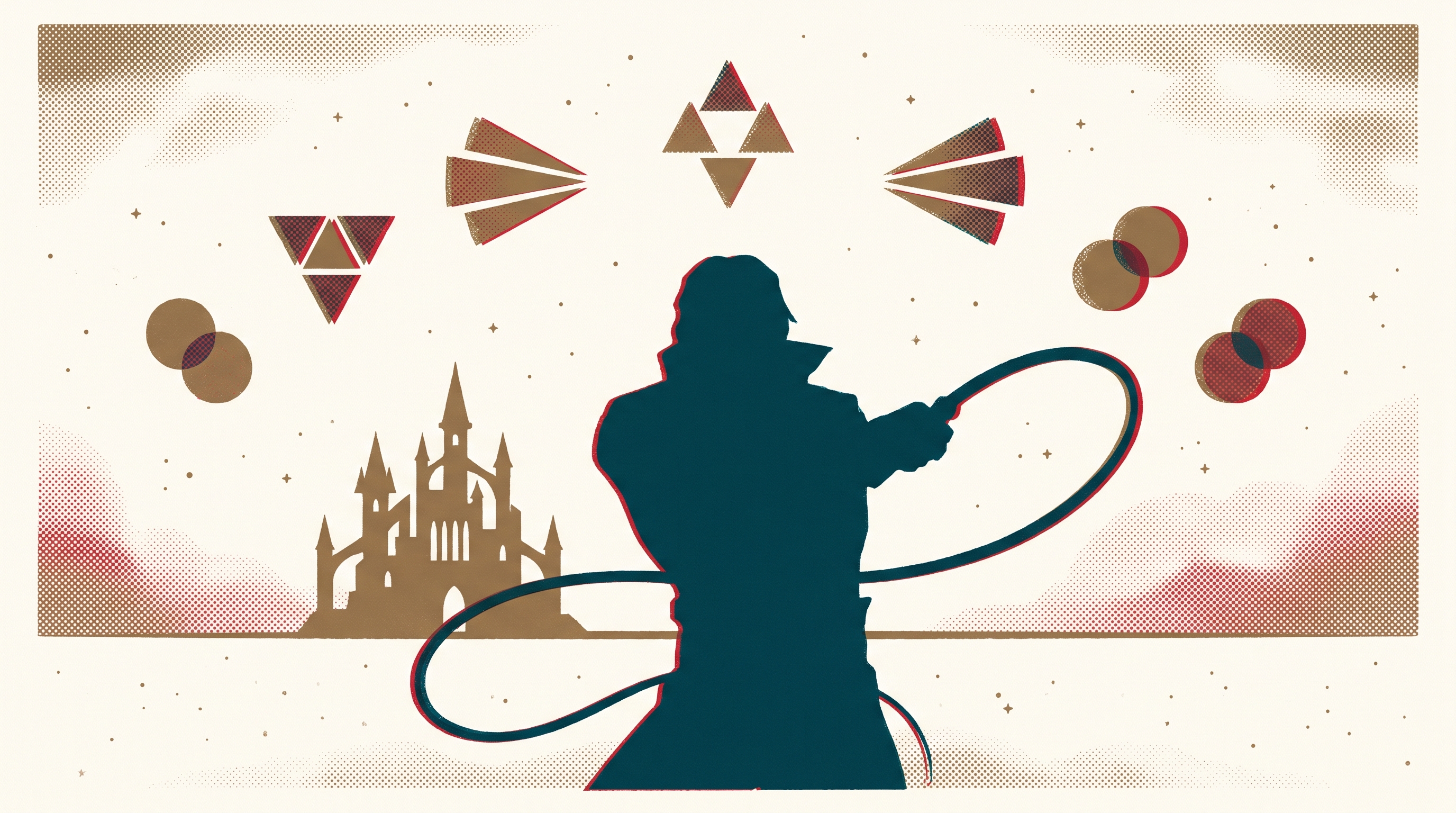
Konami Holdings Corporation is a Japanese entertainment company founded in 1969. In the 1980s and 1990s, it produced a string of influential video games including Castlevania, Contra, Metal Gear, Gradius, and Silent Hill. The original Castlevania (Akumajo Dracula) for the Famicom Disk System was released in 1986 and established one of gaming's most enduring action-platformer series.
History
Konami's origins trace back to March 21, 1969, when Kagemasa Kozuki — born November 12, 1940 — launched a sole proprietorship in Toyonaka, Osaka, to rent and repair jukebox machines. The name Konami was assembled from the surnames of its founding members: Kozuki (Ko), Nakama Yoshinobu (nami), and, by some accounts, Miyasako Tatsuo — though sources vary slightly on the exact derivation. It was a practical trade, serving bars and entertainment establishments at a time when jukebox culture was embedded in Japanese nightlife. Kozuki ran the business with the operational discipline of a maintenance engineer: keep the machines running, serve the clients, expand steadily. On March 19, 1973, the venture was incorporated as Konami Industry Co., Ltd., formalizing four years of accumulated goodwill into a legal entity.
The company's pivot toward electronics arrived in stages. In July 1976, Konami began manufacturing electronic amusement machines — coin-operated devices that sat in the same entertainment spaces as its jukeboxes. In January 1978, it made a more decisive commitment by entering the microcomputer-based video game hardware business. This was the same year that Space Invaders remade the global arcade industry, and Konami was positioned in exactly the right market at the right moment. The transition from jukebox repairman to video game manufacturer happened not through a single bold bet but through the incremental logic of serving venues that increasingly wanted machines that could do both — and then machines that could do something the jukebox never could.
The arcade years of the early 1980s established Konami's international reputation. In 1981, Scramble became a genuine phenomenon: ten thousand units sold in two months, generating approximately twenty million dollars in revenue, and reaching number one on the American Replay arcade chart. That same year, Frogger — co-published with Sega — brought the company further mainstream visibility. Time Pilot followed in 1982. By 1985, Gradius had arrived in arcades, combining precise scrolling-shooter mechanics with a power-up system that rewarded patience and positioning over reflex alone. When the Famicom version shipped on April 25, 1986, it carried inside it something that its lead programmer, Hashimoto Kazuhisa, had inserted without announcement: a cheat sequence, entered on the controller before the title screen, that granted the player thirty lives. The sequence was ↑↑↓↓←→←→BA. Hashimoto had included it because he could not finish the game himself. Guinness World Records would later certify it as the most widely recognized cheat code in gaming history.
Castlevania — known in Japan as Akumajō Dracula — debuted on the Famicom Disk System in September 1986, establishing a franchise built on gothic atmosphere, tight platforming, and a monster roster drawn from European horror tradition. The series evolved across hardware generations, but its most consequential reinvention came in 1997 with Castlevania: Symphony of the Night on the PlayStation, directed by Hagihara Toru with assistant director Igarashi Koji taking on increasing creative responsibility as development progressed. Symphony of the Night fused the franchise's gothic aesthetic with open-world exploration borrowed from Metroid, layering RPG character progression onto a labyrinthine castle map. Initial sales were modest — roughly 470,000 copies in North America and 220,000 in Japan — but word of mouth gave the game a life far exceeding its launch numbers. The hybrid design approach it pioneered became so influential that a genre label was coined to describe it: Metroidvania. Hashimoto Kazuhisa, who had hidden the Konami Code inside Gradius, died on February 25, 2020, at the age of sixty-one.
The Metal Gear franchise began in July 1987, when Kojima Hideo — who had joined Konami in 1986 — shipped his first game project on the MSX2 home computer. Hardware constraints that would have defeated another designer became, in Kojima's hands, a creative premise: because the MSX2 could not render fast-moving gunfights with multiple enemies, the player's character would avoid combat rather than seek it. Stealth became not a limitation but a philosophy. Metal Gear Solid, released for the PlayStation in 1998, translated that philosophy into three dimensions, adding cinematic presentation, layered narrative, and a depth of environmental storytelling that drew praise from outside the games industry — including a feature in American Newsweek. The game sold approximately 6.6 million copies worldwide by 2002. By June 2023, the Metal Gear series had surpassed sixty million units in cumulative sales.
In December 1997, Konami launched Beatmania in arcades, a turntable-and-keys rhythm controller that asked players to perform rather than simply react. The game sold approximately 6,700 cabinet units by May 1999. In 1999, Konami formalized its rhythm game division under the BEMANI brand, renaming the internal group from G.M.D. That same year, Dance Dance Revolution introduced a floor panel controller that players activated with their feet, transforming a video game into something closer to a fitness activity. DDR expanded to North America and Europe in 1999, acquired a competitive community, and found its way into schools and physical education curricula. The BEMANI lineup eventually grew to encompass over a dozen distinct game series, making Konami the dominant force in arcade music games for the better part of two decades.
On February 4, 1999, Konami released Yu-Gi-Oh! Vol. 1, the first set in what would become the best-selling trading card game in recorded history. On July 7, 2009, Guinness World Records certified the franchise at 22.587 billion cards sold — the top-selling trading card game on earth. In June 2011, the record was updated again: 25.17 billion cards, a figure that continued to grow. The physical card game was complemented by digital adaptations, anime licensing, and tournament infrastructure that made Yu-Gi-Oh! a self-sustaining entertainment ecosystem spanning multiple media. In 2024, Guinness certified a new record of 7,443 simultaneous duels at a single event.
On March 31, 2006, Konami restructured by dividing its entertainment operations into a wholly owned subsidiary, Konami Digital Entertainment Co., Ltd., while the parent company became a pure holding entity. In December 2015, Kojima Hideo's contract with Konami ended; the company confirmed his departure on December 15, 2015, citing the conclusion of his contract term. The following day, Kojima announced the formation of Kojima Productions as an independent studio. The Game Awards 2015, held that same month, awarded Metal Gear Solid V: The Phantom Pain its Best Score/Music prize; Kojima was not permitted to attend the ceremony to accept. The episode drew significant international attention and criticism. The years that followed saw Konami redirect energy toward mobile, sports simulation, and pachinko while critics pointed to dormant IP. But from 2020 onward, the company re-engaged its legacy catalogue: Momotaro Dentetsu shipped four million copies by July 2023; Silent Hill 2's remake crossed one million copies nine days after its October 2024 launch; Metal Gear Solid Δ: Snake Eater surpassed one million in September 2025. For fiscal year ending March 2025, Konami reported net revenue of ¥421.6 billion and business profit of ¥109.1 billion — both all-time company records.
Timeline & Works
Corporate milestones and all 64 games in the museum this studio developed — in the order they happened.
- 1969 03
Konami founded in Toyonaka, Osaka
Kagemasa Kozuki launches a sole proprietorship in Toyonaka, Osaka on March 21, 1969, renting and repairing jukebox machines for bars and entertainment venues. The name Konami is assembled from the surnames of the founding members.
founding - 1973 03
Incorporated as Konami Industry Co., Ltd.
The sole proprietorship is incorporated as Konami Industry Co., Ltd. on March 19, 1973, formalizing four years of accumulated operations.
founding - 1981
Scramble — first major international hit
Scramble ships approximately ten thousand arcade cabinets in two months, generating around twenty million dollars in revenue, and reaches number one on the American Replay arcade chart. Frogger, co-published with Sega, follows the same year.
product - 1985
Gradius launches in arcades
Gradius begins arcade operation in 1985, introducing a power-up selection system that would define the scrolling-shooter genre. The Famicom version, released on April 25, 1986, contains the hidden Konami Code entered by programmer Hashimoto Kazuhisa.
product - 1986 09
Castlevania (Akumajō Dracula) released on Famicom Disk System
The original Castlevania launches on the Famicom Disk System in September 1986, establishing a gothic action-platformer franchise that would span multiple console generations.
product - 1986
- 1986
- 1986
- 1986
- 1986
- 1986
- 1987 07
Metal Gear released on MSX2 — stealth genre born
Kojima Hideo ships Metal Gear on the MSX2 on July 13, 1987, his first game project after joining Konami in 1986. Hardware limitations are reframed as a design philosophy: the player must avoid combat rather than engage it, inventing the stealth game as a genre.
product - 1987
- 1987
- 1987
- 1987
- 1987
- 1987
- 1987
- 1987
- 1987
- 1987
- 1987
- 1987
- 1988
- 1988
- 1988
- 1988
- 1988
- 1988
- 1988
- 1989
- 1989
- 1989
- 1990
- 1990
- 1990
- 1991
- 1991
- 1991
- 1991
- 1991
- 1991
- 1992
- 1992
- 1992
- 1992
- 1992
- 1993
- 1993
- 1993
- 1993
- 1994 03
Jikkyō Powerful Pro Yakyū series launched
The first Jikkyō Powerful Pro Yakyū is released for Super Famicom on March 11, 1994. From 1997 onward, the franchise holds the cumulative top-selling position among baseball simulation games in Japan.
product - 1994
- 1994
- 1994
- 1994
- 1994
- 1995
- 1995
- 1995
- 1996
- 1997
Castlevania: Symphony of the Night — Metroidvania genre defined
Symphony of the Night, directed by Hagihara Toru with assistant director Igarashi Koji, is released for PlayStation in 1997, fusing gothic action with open exploration and RPG progression. Despite modest initial sales, it becomes one of the most critically admired games in the series and names a genre.
product - 1997 12
Beatmania launches — BEMANI era begins
Beatmania begins arcade operation in December 1997, introducing a turntable-and-keys controller that transforms the arcade experience into a performance. In 1999, the internal development group is renamed from G.M.D. to BEMANI, formalizing the brand.
product - 1997
- 1997
- 1998
Metal Gear Solid — PlayStation, worldwide acclaim
Metal Gear Solid is released on PlayStation in 1998, selling approximately six million copies worldwide. Its cinematic presentation, layered narrative, and environmental storytelling draw praise from mainstream media including Newsweek.
product - 1998
- 1999 02
Yu-Gi-Oh! Official Card Game — first set released
The Yu-Gi-Oh! Official Card Game Vol. 1 is released on February 4, 1999. By 2009 the franchise is certified by Guinness World Records as the best-selling trading card game of all time, with 22.587 billion cards sold.
product - 1999
- 1999
- 1999
- 2000
- 2006 03
Corporate split — Konami Digital Entertainment established
On March 31, 2006, Konami divides its entertainment operations into a wholly owned subsidiary, Konami Digital Entertainment Co., Ltd., and the parent company transitions to a pure holding company structure.
corporate - 2015 12
Kojima Hideo departs Konami; Kojima Productions founded
On December 15, 2015, Konami confirms Kojima Hideo's departure, citing the conclusion of his contract term. Kojima announces the formation of the independent studio Kojima Productions the following day. That same month, Metal Gear Solid V: The Phantom Pain receives recognition at The Game Awards 2015.
leadership - 2020 11
Momotaro Dentetsu returns — four million copies shipped
Momotaro Dentetsu — Showa, Heisei, Reiwa mo Teiban! launches in November 2020 and ships four million copies by July 2023, marking the largest commercial result in the franchise's history.
product - 2024 10
Silent Hill 2 remake exceeds one million copies
Silent Hill 2 — a remake developed by Bloober Team — is released on October 8, 2024, and crosses one million copies sold by October 17, nine days after launch.
product
Also developed (release year to be confirmed)
Connections
- collaborated with sega (1981–present)
Konami and Sega co-published Frogger in 1981, sharing cabinet distribution in the North American arcade market.
- collaborated with nintendo (1986–present)
Konami has published titles on Nintendo platforms continuously since the Famicom era beginning in 1986, including Gradius, Castlevania, Contra, and the Yu-Gi-Oh! card game series, spanning every Nintendo console generation.
- collaborated with sony-computer-entertainment (1997–present)
Konami released several of its most celebrated titles on PlayStation platforms, including Metal Gear Solid (1998), Castlevania: Symphony of the Night (1997), Silent Hill (1999), and the early Winning Eleven series.
- acquired hudson-soft (2005–2012)
Konami acquired a stake in Hudson Soft in 2005 and completed the full absorption in 2012, absorbing Hudson's Bomberman and PC Engine legacy into the Konami catalogue.
Also connected to
- Treasure joint development track record (2004–) (reverse)
Rooms their games live in
Sources
- コナミグループ公式沿革
- 上月景正 — Wikipedia(日本語)
- コナミグループ — Wikipedia(日本語)
- Konami — Wikipedia (English)
- コナミコマンド — Wikipedia(日本語)
- コナミコマンド40周年 — ファミ通
- メタルギアシリーズ累計6,000万本突破 — 電ファミニコゲーマー
- 小島秀夫監督退社の経緯詳細 — Game*Spark
- eFootball 7億ダウンロード突破 — gamebiz
- コナミ2025年3月期決算 — gamebiz
- 遊☆戯☆王オフィシャルカードゲーム — Wikipedia(日本語)
- 遊戯王カード251億枚でギネス更新 — J-CAST
- SILENT HILL 2 発売9日で100万本突破 — コナミ公式
- 桃鉄 累計400万本出荷 — コナミ公式
- METAL GEAR SOLID Δ: SNAKE EATER 100万本突破 — コナミ公式
- Castlevania: Symphony of the Night — Wikipedia (English)
- Beatmania — Wikipedia (English)
- Dance Dance Revolution — Wikipedia (English)
- 五十嵐孝司 — Wikipedia(日本語)
- 小島秀夫(ゲームデザイナー)— Wikipedia(日本語)