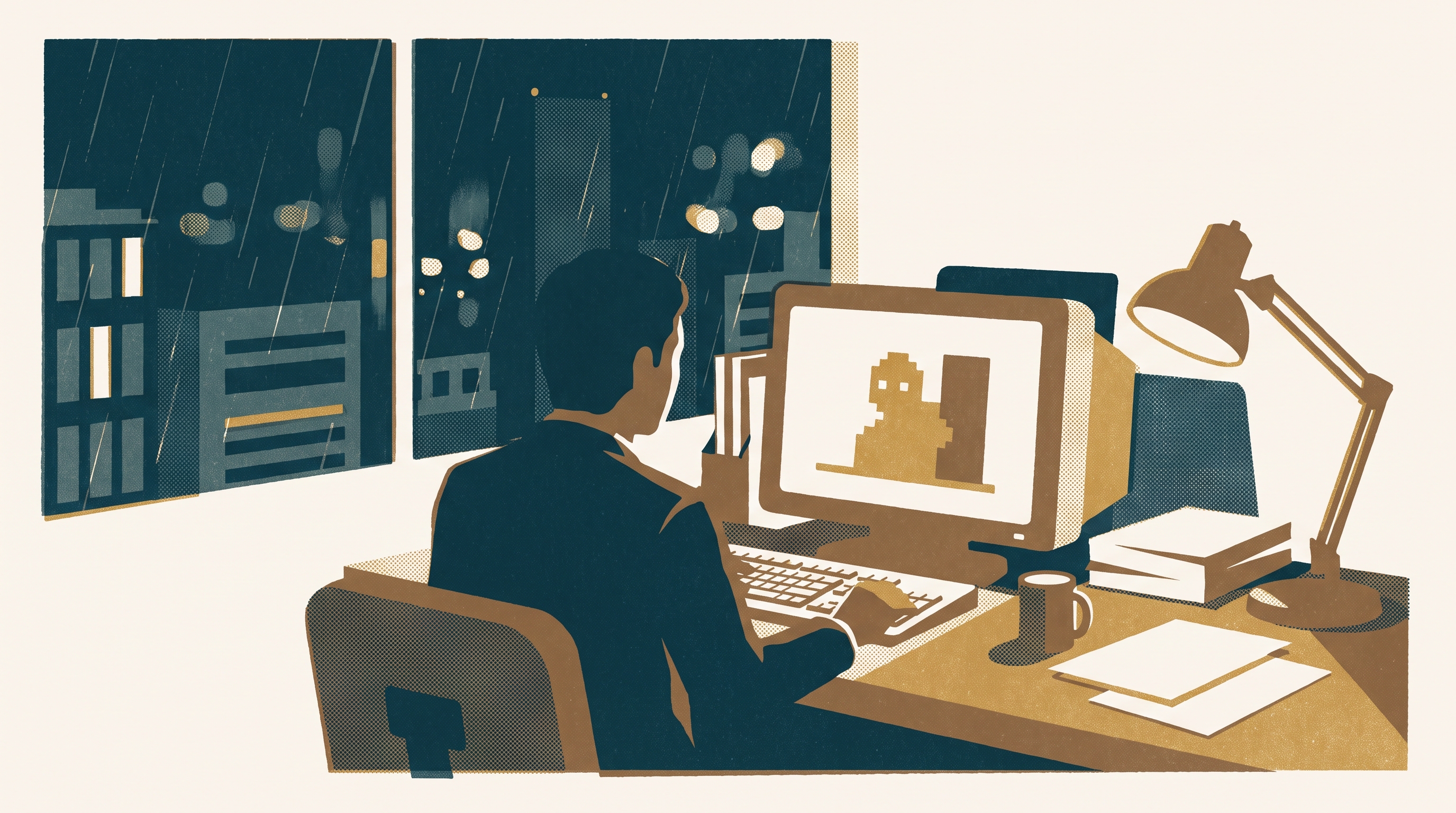
Hideo Kojima was born in Tokyo on August 24, 1963. When he was four, his family moved to Osaka. His parents loved cinema — European films, westerns, horror — and every night the family watched a movie together. The children were not allowed to sleep until the film ended. When Kojima was thirteen, his father died. The family faced financial hardship. Films had been a tradition; now they were also an anchor. Stories became a way to understand loss.
He studied economics at university, but the shape of his future was already taking form. He saw the Nintendo Famicom and thought about making games. He wanted to work in film, but no path opened. After graduating in 1986, he applied to several major electronics and game companies. Most rejected him. Konami hired him into their MSX home computer division. He was twenty-three years old.
His first assignment as a designer was a game called Metal Gear, released for the MSX2 in July 1987. The MSX2 hardware had a sprite limitation: too many objects grouped on the same horizontal plane would cause flickering. Kojima had originally wanted to make a modern military action game — soldiers, gunfire, combat — but the hardware could not support the number of on-screen enemies and bullets required. The action he envisioned would not run.

Instead of accepting failure, he changed the premise. The player would control a soldier infiltrating an enemy base not by shooting everyone but by avoiding detection. Combat was still possible, but the safer path — hiding in shadows, timing patrols, slipping past guards — was quieter and often necessary. The goal was not to fight but to not be seen. It inverted the dominant arcade convention of the era: instead of destroying all obstacles, you avoided them. The limitation became the design.
He took inspiration from The Great Escape, a 1963 film about prisoners of war planning an escape. He wanted the player to feel like someone moving carefully through hostile territory, where a single mistake could end the mission. The game sold well in Japan and became the foundation for what would later be called the stealth game genre. A constraint of hardware had forced a new way of thinking about action.
Over the next decade, Kojima continued at Konami, directing sequels and other projects. In 1995, he began work on a new Metal Gear for the emerging PlayStation platform. The result was Metal Gear Solid, released in Japan on September 3, 1998, and in North America the following month. It combined stealth gameplay with full voice acting, cinematic camera angles, and a story structure borrowed from film. The game shipped more than six million copies worldwide and is widely considered one of the most important games ever made.

Kojima's approach to design often prioritized player expression over linear challenge. In a 2012 interview, he said: 'I want my games to teach a message about life, by presenting situations where the answer isn't a clear yes or no.' His work explored themes of nuclear deterrence, genetic determinism, information control, and the ethical ambiguity of war. The games were also known for moments of playful absurdity — codec conversations about movies, fourth-wall-breaking gags, Easter eggs that rewarded close attention. The seriousness and the playfulness existed side by side.
In 2015, Kojima's relationship with Konami ended. The circumstances were not fully disclosed. In October, reports confirmed that he had left the company after nearly three decades. His employment contract concluded in December. Within days, he announced the establishment of an independent studio, also named Kojima Productions, in partnership with Sony Computer Entertainment. On December 16, 2015, at the PlayStation Experience event, he stood on stage and introduced his new company. He said there was still work to do.
The first product of that independence was Death Stranding, released in November 2019 for PlayStation 4 and later for PC. The game departed from the conventions of the Metal Gear series. Players controlled a courier in a post-apocalyptic America, delivering cargo across dangerous terrain while managing balance, stamina, and the weight of their load. The central mechanic was not combat but cooperation — players could leave equipment, structures, and signs for others in their game world, creating a shared infrastructure of mutual support. Critical reception was divided, but the game sold well and was recognized for attempting something structurally unusual within the commercial action-game space.
What runs through Kojima's career is a pattern: constraints — technical, institutional, or market-driven — become starting points rather than endpoints. When the MSX2 could not render enough enemies, he made a game about not being seen. When he could not enter the film industry, he built cinematic structures inside games. When he left the company that had published his work for twenty-nine years, he started again. The work itself — the act of building something and putting it in front of people — is a renewable resource, even when everything else changes. The question is not whether the constraints exist. The question is what you make from them.