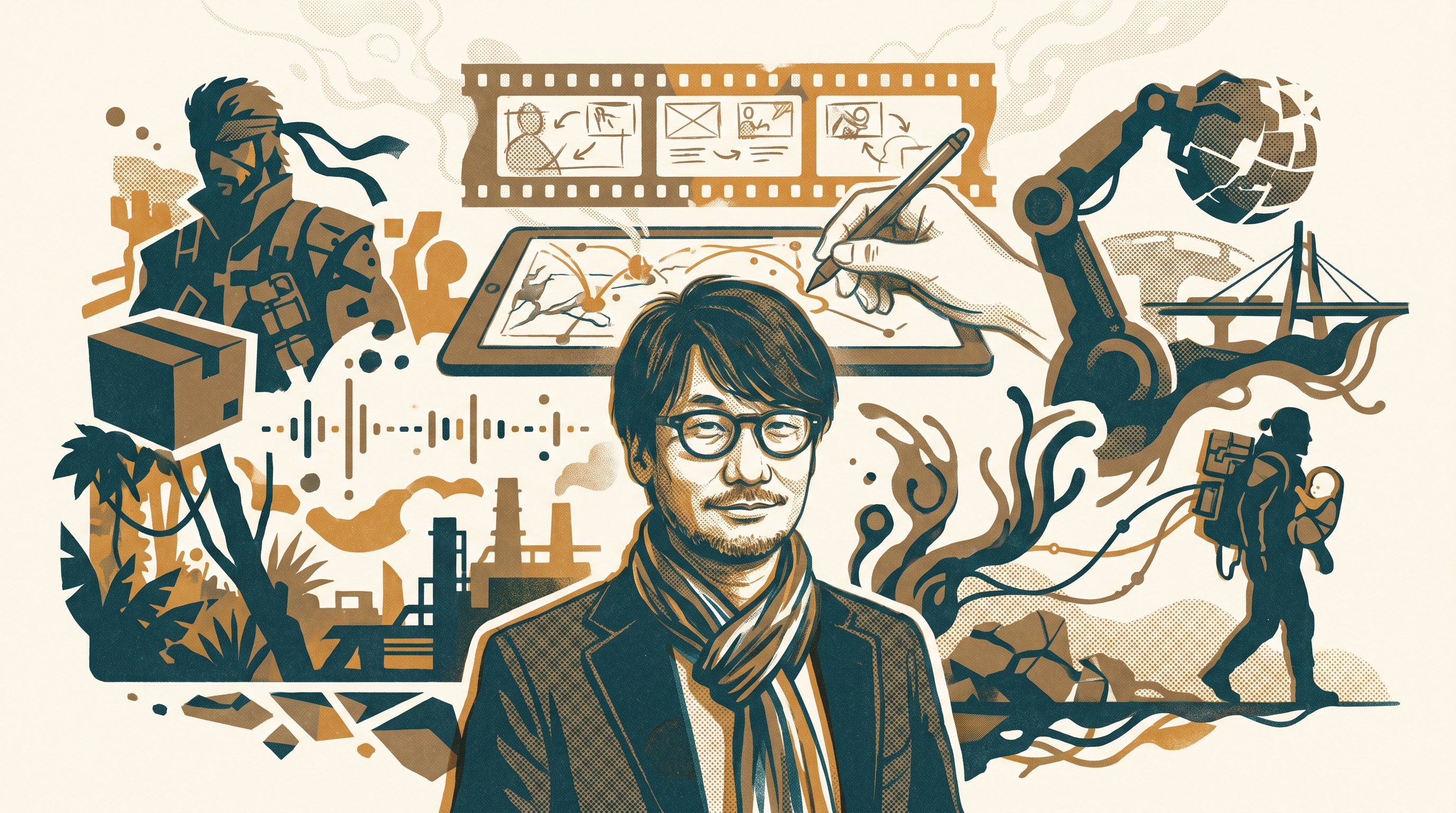
director
Hideo Kojima
小島秀夫
Games should teach you something about life — not with answers, but with questions you carry home.
About
Hideo Kojima is a Japanese game designer and the director of the Metal Gear series. He joined Konami in 1986 and created the original Metal Gear (1987) for the MSX2 — a stealth game where avoiding combat was the primary strategy, inverting the action-game convention of the era. Metal Gear Solid (1998) for PlayStation brought the series to 3D and full voice acting, demonstrating that video games could carry the narrative weight of cinema. Kojima left Konami in 2015 to found Kojima Productions.
History
Hideo Kojima was born on August 24, 1963, in the Setagaya ward of Tokyo. When he was four years old, his family moved to Osaka. His parents were passionate about cinema — especially European films, horror, and westerns — and began a nightly tradition of watching a film with their children, who were not allowed to go to bed until the film had finished. When he was thirteen, his father died. In interviews, Kojima has spoken about the impact of his father's death and the financial hardship that followed. Films became both an escape and a framework for understanding narrative, loss, and the structure of stories.
He studied economics at university. At that time, he saw Nintendo's Famicom and thought of joining the video game industry, though he had initially searched for a way into film. Upon graduating, he applied to several major Japanese electronics and game companies. Most turned him down. In 1986, Konami hired him into their MSX home computer division. He was twenty-three years old.
His first assignment as a designer was Metal Gear, released for the MSX2 in July 1987. The MSX2 hardware could not handle the number of on-screen enemies required for a traditional action game. Kojima turned the limitation into the design. The player controlled a soldier who infiltrated an enemy base not by shooting everyone but by avoiding detection. Combat was still possible, but the quieter path — hiding in shadows, timing patrols, slipping past guards — was safer and often necessary. The game inverted the dominant arcade convention: the goal was not to fight but to not be seen. It sold well in Japan and became the foundation for what would later be called the stealth game genre.
Over the next decade, Kojima directed several sequels and other projects at Konami. In 1995, he began development on a new Metal Gear for the emerging PlayStation platform. The project was initially planned for the 3DO Interactive Multiplayer, but was soon moved to Sony's machine. The result was Metal Gear Solid, released in Japan on September 3, 1998, and in North America the following month. It combined stealth gameplay with full voice acting, cinematic camera angles, and a story structure borrowed from film. The game shipped more than six million copies worldwide and is widely considered one of the most important games ever made. Kojima became known outside Japan, and his name became inseparable from the series he had built.
He continued to direct Metal Gear Solid sequels — Sons of Liberty in 2001, Snake Eater in 2004, Guns of the Patriots in 2008, and The Phantom Pain in 2015. Each installment expanded the narrative scope and mechanical complexity of the series. Kojima's approach to game design often prioritized player expression and experimentation over linear challenge. In a 2012 interview, he said: 'I want my games to teach a message about life, by presenting situations where the answer isn't a clear yes or no.' His games frequently explored themes of nuclear deterrence, genetic determinism, information control, and the ethical ambiguity of war. They were also known for moments of playful absurdity — codec conversations about movies, fourth-wall-breaking gags, and Easter eggs that rewarded close attention.
In 2015, Kojima's relationship with Konami ended. The circumstances were not fully disclosed, but in October of that year, reports confirmed that Kojima had left the company after nearly three decades. His employment contract concluded in December. Within days, he announced the establishment of an independent studio, also named Kojima Productions, in partnership with Sony Computer Entertainment. On December 16, 2015, at the PlayStation Experience event, he stood on stage and introduced his new company. He said there was still work to do.
The first product of that independence was Death Stranding, released in November 2019 for PlayStation 4 and later for PC. The game departed from the conventions of the Metal Gear series. Players controlled a courier in a post-apocalyptic America, delivering cargo across dangerous terrain while managing balance, stamina, and the weight of their load. The central mechanic was not combat but cooperation — players could leave equipment, structures, and signs for others in their game world, creating a shared infrastructure of mutual support. Critical reception was divided, but the game sold well and was recognized for attempting something structurally unusual within the commercial action-game space.
The work continued. In 2020, the British Academy awarded Kojima its Fellowship — its highest honor — making him the second Japanese game creator to receive it, after Shigeru Miyamoto. By then he had become one of the few game directors known by name outside the medium, moving easily between games and film; his friendships with directors such as Guillermo del Toro and Nicolas Winding Refn, and the actors who lent their faces and voices to his work, made the boundary between the two forms look thinner than it once had. In June 2025 he released Death Stranding 2: On the Beach, and announced two further projects in development — OD, a horror game made with Xbox, and Physint, a return to the espionage-action form he had defined decades earlier. Nearly forty years after Konami first hired him, he was still starting new things.
Kojima's career demonstrates that constraints — technical, institutional, or market-driven — can be starting points rather than endpoints. When the MSX2 could not render enough enemies, he made a game about not being seen. When he could not enter the film industry, he built cinematic structures inside games. When he left the company that had published his work for twenty-nine years, he started again. The choice to keep working, to continue making things under new conditions, is the thread that runs through his story. What he has shown is that the work itself — the act of building something and putting it in front of people — is a renewable resource, even when everything else changes.
In Hideo's Own Words
Real interview footage, not paraphrase. Each line links back to the exact moment in the video so you can hear it for yourself.
“Nothing’s ever perfect. Just the act of trying to be perfect.”
“It’s good! When what I want to say is there, and I wrap it in a bit of entertainment and deliver it— most people may not get it, and that’s fine.”
“That sense of being tied to an era it quite similar to games. The inherent fun of games changes too, right?”
“To me, the details are the key to creativity. You could say “this is good enough” and make it more efficient.”
“We are working on DEATH STRANDING 2 right now. As I've mentioned on my social media, right now is the most critical phase where we are building up the game.”
“-Well, I've been, preparing our project, looking for our new offices, looking for talented people to join us... aaand, I've been looking into, experimenting with new ideas and technologies and other services.”
“Well, when I went independent, I was already past 50. People typically start thinking about retirement, right?”
“Yes, it will be a brand new, original IP, a next-generation ACTION ESPIONAGE game. Preparations are underway, but production will begin in earnest at KOJIMA PRODUCTIONS after DEATH STRANDING 2.”
“So why did I decide to make this? Well first off, because I became independent, I wanted to do something new with my own IP.”
Timeline & Works
Career milestones and all 7 games in the museum they worked on — in the order they happened.
- 1963 08
Born in Tokyo
Hideo Kojima was born in Setagaya ward, Tokyo. His family moved to Osaka when he was four years old.
people - 1976
Father's death
At age thirteen, Kojima's father died. He has spoken about the impact of this loss and the financial hardship that followed.
people - 1986
Joined Konami
After graduating with a degree in economics, Kojima joined Konami's MSX home computer division at age 23.
people - 1987 07
Metal Gear released
Kojima's first game as designer, Metal Gear for MSX2, was released. It pioneered the stealth game genre by making avoidance rather than combat the primary strategy.
product - 1987
- 1988
- 1990
- 1995
- 1996
- 1998 09
Metal Gear Solid released
Metal Gear Solid for PlayStation was released in Japan (October in North America), combining stealth gameplay with cinematic presentation and full voice acting. It shipped over six million copies worldwide.
product - 1998
- 2001
Metal Gear Solid 2 released
Metal Gear Solid 2: Sons of Liberty was released for PlayStation 2, expanding the narrative and thematic complexity of the series.
product - 2004
Metal Gear Solid 3 released
Metal Gear Solid 3: Snake Eater was released for PlayStation 2, set during the Cold War and exploring the origins of the series.
product - 2004
- 2008
Metal Gear Solid 4 released
Metal Gear Solid 4: Guns of the Patriots was released for PlayStation 3, concluding the story of Solid Snake.
product - 2014
P.T. released
P.T., a playable teaser for the cancelled Silent Hills (a collaboration with filmmaker Guillermo del Toro), was released for PlayStation 4 — widely regarded as one of the most acclaimed horror demos ever made.
product - 2015 09
Metal Gear Solid V released
Metal Gear Solid V: The Phantom Pain was released, the final Metal Gear game directed by Kojima.
product - 2015 10
Left Konami
After nearly three decades at Konami, Kojima left the company. His employment contract concluded in December 2015.
people - 2015 12
Founded independent Kojima Productions
Kojima announced the establishment of an independent studio, Kojima Productions, in partnership with Sony Computer Entertainment.
people - 2019 11
Death Stranding released
Death Stranding, the first game from the independent Kojima Productions, was released for PlayStation 4. It explored themes of connection and cooperation in a post-apocalyptic setting.
product - 2020
Received the BAFTA Fellowship
The British Academy awarded Kojima its Fellowship — its highest honor — making him the second Japanese game creator to receive it, after Shigeru Miyamoto.
award - 2025 06
Death Stranding 2: On the Beach released
Death Stranding 2: On the Beach was released on June 26, 2025, to strong critical reception. Kojima also announced OD (with Xbox) and Physint in development.
product
Connections
- employed konami (1986–2015)
Kojima spent nearly three decades at Konami, where he created and directed the Metal Gear series.
Explore the work
Each title has its own page — history, trivia, and collector's notes.
Nintendo GameCube · 2004
Metal Gear Solid: The Twin Snakes
Kojima and Iwata agreed on it at E3 2002. Silicon Knights built it in two years.…
PlayStation · 1998
Metal Gear Solid
The mission was never to fight. It was to ask whether you had to.…
PlayStation · 1996
Policenauts
Kojima asked what happens when humans live in space. He built Policenauts to let…
3DO · 1995
Policenauts
They finished it for a machine already going down. Every version that came after…
MSX · 1990
Metal Gear 2: Solid Snake
Metal Gear 2: Solid Snake topped Japan's sales charts for six months in 1990. It…
MSX · 1988
Snatcher
Snatcher went on sale in 1988 with its ending missing. The people who bought it …
Rooms their games live in
Sources
- Hideo Kojima — Wikipedia (English) — accessed 2026-06-08
- 小島秀夫 (ゲームデザイナー) — Wikipedia 日本語版 — accessed 2026-06-08
- Metal Gear Solid (video game) — Wikipedia — accessed 2026-06-08
- Kojima Productions — Wikipedia — accessed 2026-06-08
- Hideo Kojima — Wikiquote — accessed 2026-06-08
- Hideo Kojima - Biography - IMDb — accessed 2026-06-08
- The Fellowship 2020: Hideo Kojima — BAFTA — accessed 2026-07-01
- Death Stranding 2: On the Beach — Wikipedia — accessed 2026-07-01
- Why 1987's Metal Gear Is Still Important — Den of Geek — accessed 2026-07-01
- Hideo Kojima and Nicolas Winding Refn Are Blurring the Lines Between Games and Cinema — Rolling Stone — accessed 2026-07-01
From the Museum's Screening Room
Untold Kojima — Dark Exhibit
Kojima Metal Gear The Shooter He Couldnt Build — Feature