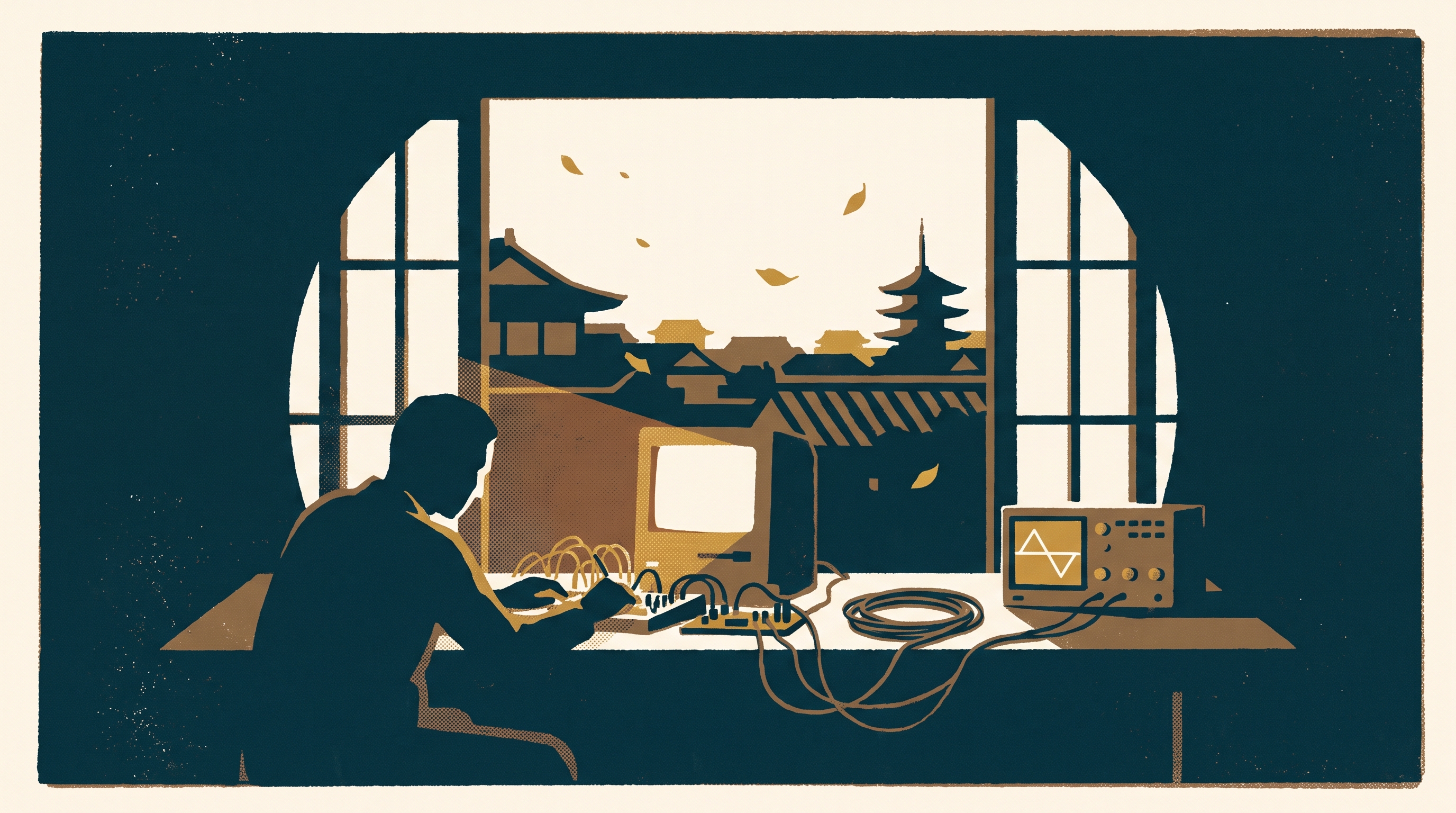
Hirokazu Tanaka was born on December 13, 1957, in Kyoto. At five years old, his parents enrolled him in the Yamaha Music School. From age nine to eleven, he studied piano. When The Monkees aired in Japan, he was nine. He became interested in rock music and played in groups on guitar, keyboard, and drums from that point until he turned thirty. But when he graduated from university in 1980 with a degree in electronic engineering, he applied to Nintendo not to play music — to work as a sound designer.
He was hired in April of that year, at twenty-two. Nintendo was in the arcade business at the time, transitioning to home consoles. His first project was Space Firebird (1980), where he designed the sound chip itself and composed the music. The hardware and the composition were inseparable. A year later, the Game & Watch line launched. Tanaka worked on those too — programming the games, designing the sound. The job was not categorized. You did whatever the machine needed.
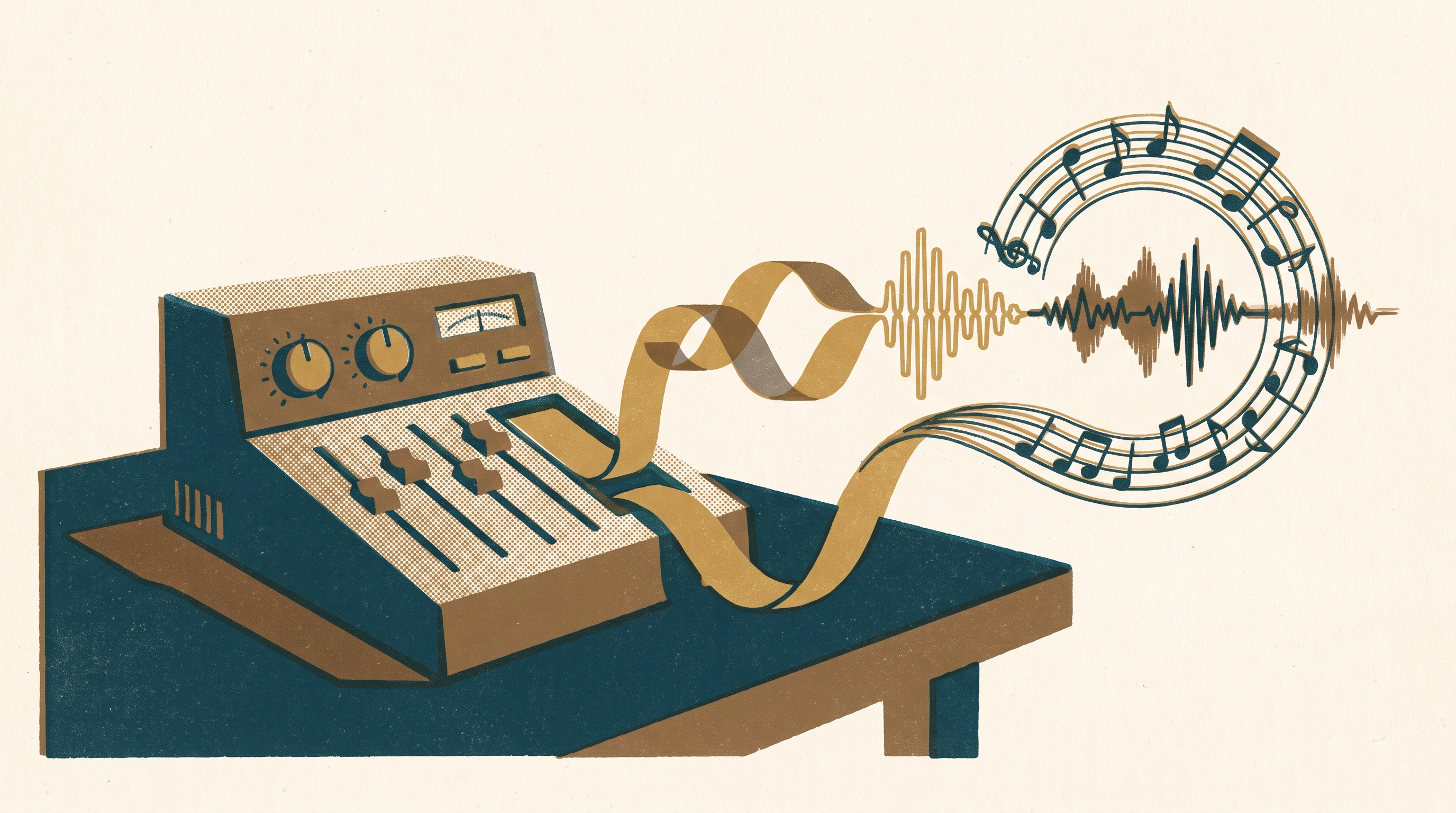
Then came the Famicom, released in Japan in 1983 — the NES in the rest of the world. Tanaka had a hand in designing its audio hardware: a 2A03 chip with five sound channels. Three pulse-wave tones, one triangle wave, one noise channel. Later, he did the same for the Game Boy. In 1986, Nintendo was preparing to release Metroid, a side-scrolling exploration game set in an alien planet's labyrinth. Tanaka was assigned as composer.
At that time, most game music followed a pattern: upbeat, melodic, repeating. Catchy tunes that encouraged the player to keep going. Tanaka did not want that for Metroid. In later interviews, he explained that his concept was to create music not as game music, but as sound the player would feel as if they were encountering a living creature — no distinctions between music and sound effects. His phrase was: 'Anything that comes out from the game is the sound that game makes.'
The result was Brinstar, Norfair, Kraid's Lair — tracks that hovered, droned, pulsed. Sparse melodies over long sustained tones. The music did not push you forward; it surrounded you. Some players said it was too heavy. Within Nintendo, many people felt the music for Metroid was too serious. But Tanaka later said he believed he had succeeded in emphasizing the characteristic of Metroid by synchronizing the theme of the music with the theme of the gameplay. The music became the standard for the entire series.

He went on to compose for Kid Icarus (1986), Dr. Mario (1990), Tetris for Game Boy (1989), Super Mario Land (1989), and Mother (1989). In the late 1990s, he began composing music for the Pokémon anime, which had started airing in 1997. One of his compositions, 'Mezase Pokémon Master,' sold over two million CDs. But Nintendo's employee policy forbade staff from working for other companies. Tanaka wanted to continue the Pokémon work. In 1999, he resigned from Nintendo after nineteen years and joined Creatures Inc., a Pokémon-related company, full-time.
In 2001, he became president and executive director of Creatures Inc. He held that position until 2023, when he stepped down and took the title of Creative Fellow. During those years, he also performed electronic music under the name Chip Tanaka. The man who designed the sound chip and composed the first alien soundscape in a video game went on to run a company, make pop songs, and perform techno. The work changed shape, but the principle did not.
In a 2010 interview, someone asked him what he thought the role of game sound should be. His answer was the same as it had been in 1986: the sound is not separate from the game. The sound is what the game is saying. If you listen, the game will tell you what it is.