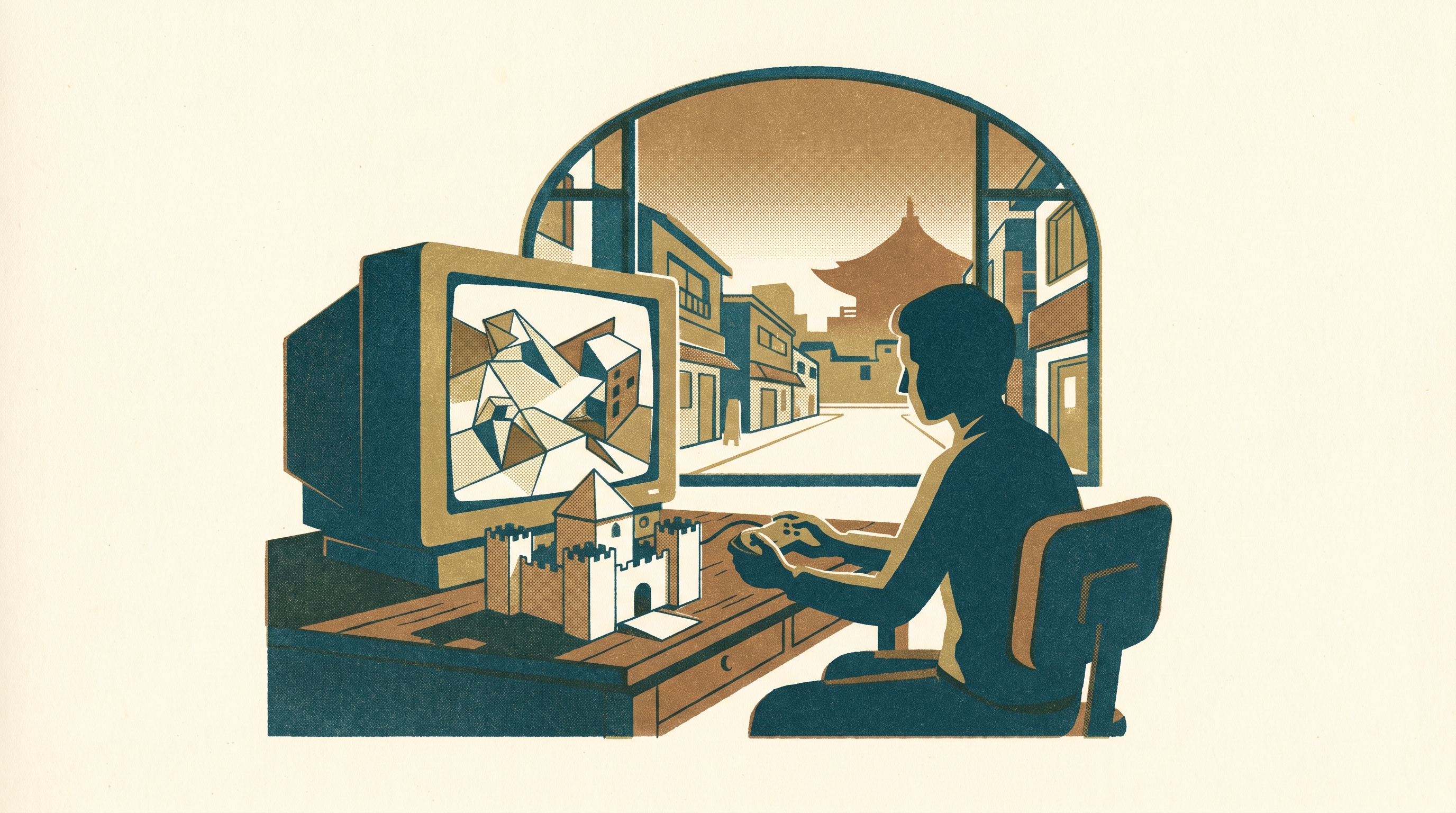
Koji Igarashi joined Konami in 1990 as a programmer. For most of the decade he worked in support roles — code that kept systems running, contributions that did not carry his name forward. When he was assigned to the Castlevania series, it was not as a director. It was as someone who knew how the older games had been built, how they worked under the surface, and where the seams held.
The Castlevania games that preceded Symphony of the Night followed a single design rule: you moved from left to right, stage by stage, until you reached the end. If you died, you started the level again. There was no map to fill in. There was no reason to go back. The structure was borrowed from the arcade — tight, unforgiving, built to be finished in one sitting or not at all.
Development of Symphony of the Night began under director Toru Hagihara, but partway through production Hagihara received a promotion within Konami. Igarashi, who had been working as assistant director, took on increasing creative responsibility. The question he faced was simple: what happens if you let the player get lost?

He looked to The Legend of Zelda, which had made exploration and backtracking a core part of its design. He also looked at Castlevania II: Simon's Quest, a game from 1987 that had experimented with open-world structure and been criticized for it. Players had found it confusing. Igarashi believed the idea had been right — the execution had just needed refinement. He pitched Konami on a Castlevania built not as a sequence of stages but as a single enormous castle that opened up as you gained new abilities.
The castle in Symphony of the Night does not guide you. It sprawls. Rooms connect in ways that only make sense once you have the map. Corridors loop back on themselves. You acquire an ability — double jump, bat transformation, mist form — and suddenly an area you walked through an hour ago becomes accessible in a new way. The game rewards you for remembering where you have been and returning with the right tool.

Symphony of the Night released for the PlayStation in March 1997 in Japan, and in North America in October of the same year. Its commercial reception was modest — around 470,000 copies sold in North America in the first year. But word of mouth carried it forward. By the early 2000s, its reputation had solidified. The design pattern it pioneered — exploration, progression through abilities, a map that fills in as you wander — became common enough to earn a name: Metroidvania, a compound word joining Metroid and Castlevania together.
Igarashi became the producer of the Castlevania series and oversaw a string of sequels on the Game Boy Advance and Nintendo DS that refined the formula. He left Konami in 2014 after twenty-four years. In 2015 he launched a Kickstarter campaign for Bloodstained: Ritual of the Night, a spiritual successor to Symphony of the Night. The campaign raised over five and a half million dollars, making it the largest crowdfunding effort for a video game at the time. The game was released in 2019.
Symphony of the Night did not invent exploration in games. But it made getting lost feel deliberate. It made backtracking feel like progress. It turned a castle into a puzzle you solved by wandering through it with a pencil and a blank sheet of paper, drawing the map yourself as you went. The question Igarashi asked in 1997 was: what if the player wants to get lost? The answer became a genre.