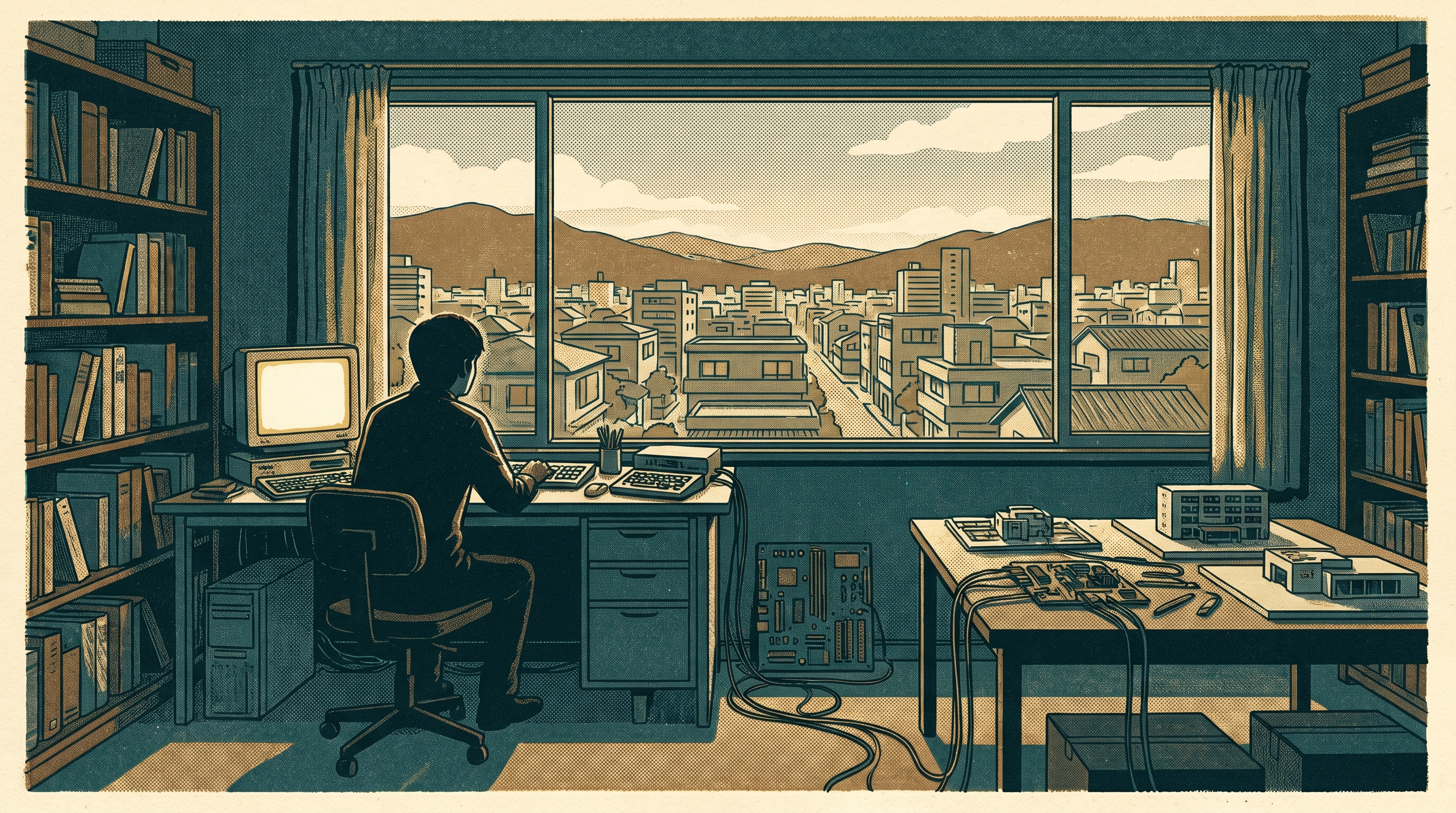
Satoru Iwata was born in Sapporo on December 6, 1959. As a teenager, he programmed a calculator to play a simple baseball game and showed it to classmates. He enrolled in the Tokyo Institute of Technology to study computer science, and while still a student in 1980, he began working part-time at a small game developer in Tokyo called HAL Laboratory. He never really left.
HAL Laboratory grew through the early years of the Famicom, contributing games to Nintendo's catalog. But growth carried costs — new development facilities, expanding staff, the ordinary expenses of a company trying to keep pace with an industry moving faster than anyone had predicted. By 1992, with the economic bubble having burst, the accumulated debts had grown to an estimated fifty billion yen in total liabilities. HAL filed for bankruptcy protection in 1992. Under the recovery plan, the obligations were restructured to approximately fifteen billion yen, and over roughly the next six years the company repaid what it owed.
Nintendo, which had a longstanding relationship with HAL, agreed to support the company's recovery — but on a condition. Iwata, who had been a programmer and then a manager, would need to become president and take personal liability. He accepted in 1993, at thirty-two years old. According to accounts from that period, his response was something close to: if I run away from this, I will regret it for the rest of my life.
The recovery took years of careful reduction: consolidating divisions, removing product lines that were not games, focusing the company on what it did best. HAL survived. During this period, Iwata was also working directly on games. His most discussed contribution came not from within HAL but as a favor to an outsider.
The writer Shigesato Itoi had been working for years on a game called MOTHER 2. Development had stalled. When Iwata was brought in to assess the situation, he examined the existing codebase and told Itoi plainly: if we continue with what exists now, it will take two years to finish. If we start from scratch, we can do it in six months. They started from scratch. According to Itoi, the game was finished in roughly that time. Itoi later said that Iwata had given each programmer something like a mechanical shovel where before they had all been digging with their hands.
In 2000, Iwata joined Nintendo as head of corporate planning. Two years later, when Hiroshi Yamauchi stepped down after more than fifty years as president, Iwata became Nintendo's fourth president — the first in the company's history who was not related to the founding Yamauchi family, and the first whose career had been built entirely in software.
He ran the company through the Wii era, when Nintendo reached audiences who had never touched a game controller. He gave talks at industry conferences in which he dissected his own mistakes in public with an engineer's dispassion. He launched a video series called 'Iwata Asks' in which he interviewed the developers of Nintendo games — not from above, as a president interviewing employees, but as someone who understood what they had done and wanted to know how. At the Game Developers Conference in 2005, he opened his presentation by holding up his business card and reading it aloud: 'On my business card, I am a corporate president. In my mind, I am a game developer. In my heart, I am a gamer.'
In June 2014 he disclosed that he had undergone surgery to remove a bile duct tumor. He returned to work and continued making public appearances. On July 11, 2015, he died. He was fifty-five years old. The condolences that arrived over the following days came from competitors, from developers who had worked with him, and from players who had never known his name until then and who only now were finding out what he had built. Among the things he had said, the one that traveled farthest in those days was the simplest: that the purpose of a game is to make someone smile.