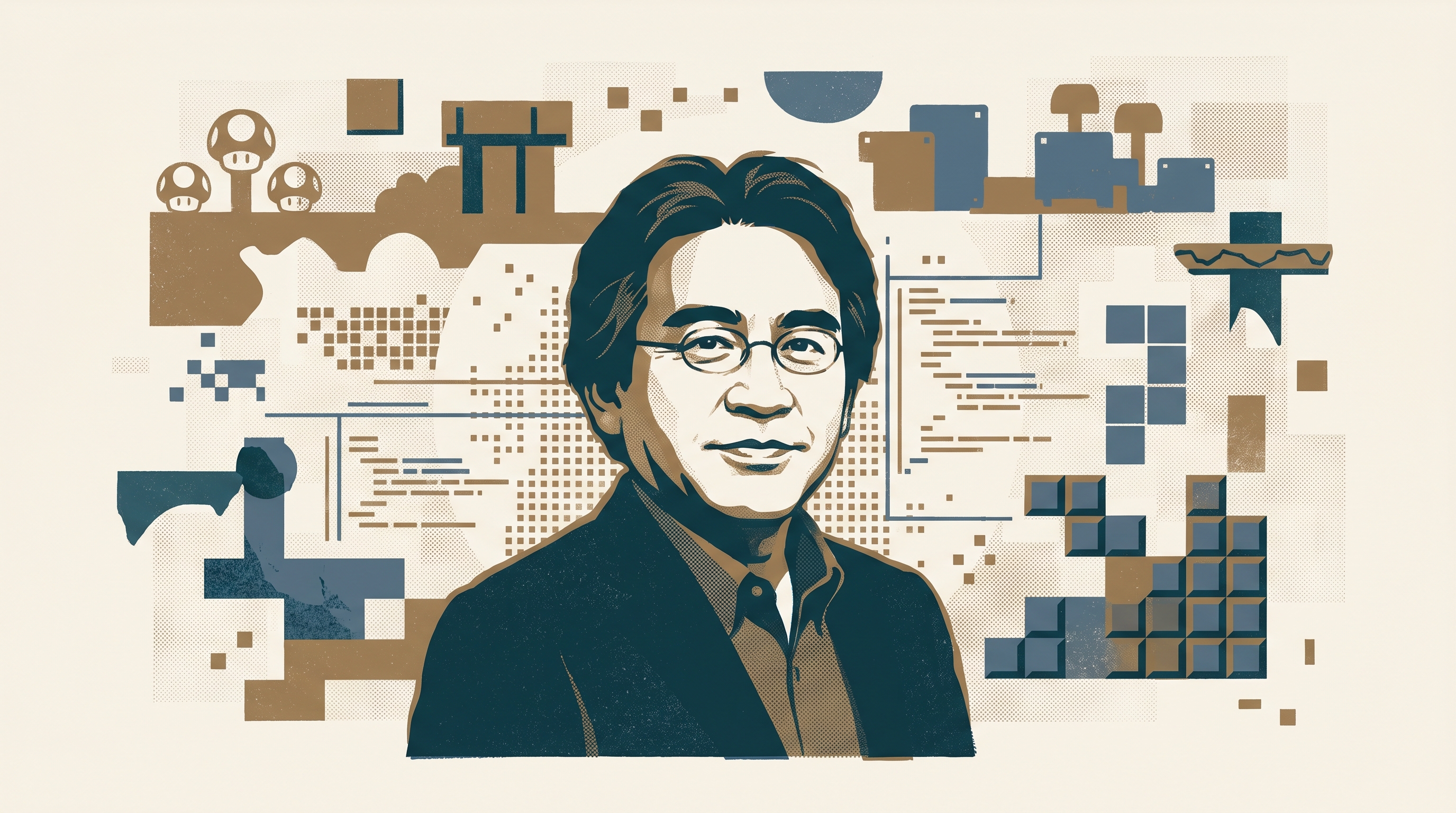
programmer
Satoru Iwata
岩田聡
On the card, a president. In his mind, a developer. In his heart, always a gamer.
About
Satoru Iwata (1959–2015) was a Japanese video game programmer and executive who served as the fourth president of Nintendo from 2002 until his death in 2015. He joined HAL Laboratory as a part-time employee in 1980, became its president at thirty-three to rescue the company from ¥1.5 billion in debt, and was then recruited by Hiroshi Yamauchi to lead Nintendo in an unprecedented external appointment. Under his presidency, the Nintendo DS and Wii sold over 200 million units combined, reaching audiences who had never before played games. He conducted more than 200 developer interviews for the Iwata Asks series and died on July 11, 2015, at the age of fifty-five.
History
Satoru Iwata was born on December 6, 1959, in Sapporo, Hokkaido. From an early age he was drawn not to games as entertainment but to games as problems waiting to be solved. In high school, working with an HP-67 programmable calculator — a device with a twelve-character display and a magnetic card reader — he programmed a Star Trek game entirely from scratch. His version was so fully realized, with systems for resource management and spatial navigation, that when the regional Hewlett-Packard representative saw it, he was astonished and mailed Iwata technical documentation as a gesture of professional recognition. A boy from the provincial north, armed with a pocket calculator, had built something that compelled a corporation to pay attention. He enrolled at the Tokyo Institute of Technology, studying information engineering, and graduated in 1982.
Iwata had already been working at HAL Laboratory as a part-time employee since 1980, contributing to software development while still a student. He joined full-time after graduation. In 1984, Gunpei Yokoi approached him with a request: create the Balloon Trip mode for Balloon Fight in time for the Famicom release. Iwata completed the mode in three days. Yoshio Sakamoto, who witnessed the work, later said: 'That was when I became certain he was a genius programmer.' The episode was characteristic — not the speed alone, but the completeness of what he delivered. Iwata did not produce a rough draft and iterate. He understood, with unusual precision, what a finished thing needed to feel like, and he built it that way from the start.
In 1989, game designer Shigesato Itoi approached HAL Laboratory with a vision for MOTHER 2, a sequel to his cult Famicom RPG. By 1993 the project had consumed four years of development and remained playable only in fragments — a body of code that could not hold itself together. Itoi was close to cancelling the entire endeavor. Iwata reviewed the existing code and made a declaration that was as much diagnostic as it was courageous: 'If we patch what's here, it will take two years. If I rebuild it from scratch, I can deliver it in six months.' He rebuilt it. The game shipped as EarthBound in Japan in August 1994, approximately one year after Iwata's intervention. The MOTHER 2 rescue is the clearest single demonstration of the principle that would later define his presidency: that identifying the correct problem, precisely, is more than half the solution.
In 1999, the team developing Pokémon Gold and Silver for the Game Boy Color ran into a structural constraint that threatened to hollow out the game. The Kanto region — the entire map of the original Pokémon Red and Green — was supposed to appear as a second explorable world, but the cartridge's memory budget had been exhausted. The region would have to be cut. Iwata built a custom graphics compression tool from scratch. The result was not merely that Kanto fit; after his compression, there was room to spare. The story of Kanto almost being lost — and being saved not by a design compromise but by a programmer who simply built the tool that did not yet exist — became one of the founding legends of Iwata's reputation. In 2017, the game Pokémon Ultra Sun and Ultra Moon paid tribute by naming a character Morimoto, in a scene that reenacts the compression episode.
In 1992, HAL Laboratory's management had made a series of real-estate investments that left the company carrying ¥1.5 billion in debts. Nintendo president Hiroshi Yamauchi agreed to provide support on one condition: Iwata must be installed as president. He was thirty-three years old. For six years he led the company through a restructuring so thorough that by 1999 the entire debt had been repaid without a single employee dismissed. The method was not austerity as sacrifice — it was prioritization as engineering. Iwata treated the recovery as he had treated every programming problem: decide what is essential, eliminate what is not, and execute the essential things in the right order. When the debt was cleared, he had also built the company that produced Kirby's Dream Land, Kirby's Adventure, and the early Super Smash Bros.
In May 2002, Hiroshi Yamauchi stepped down from the Nintendo presidency he had held for fifty-three years and named Iwata as his successor — the first time in the company's history that the role had gone to someone from outside the Yamauchi family and outside Nintendo's own executive structure. Before the appointment was formalized, the two men met alone for three hours. The broad strategy Iwata brought to the role came from an observation about the game industry that felt obvious once stated but had been generally ignored: the race for graphical and processing power was producing games that were increasingly expensive, increasingly complex, and increasingly appealing to a shrinking constituency of committed players. He proposed a different direction — later described in business literature as a blue ocean strategy — of reaching people who did not currently play games. The Nintendo DS launched in 2004 with its dual screens and touch interface, and the Wii launched in 2006 with motion-controlled play that required no prior gaming experience. Together they sold over 200 million units.
The 3DS, launched in February 2011, struggled to find an audience at its introductory price of ¥25,000. In August of that year Iwata cut the price to ¥15,000 — a forty percent reduction — and reduced his own salary by fifty percent, with other executives taking proportional cuts, to signal that the financial responsibility began at the top. Early purchasers were compensated through the Ambassador Programme, which provided twenty free games for each system. Iwata later introduced Nintendo Direct, a format that allowed the company to communicate with players directly through video broadcasts without passing through media intermediaries. He personally hosted and produced more than 200 developer interviews for Iwata Asks, traveling to studios, asking questions that showed he had read the source code, and drawing out details that neither journalists nor marketing would have thought to surface. The Wii U, launched in November 2012, sold only 13.56 million units — a failure Iwata acknowledged without circumlocution. He authorized the development of Nintendo's next console, codenamed NX, which would eventually launch as the Nintendo Switch. On his philosophy of never dismissing employees: 'If we reduce the number of employees for better short-term financial results, employee morale will decrease, and I sincerely doubt that employees who fear that they may be laid off would be able to develop software that could impress people around the world.'
At GDC 2005 in San Francisco, Iwata delivered a keynote titled 'Heart of a Gamer.' The line that opened and closed the talk has been quoted in obituaries, academic papers, and eulogies in ten languages: 'On my business card, I am a corporate president. In my mind, I am a game developer. But in my heart, I am a gamer.' It was not a performance. Every account of his working life — the HP-67 Star Trek game at fifteen, the Balloon Trip mode in three days, the MOTHER 2 code rebuilt in six months, the compression tool that saved Kanto — confirms that it was a precise description. He chaired Nintendo's annual general meeting on June 26, 2015, and the shareholders voted to continue under his leadership. Two weeks later, on July 11, 2015, he died from cholangiocarcinoma — a bile duct tumor — at 4:47 in the morning. He was fifty-five. The posthumous collection of his conversations, published in Japan in 2019 as Iwata-san and in English as Ask Iwata, was issued in ten languages. What Iwata modeled — in a career that ran from a calculator in a bedroom in Sapporo to the presidency of one of the largest entertainment companies in the world — was a particular habit of mind: find the real problem, not the apparent one; measure what actually matters; and build the tool that does not yet exist. The rest will follow.
Timeline & Works
Career milestones and all 1 game in the museum they worked on — in the order they happened.
- 1959 12
Satoru Iwata born in Sapporo, Hokkaido
Satoru Iwata is born on December 6, 1959, in Sapporo, Hokkaido. From a young age he is drawn to programming as a form of problem-solving rather than simply a technical skill.
people - 1980
Joins HAL Laboratory as part-time employee
While studying information engineering at the Tokyo Institute of Technology, Iwata begins working part-time at HAL Laboratory, contributing to software development. He joins full-time after graduating in 1982.
people - 1984
Balloon Fight — Balloon Trip mode completed in three days
At the request of Gunpei Yokoi, Iwata programs the Balloon Trip mode for Balloon Fight for the Famicom in three days. Yoshio Sakamoto, observing the work, later says: "That was when I became certain he was a genius programmer."
product - 1992
Kirby's Dream Land released; HAL enters financial crisis
Kirby's Dream Land launches for the Game Boy, co-developed with Masahiro Sakurai and supported by Iwata's involvement at HAL Laboratory. The same year, failed real-estate investments leave HAL Laboratory with ¥1.5 billion in debts.
milestone - 1993
Appointed President of HAL Laboratory, aged 33
Nintendo president Hiroshi Yamauchi agrees to support HAL Laboratory's recovery on the condition that Iwata becomes president. At thirty-three, Iwata takes the role and begins a six-year restructuring that will repay ¥1.5 billion in debt without a single dismissal.
leadership - 1994
MOTHER 2 / EarthBound released after Iwata rebuilds the code
After four years of stalled development, Iwata reviews the existing MOTHER 2 code and declares he can rebuild it from scratch in six months — versus two years to patch what exists. He delivers the game in approximately one year. It launches in Japan in August 1994.
product - 1996
- 1999
HAL Laboratory's ¥1.5 billion debt fully repaid
After six years of restructuring under Iwata's leadership, HAL Laboratory repays its entire ¥1.5 billion debt. No employees were dismissed during the recovery period.
milestone - 1999
Pokémon Gold & Silver — Iwata's compression saves the Kanto region
With the Pokémon Gold and Silver cartridge's memory exhausted and the Kanto region facing removal, Iwata builds a custom graphics compression tool from scratch. Not only does Kanto fit — there is capacity to spare.
product - 2002
Appointed fourth President of Nintendo
Hiroshi Yamauchi steps down after fifty-two years and names Iwata as his successor — the first external appointment in Nintendo's history. Before the announcement, the two men meet alone for three hours. Iwata takes office in May 2002.
leadership - 2004
Nintendo DS launched
The Nintendo DS launches in North America on November 21, 2004, with dual screens and a touchscreen interface. It is the first major hardware product of Iwata's blue ocean strategy, aimed at players beyond the existing gaming audience. The DS family sells over 154 million units worldwide.
hardware - 2006
Wii launched and Iwata Asks series begins
The Wii launches in North America on November 19, 2006. Its motion-based controls require no prior gaming experience; the console sells over 101 million units worldwide. Iwata also begins the Iwata Asks interview series, in which he personally conducts more than 200 in-depth conversations with game developers.
hardware - 2011
Nintendo Direct begins; 3DS price cut with 50% salary reduction
Iwata launches Nintendo Direct, enabling direct video communication with players without media intermediaries. In August 2011 he cuts the 3DS price from ¥25,000 to ¥15,000 and halves his own salary, with other executives taking proportional reductions. Early purchasers receive twenty free games through the Ambassador Programme.
corporate - 2015 07
Satoru Iwata passes away, aged 55
Two weeks after chairing Nintendo's annual general meeting on June 26, 2015 — where shareholders voted for his continuance as president — Iwata dies from cholangiocarcinoma at 4:47 a.m. on July 11, 2015. He was fifty-five years old.
people
Connections
- employed hal-laboratory (1982–2000)
Iwata joined HAL Laboratory as a part-time employee in 1980 and full-time in 1982. He became president in 1993 and led the company through recovery from ¥1.5 billion in debt before moving to Nintendo in 2000.
- employed nintendo (2000–2015)
Iwata joined Nintendo in 2000 and was appointed its fourth president in May 2002, serving until his death on July 11, 2015.
- collaborated with shigeru-miyamoto
Miyamoto and Iwata served together in Nintendo's executive structure from 2002, sharing a commitment to reaching new players and jointly shaping the DS and Wii era.
- collaborated with gunpei-yokoi
Yokoi commissioned Iwata to program the Balloon Trip mode for Balloon Fight in 1984. The encounter was one of the formative moments of Iwata's reputation as a programmer.
- collaborated with genyo-takeda (2002–present)
As president, Iwata worked closely with hardware chief Genyo Takeda on the direction of the Wii — the machine built to be picked up by people who had never touched a controller.
- collaborated with masahiro-sakurai
Sakurai worked at HAL Laboratory under Iwata's presidency, co-developing Kirby's Dream Land (1992). Their relationship continued through the early Super Smash Bros. titles and beyond.
- collaborated with hiroshi-yamauchi (2002–present)
In 2002 Hiroshi Yamauchi chose Iwata to succeed him as Nintendo's president — the first president from outside the Yamauchi family in over a century. Yamauchi had spotted his ability years earlier, when Iwata was a programmer at HAL Laboratory.
Also connected to
- Hirokazu Tanaka co-created Super Mario Land / co-created Tetris
- Jun Ishikawa co-created Kirby Super Star (Hoshi no Kirby Super Deluxe) / same employer (HAL Laboratory, 1990–2000)
Explore the work
Each title has its own page — history, trivia, and collector's notes.
Sources
- 岩田聡 — Wikipedia(日本語) — accessed 2026-05-29
- Satoru Iwata — Wikipedia (English) — accessed 2026-05-29
- Satoru Iwata "Heart of a Gamer" Keynote at GDC 2005 — Game Developer — accessed 2026-05-29
- MOTHER2対談 岩田聡×糸井重里 — ほぼ日刊イトイ新聞 — accessed 2026-05-29
- 岩田さん 岩田聡はこんなことを話していた。— ほぼ日刊イトイ新聞 — accessed 2026-05-29
- Nintendo CEO once halved salary to prevent layoffs — CNBC — accessed 2026-05-29
- Iwata Asks — Nintendo official archive — accessed 2026-05-29
From the Museum's Screening Room
Iwata The Programmer — Dark Exhibit