Jun Ishikawa was born in 1964. He had no formal music education when he found an advertisement for a sound creator position at HAL Laboratory in 1990. The company hired him anyway.
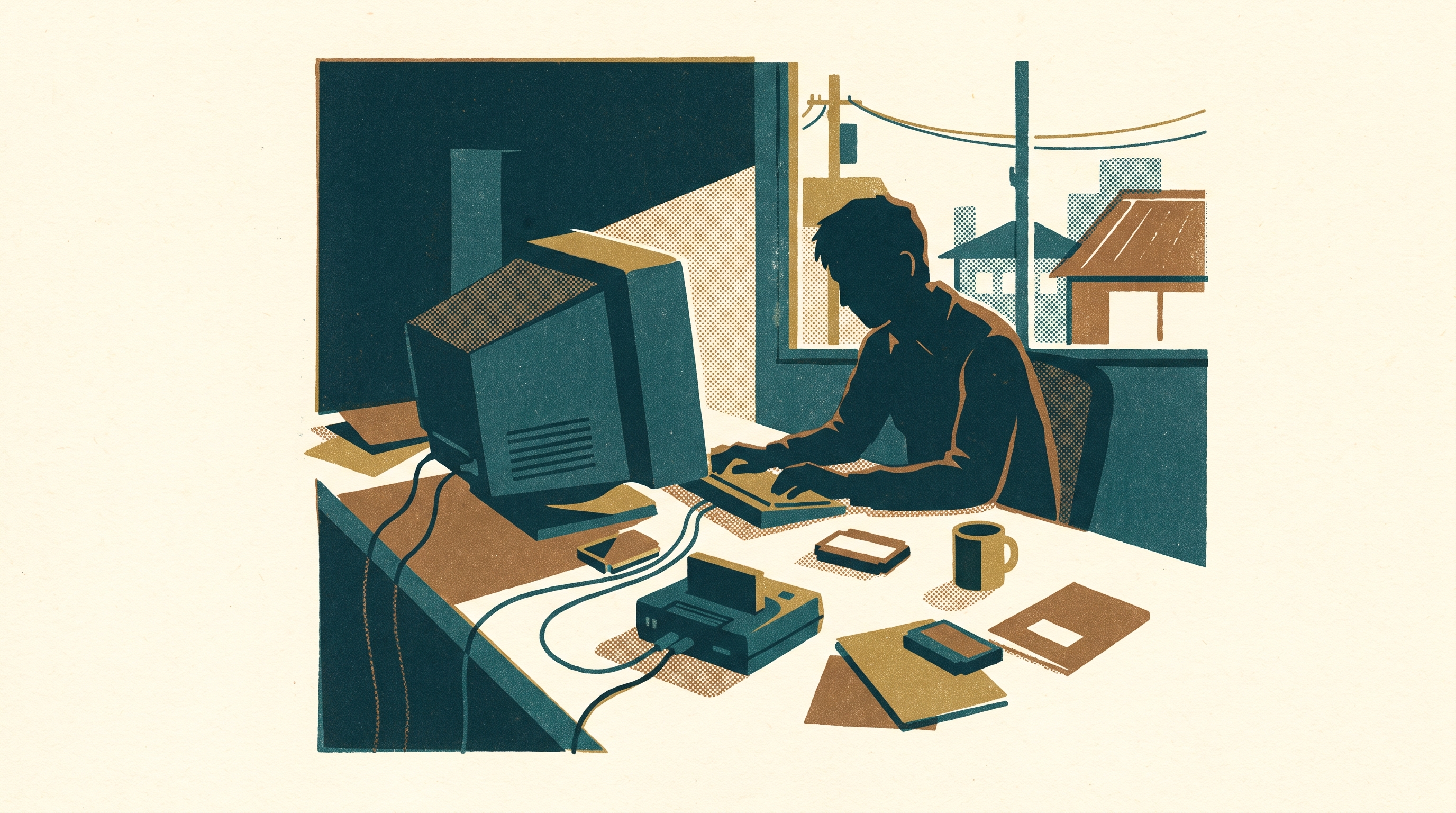
His first assignment was composing a single track and sound effects for Uchuu Keibitai SDF, a game for the Nintendo Entertainment System. He had never written music for the NES before and did not know how. HAL assigned Hideki Kanazashi, a senior composer, to teach him.
Two weeks later, Kanazashi left the company.
Ishikawa had watched. For two weeks, he had watched Kanazashi work — how he programmed the NES sound chip, what patterns he used, how he shaped melody around the machine's limitations. He had taken notes. He had asked questions. He did not know, at the time, that those two weeks would be all the formal instruction he would ever receive.
After Kanazashi left, there was no one to ask. Ishikawa kept working. He taught himself by trial, by listening, by breaking things and fixing them again. The NES had four sound channels and severe memory constraints. He learned to make music inside those walls.
In 1992, HAL Laboratory began work on a small Game Boy title about a round pink creature who could inhale enemies and copy their abilities. The game was called Kirby's Dream Land. Ishikawa composed the music. Among the tracks he wrote was one called 'Green Greens' — a bouncing, playful melody that felt like it had always existed, like something a child might hum without thinking.
'Green Greens' became one of the most recognizable themes in video game history. It appeared in nearly every Kirby game that followed, arranged and re-arranged across decades. Alongside composer Hirokazu Ando, Ishikawa also created 'Gourmet Race' and 'King Dedede's Theme,' melodies that became the sonic identity of an entire franchise.
Ishikawa's music is marked by playfulness and rhythmic complexity. He often used odd time signatures — 5/4, 7/8 — in ways that felt natural rather than academic. Fans coined the term 'Ishikawa-bushi' to describe his distinctive phrasing, a style he most likely absorbed during those two weeks with Kanazashi, who was known for similar techniques.
In April 2023, after thirty-three years at HAL Laboratory, Ishikawa left the company. He continues to compose for Kirby games as a freelancer. The soundscape he built — bright, energetic, full of small surprises — has outlasted every hardware generation it was written for.
There is no record of what Hideki Kanazashi said to Jun Ishikawa during those two weeks in 1990. There is no syllabus, no lesson plan. But somewhere in that short window, something was passed — a way of listening, a way of building joy note by note inside a machine that had almost no room for it. Thirty years later, millions of people have heard what Ishikawa learned. Most of them have no idea how little time he had to learn it.