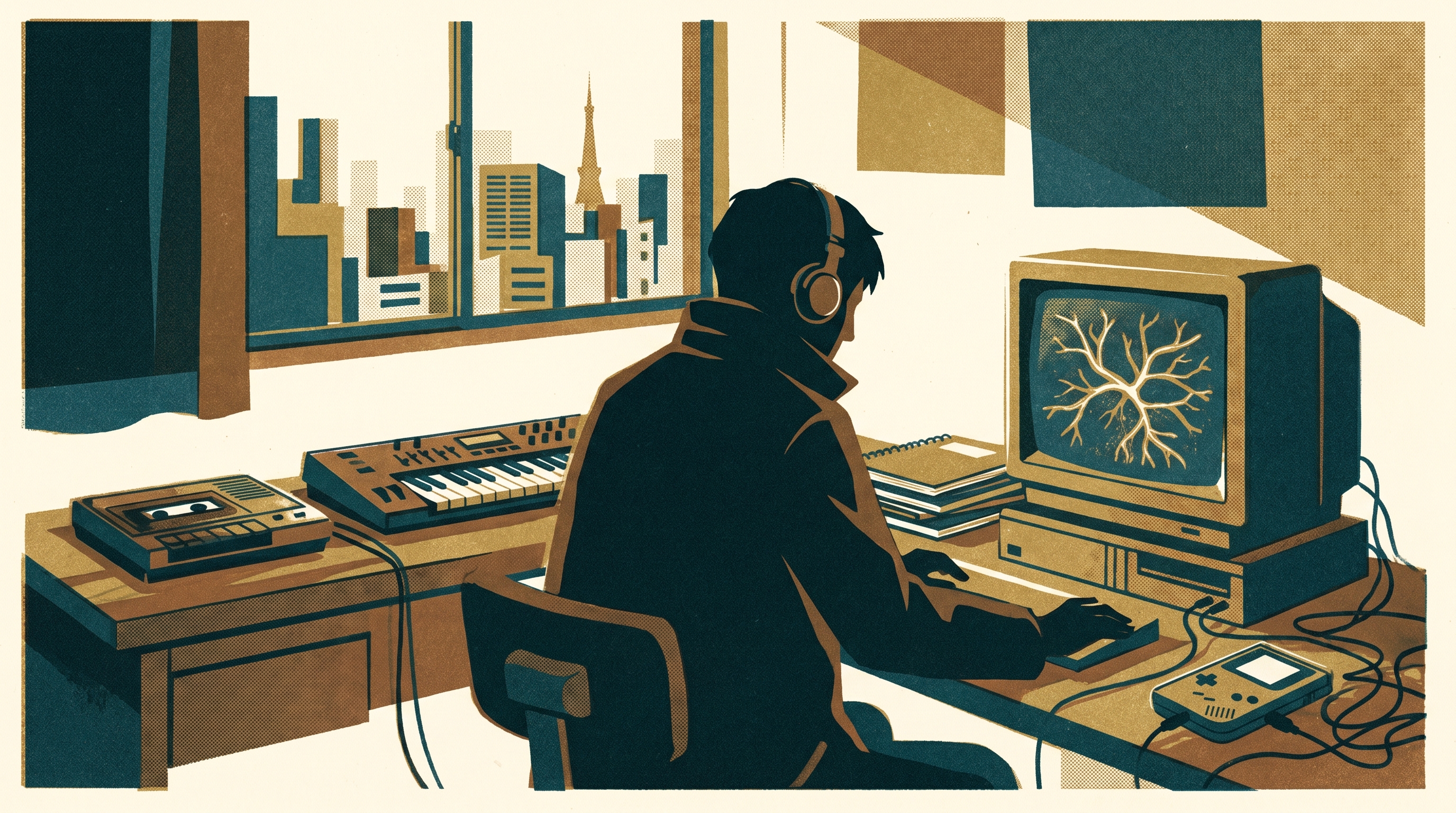
Junichi Masuda was born in Yokohama on January 12, 1968. In high school, he played the trombone. He discovered classical music then — works by Stravinsky, Shostakovich, pieces that built sound in layers and let dissonance breathe. He attended Japan Electronics College to study computer graphics and the C programming language. While he was there, a classmate introduced him to a man looking for someone who could compose music for games.
That man was Satoshi Tajiri. Game Freak was still a doujin circle, a group of friends making games between day jobs. Masuda brought a cassette tape of music he had written. Tajiri asked him to compose the soundtrack for a puzzle game called Quinty. Masuda wrote the music on weekends. He liked it. On June 1, 1989, when Game Freak became a company, Masuda left his job at a software company and joined. He said later that it had nothing to do with money or stability. He wanted to make games. He wanted to make what he wanted.

Pokémon Red and Green took six years to finish. The Game Boy hardware could only produce four channels of sound — two square waves, one noise channel, and one basic waveform. The sound was limited. Masuda composed every piece of music and created every creature's cry. He worked within the limits. He said later that because the sound palette was so narrow, he had to pour everything he had into each note.
The game was about connection. You caught creatures and trained them. You traded them with friends via a cable that linked two Game Boys together. That was the center of the design. The act of trading, of connecting, was not optional. Certain creatures could only be obtained by trading. To complete the game was to ask someone else to help.

Masuda composed music for a world where connection was the point. Routes were quiet and hopeful. Battles were tense but bright. Towns were small and safe. He wrote the music before the game was finished. He worked from the idea of a place and what it should feel like, and then the designers built the place around that feeling. Later, when the game sold millions of copies and children around the world hummed the theme from Pallet Town without being taught, Masuda said nothing about it in public. He kept working.
After Pokémon Crystal, Masuda became a director. He directed Ruby and Sapphire, Diamond and Pearl, Black and White, X and Y. The series became the highest-grossing media franchise in history. But his role shifted. He was approving character models, overseeing teams, managing production schedules. He was no longer the person writing every sound. Other composers joined. The work divided.
In June 2022, Masuda was appointed Chief Creative Fellow at The Pokémon Company. He left Game Freak after thirty-three years. He did not explain why in detail. What he said in a statement was that he wanted to continue contributing to the world of Pokémon from a different position. The music he wrote in 1996 is still in the game. Children who were not yet born when he composed it now hum the same melodies their parents did.
Connection was not a theme Masuda invented. It was something Tajiri wanted from the start — the idea that a game should bring people together, literally, through a cable. Masuda's contribution was to give that idea a sound. He made the world feel like a place worth sharing. He made the act of connecting feel warm. The game about connection connected two hundred million people. And when you open the link cable window in Pokémon Red, the sound that plays is still the one Masuda wrote, in a cramped office in Tokyo, when he was twenty-eight years old and the future was still only an idea written on graph paper.