designer
Satoshi Tajiri
田尻智
What you loved as a child isn't a detour. It can become your life's work.
About
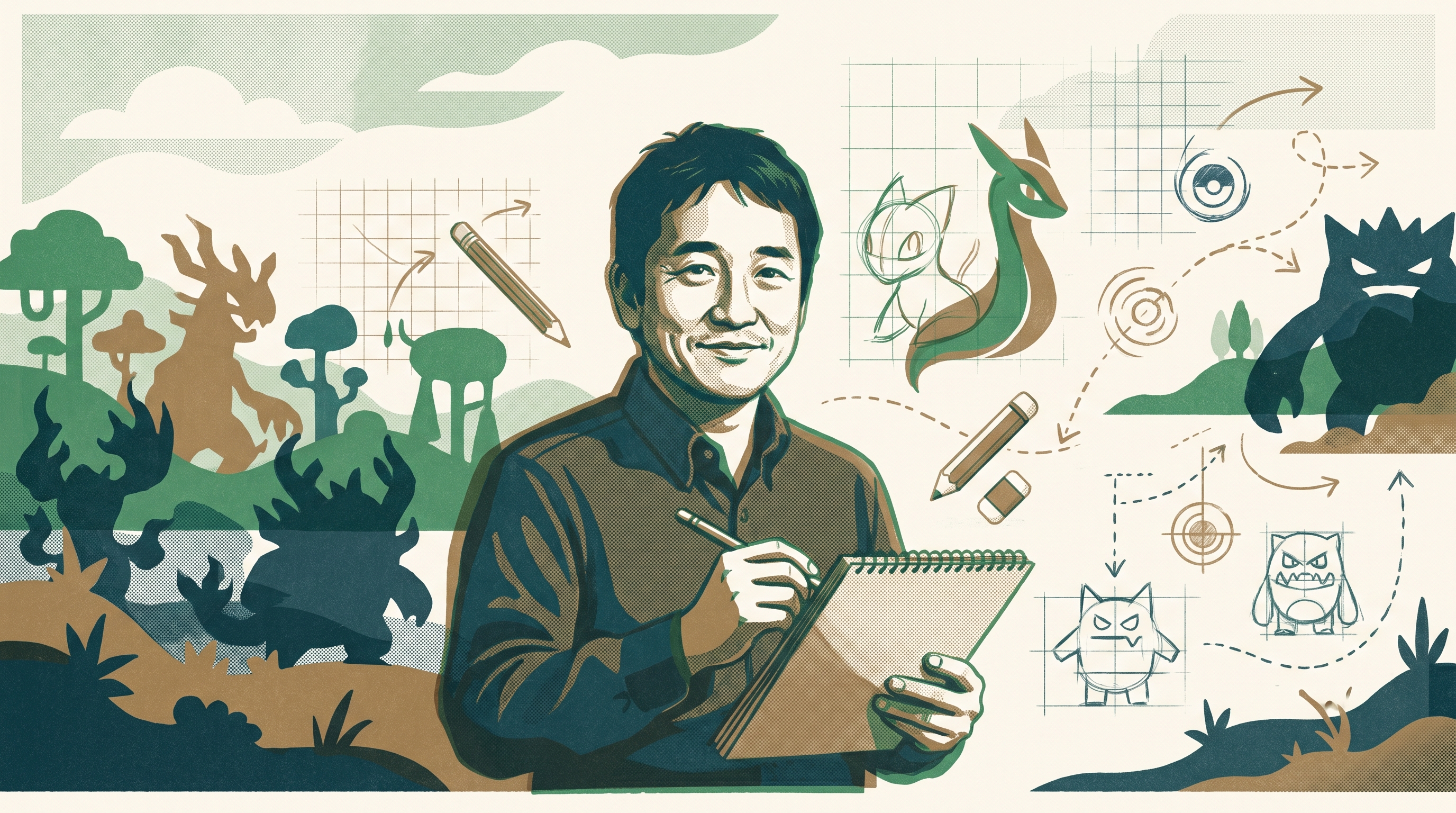
Satoshi Tajiri is a Japanese game designer and the creator of the Pokémon franchise. Inspired by his childhood hobby of collecting insects, he conceived Pokémon as a game about finding, collecting, and trading creatures via the Game Boy Link Cable. He founded Game Freak with Ken Sugimori in 1989, and spent six years developing the original Pokémon Red and Green. The games launched in Japan on February 27, 1996, and became the best-selling Game Boy titles of all time.
History
Satoshi Tajiri was born on August 28, 1965, in Setagaya, Tokyo, and grew up in the semi-rural outskirts of Machida, a city on Tokyo's southwestern edge. As a child, he spent his days hunting insects in the rice paddies, thickets, and irrigation ditches that surrounded his neighborhood, earning the nickname "Dr. Bug" from classmates. Beetles, mantises, and beetles of every variety fascinated him not for their beauty alone but for the mystery each new specimen carried. "They kind of moved funny. They were odd," he later told TIME magazine in 1999. "Every time I found a new insect, it was mysterious to me. And the more I searched for insects, the more I found."
Around 1978, when Tajiri was thirteen, the fields and woods he had roamed since childhood were swallowed by residential development. The fishing pond near his house became a game center. Confronted with a world that had traded nature for neon, he turned to the machines filling that new space — and was immediately consumed. Taito's Space Invaders, released the same year, became his gateway. He enrolled in the Tokyo Metropolitan College of Industrial Technology to study electronic engineering, but attendance held little appeal; he spent most of his school days at arcades, mastering game after game. He scraped through on supplemental coursework, earning a high school equivalency credential rather than a proper diploma, and never pursued a university degree.
In 1983, at eighteen, Tajiri channeled his obsession into a self-published fanzine he simply called "Game Freak" — a hand-stapled arcade strategy magazine he wrote, designed, and hawked by himself. One early reader, a teenager named Ken Sugimori, sent a letter praising the zine and offering his own illustrations. The two began a correspondence that would become one of the most consequential creative partnerships in the history of interactive entertainment. Sugimori's visual sensibility would eventually give the world its first look at Pikachu, Gengar, and the original 151 pocket monsters.
The conceptual seed of Pokémon was planted around 1989 to 1990 when Tajiri stared at the link cable of Nintendo's new Game Boy handheld and imagined an insect crawling along the wire from one device to another. The image was simple but electric: what if two children could trade living creatures through that cable, the way he had once traded insects caught in Machida's vanished fields? He sketched a proposal under the working title "Capsule Monsters" and began knocking on Nintendo's door. The project was a direct translation of childhood into technology — "Everything I did as a kid is kind of rolled into one," he said years later. "That's what Pokémon is."
The development that followed was a slow emergency lasting roughly six years. Five staff members quit during the project. Tajiri himself drew no salary and lived off money provided by his father. He slept at the office, bathed infrequently, and was known among colleagues as something close to homeless — subsisting on four hours of sleep a night and the singular conviction that the game was worth finishing. A catastrophic data crash at one point threatened to erase months of work. The studio survived only after an investment from APE (later reorganized as Creatures Inc.), though the price was steep: intellectual property rights to the Pokémon franchise were divided three ways among Nintendo, Game Freak, and Creatures.
What kept the project alive during those six years was a quiet vote of confidence from inside Nintendo itself. Gunpei Yokoi, the veteran engineer who had created the Game Boy, heard Tajiri's pitch and decided to support it — an act of institutional trust that gave Game Freak the room it needed. Shigeru Miyamoto joined the project as a supervisor and contributed one of its defining structural decisions: release the game in two versions with version-exclusive creatures, making trading not just an option but a necessity. Nintendo never rushed Tajiri to ship. The patience of the platform holder, as much as the tenacity of the developer, is part of why the game exists at all.
Pocket Monsters Red and Green launched in Japan on February 27, 1996. Initial shipments totaled roughly 230,000 units across both versions — a modest opening for a game that had consumed half a decade. Sales were slow until April, when CoroCoro Comic ran a reader event offering the otherwise unobtainable Pokémon "Mew" to lucky applicants; the campaign attracted 78,000 responses and ignited word-of-mouth that swept through Japanese schoolyards. Few people knew at the time that Mew existed because programmer Shigeki Morimoto had secretly inserted it into the nearly finished game as a personal surprise — a small act of mischief that accidentally became the franchise's first legend. By the end of the year, Pokémon was the bestselling game in Japan.
After the release of Pokémon Gold and Silver in 1999 — the last installment on which Tajiri served as a primary creative force — he stepped back from day-to-day development. Junichi Masuda and others have led subsequent entries. Tajiri has remained president of Game Freak but maintains an almost complete absence from public life, giving interviews rarely and appearing at industry events almost never. His legacy is not a catalog of releases but a single, total act of imagination: the conversion of a lost childhood landscape into an enduring world. The lesson Tajiri's life offers is concrete and demanding in equal measure — that the things taken from you in childhood can become the raw material of your life's work, but only if you are willing to stay in the room, without pay, without comfort, and without certainty, for as long as the work requires.
Timeline & Works
Career milestones and all 5 games in the museum they worked on — in the order they happened.
- 1965 08
Born in Setagaya, Tokyo
Satoshi Tajiri is born on August 28 in Setagaya, Tokyo. His family later moves to Machida, on the southwestern edge of the metropolis, where he spends his childhood hunting insects in rice paddies and woodlands.
people - 1978
Childhood fields vanish; discovers Space Invaders
The rice paddies and thickets Tajiri had roamed are paved over by residential development. A nearby fishing pond becomes a game center. Around this time, the thirteen-year-old encounters Taito's Space Invaders and shifts his obsessive energy from insects to arcade machines.
milestone - 1983
Fanzine "Game Freak" founded
Tajiri self-publishes an arcade strategy fanzine titled "Game Freak," writing and distributing it entirely on his own. Reader Ken Sugimori sends a letter in response; the correspondence marks the beginning of the creative partnership that will eventually produce Pokémon's iconic visual identity.
founding - 1989 04
Game Freak Inc. established; Quinty released
Game Freak is incorporated on April 26 in a Shimokitazawa apartment. Funding is drawn from royalty income earned on Quinty, published by Namco on June 27 of the same year.
founding - 1990
Pokémon concept pitched to Nintendo
Inspired by the image of an insect crawling along a Game Boy link cable, Tajiri conceives "Capsule Monsters" — a game built around trading living creatures between two handhelds. He brings the proposal to Nintendo, where Gunpei Yokoi agrees to support development and Shigeru Miyamoto later proposes the dual-version structure.
product - 1991
Yoshi's Egg released — contract work sustains studio
Game Freak develops Yoshi's Egg for Nintendo as contract work during the long Pokémon development cycle. The revenue helps sustain the studio through the lean years while the core team continues building the monster-trading RPG.
product - 1991
- 1994
Pulseman released (Sega Mega Drive)
Game Freak releases Pulseman for the Mega Drive through Sega — another revenue lifeline during the Pokémon development marathon. The title later gains cult status among fans of 16-bit action platformers.
product - 1994
- 1996 02
Pocket Monsters Red & Green launch in Japan
After approximately six years of development, Pocket Monsters Red and Green are released on February 27. Initial shipments total roughly 230,000 units. Sales accelerate dramatically after CoroCoro Comic runs a Mew giveaway event attracting 78,000 applicants, and the franchise explodes across Japanese schoolyards.
product - 1996 04
Mew campaign triggers national phenomenon
CoroCoro Comic's Mew distribution event reveals the existence of a hidden Pokémon secretly inserted by programmer Shigeki Morimoto. The campaign generates 78,000 applications and creates a word-of-mouth wildfire that transforms modest sales into a cultural phenomenon.
milestone - 1996
- 1998
- 1999
Pokémon Gold & Silver — final direct involvement
Gold and Silver are released in Japan on November 21, representing Tajiri's last project as a primary creative force on the main series. Satoru Iwata of HAL Laboratory provides compression tools that allow both the new Johto region and the entire original Kanto map to fit on a single Game Boy cartridge.
product - 1999
Connections
- collaborated with nintendo (1990–present)
Nintendo served as publisher and platform holder for the Pokémon series from its inception. Gunpei Yokoi championed the original pitch and Shigeru Miyamoto supervised development, proposing the dual-version structure that became central to the franchise.
- collaborated with gunpei-yokoi (1990–1996)
Gunpei Yokoi was the Nintendo engineer who agreed to support Tajiri's Pokémon pitch and served as the internal advocate who gave Game Freak the institutional runway to complete a six-year project.
- collaborated with satoru-iwata (1999–1999)
Satoru Iwata of HAL Laboratory provided the data-compression tools that allowed Pokémon Gold and Silver to include both the new Johto region and a fully playable Kanto region on a single Game Boy cartridge.
Also connected to
- Junichi Masuda co-created Pokémon Yellow / co-created Pokémon Red and Green / co-created Pulseman / co-created Yoshi (Mario & Yoshi)
- Shigeru Miyamoto co-created Pokémon Red and Green / co-created Yoshi (Mario & Yoshi)
- Ken Sugimori co-created Pokémon Red and Green
Explore the work
Each title has its own page — history, trivia, and collector's notes.
Game Boy Color · 1999
Pokémon Gold Version / Silver Version
The final boss is the protagonist from the first game. He hasn't spoken since 19…
Game Boy · 1998
Pokémon Yellow
Your starter isn't in a ball. He's the one walking behind you — and whether he l…
Game Boy · 1996
Pokémon Red and Green
Some things can't be finished alone — and that isn't a flaw in the design. It's …
Sega Mega Drive / Genesis · 1994
Pulseman
The team that built Pokémon built this first.…
Family Computer (Famicom) / NES · 1991
Yoshi (Mario & Yoshi)
They needed to make Pokémon — so they made a puzzle game first.…
Rooms their games live in
Sources
- 田尻智 — Wikipedia(日本語) — accessed 2026-05-29
- Satoshi Tajiri — Wikipedia (English) — accessed 2026-05-29
- The Ultimate Game Freak — TIME Magazine Interview (1999) — accessed 2026-05-29
- How Mew Saved Pokémon — GameSpot — accessed 2026-05-29
- Motivation Behind Pokémon Was Not to Make Money — FandomWire — accessed 2026-05-29
From the Museum's Screening Room
Tajiri Vacant Lot — Dark Exhibit
Tajiri Pokemon Took No Salary — Feature