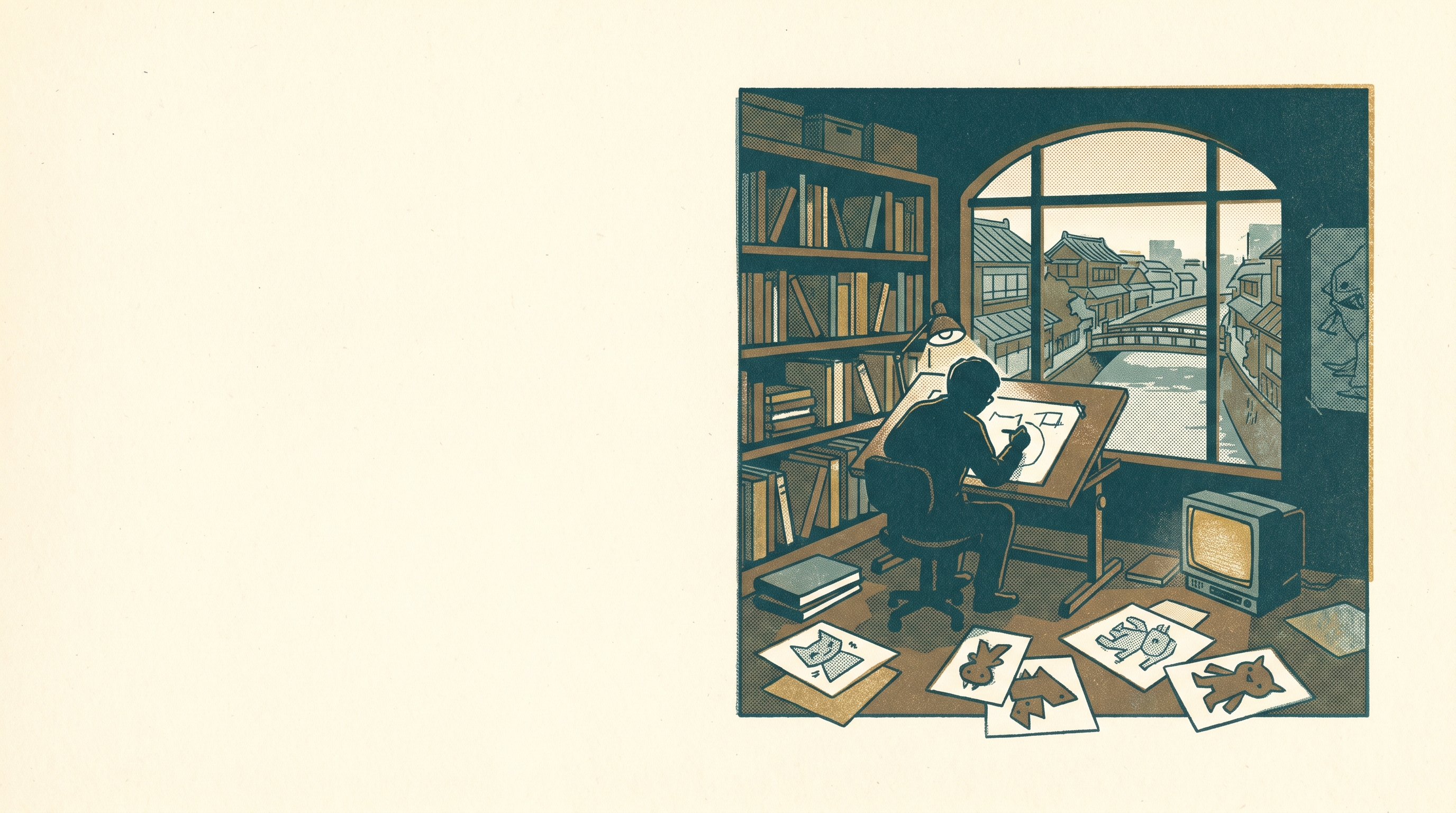
Ken Sugimori joined Satoshi Tajiri's arcade-game fanzine in the early 1980s as its illustrator. The magazine was called Game Freak, hand-assembled and sold through game shops. Sugimori drew what Tajiri wrote. They became friends. In 1989, they turned the fanzine's name into a company.
Game Freak Inc. started small. The office in Kanda, Tokyo rarely exceeded a dozen people. The early work was made-for-hire — a puzzle game for Namco, later a Mario spinoff for Nintendo. Competent projects that paid the bills. During those lean years, a far larger idea was taking shape. Tajiri wanted to make a game about collecting creatures. Sugimori would draw them.
The project was called Capsule Monsters, later renamed Pocket Monsters. Development dragged on for six years. The Game Boy's tiny monochrome screen meant every creature had to read clearly as a silhouette. Sugimori produced the designs almost entirely alone, at a pace of several creatures a week. One hundred and fifty-one in total. Each one had to feel like both a believable animal and a character a child would want.
There was no visual precedent for this. Sugimori could not look at what others had done, because no one had done it at this scale. He established a system: encode both biology and personality into each design. A creature's stance, shape, and expression would tell you what it was and how it felt about you. The constraint of the hardware forced a clarity that still defines the franchise today.
When Pokémon Red and Green released on February 27, 1996, initial sales were modest. The game had been delayed multiple times, and Nintendo's internal expectations were cautious. But word spread among children. By the end of the year, the game had become a phenomenon in Japan. A year later, it reached the rest of the world. The creatures Sugimori had drawn alone in a small Tokyo office became the most recognized roster of characters in gaming history.
After release, Sugimori redrew all 151 Pokémon in watercolor for promotional use. While doing so, he revised and refined many elements. These paintings became the official artwork — the version the public would see on cards, posters, and guidebooks. The in-game sprites were pixelated approximations. The watercolors were the creatures as Sugimori intended them to be seen.
As the franchise grew, the design work spread across a team Sugimori supervised. The roster crossed a thousand species. New generations arrived in cycles. But the visual language he established in those six years — the clarity of silhouette, the encoding of personality into posture — remained the template every later generation would follow.
His career is a quiet argument that the look of a world is what makes people want to live inside it. One hundred and fifty-one creatures, drawn by hand, became the foundation of the highest-grossing media franchise in history. Not because they were realistic, but because each one felt alive.
The question left by his work is not about talent or success. It is about patience. How long are you willing to sit in a small room, drawing one small creature at a time, before the world you are building becomes visible to anyone else?