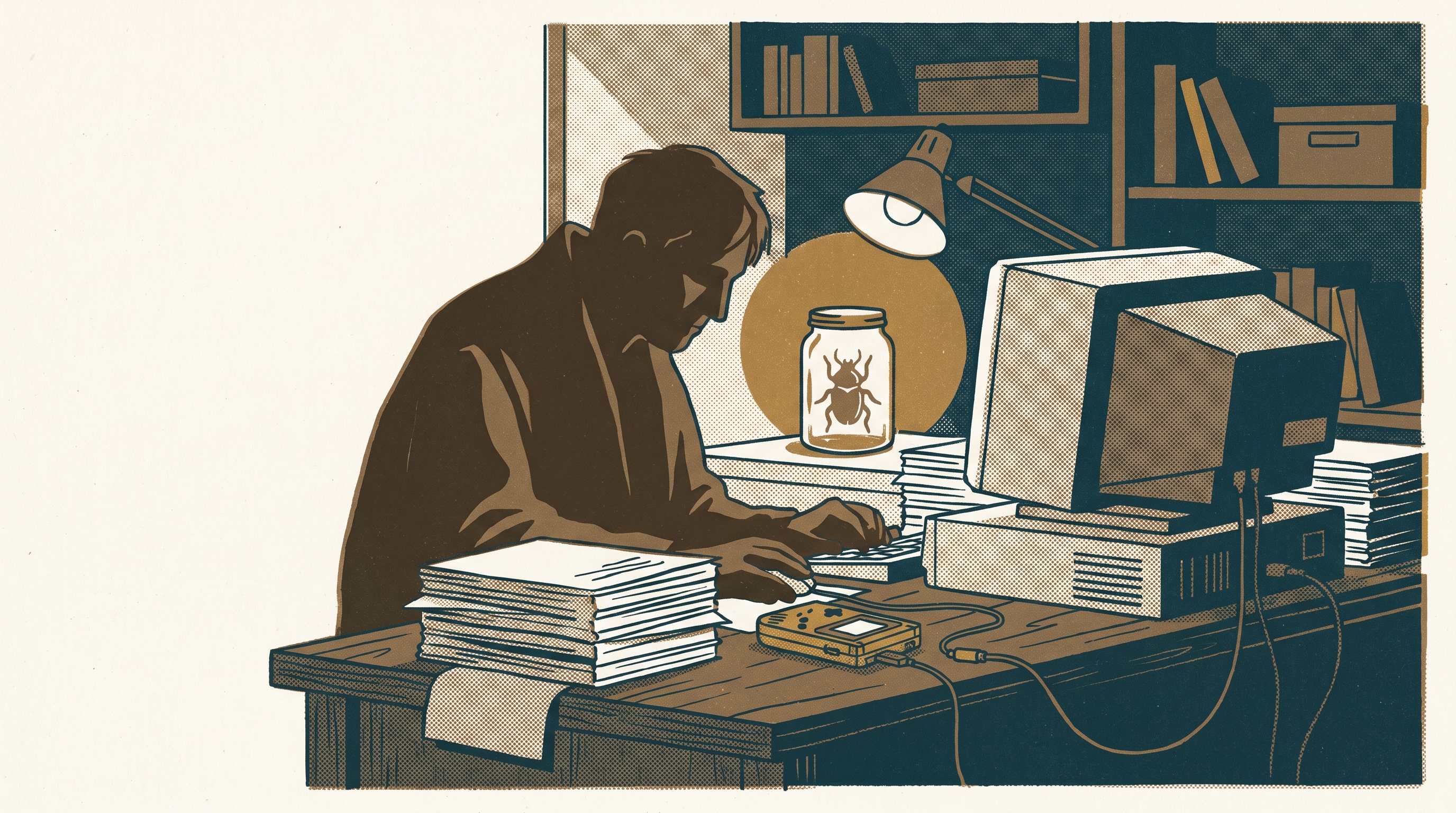
In the fields and rice paddies around the town of Machida, on the outskirts of Tokyo, a boy spent his childhood chasing insects. Beetles mostly. He was known to the children in the neighborhood as Dr. Bug. He would come home with jars full of things most adults would not want to touch. He was happy.

Then the fields were built over. One by one, the lots were cleared and houses went up. The insects had nowhere to go, and neither did the boy. He was somewhere around middle school age when the last of his hunting grounds disappeared. Later, he would talk about this as a real loss — not dramatic, just true. The places where he had spent his best hours were gone.
He found something else. In a game center, he stood in front of a Space Invaders machine and felt the same thing: total absorption. The same vanishing of time that had happened in the fields. He became interested in how games worked, then obsessed. At the Tokyo Institute of Technology College of Technology, studying electronics, he began writing a fanzine about games — a photocopied newsletter he sold at Comiket, filled with reviews and strategies. He called it Game Freak. A cartoonist named Ken Sugimori read it and wrote him a letter. They started working together.
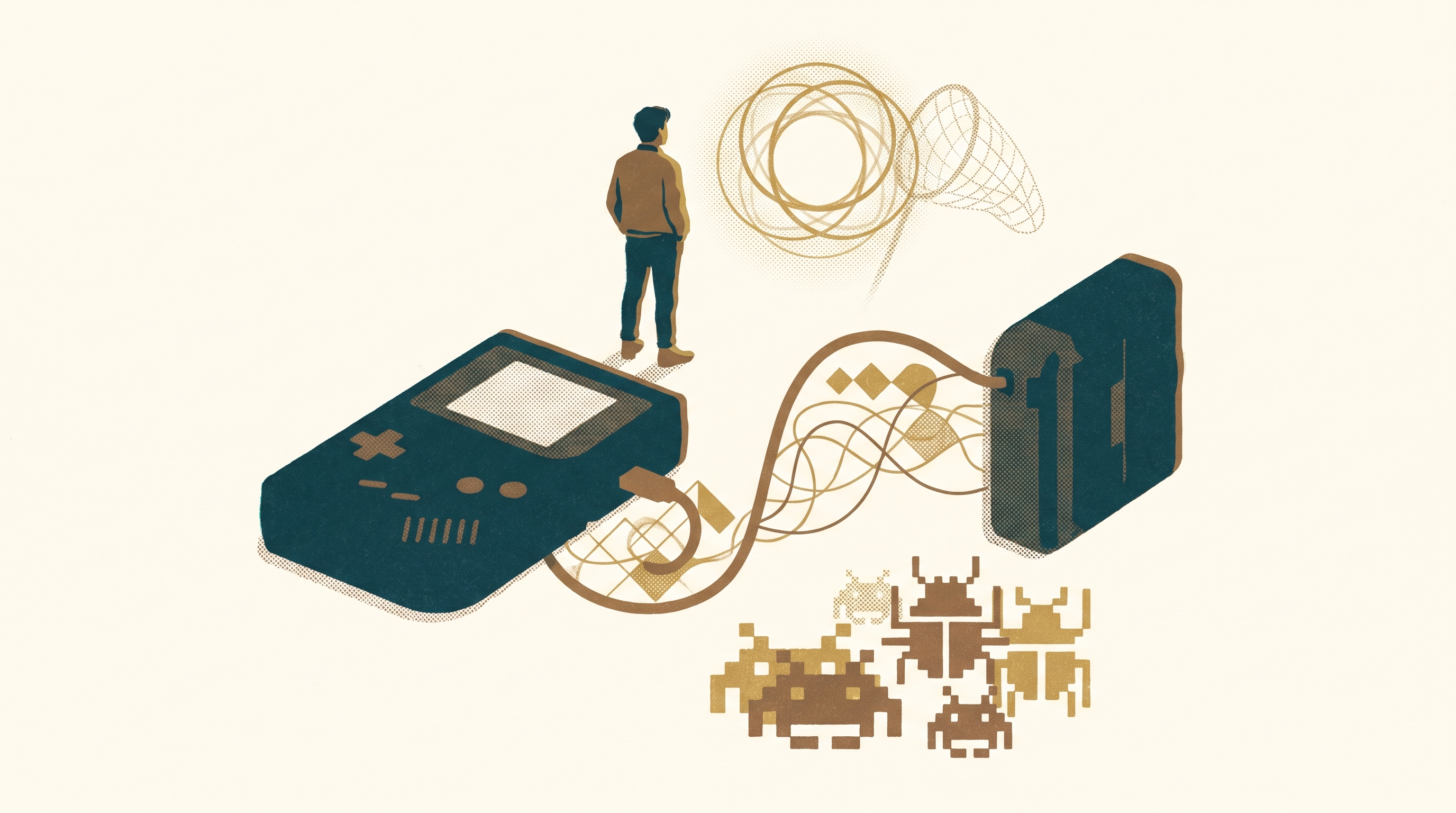
By 1989, the fanzine had grown into a small company, also called Game Freak. Their first commercial release, Quinty, came out that year on the Famicom, published by Namco. It sold around two hundred thousand copies. The same year, Nintendo released a grey handheld device called the Game Boy, along with a communication cable that let two units exchange data. Tajiri saw the cable and thought about insects. He thought about the beetle he had kept in a jar, and the one a friend had, and the moment of showing each other what you had found. He thought: what if the verb was not just play, but trade?
In the autumn of 1990, Tajiri — twenty-five years old, with a company of two — walked into Nintendo's headquarters in Kyoto and presented a design document. He called the concept Capsule Monsters. The proposal took six years to become a finished product.
The development stopped completely in 1992. The reasons are not fully documented, but the small team ran out of resources and the project was suspended. Gunpei Yokoi, who had overseen Game Boy hardware, brought Game Freak in to develop Yoshi's Egg as contract work — a way to keep the company alive. The game sold over a million copies on Famicom and over three million on Game Boy. It bought time. In 1994, development on the monster-trading game resumed. By then the working title had changed: a trademark conflict meant Capsule Monsters could not be used. The project became Pocket Monsters.
During those years, several programmers left. The exact number depends on the source — some accounts say three, others say more. Tajiri himself, according to accounts that have circulated widely, did not draw a salary during much of the development. He lived on his father's income. The game he was making had no guarantee of success. The Game Boy was six years old. There were faster, brighter machines on the market. A game built around two cartridges, a link cable, and the premise that players would seek each other out in the real world was not an obvious bet.
Pocket Monsters Red and Green were released on February 27, 1996. The initial shipment was approximately 130,000 units for both versions combined. Sales were moderate. Then, on April 15, 1996, the monthly manga magazine CoroCoro Comic printed a story about a hidden creature named Mew that could only be obtained through special events. Word spread the way it does among children — sideways, at school, in the same fields where insects had once been traded. The games found their audience.
By the time the run ended, Pocket Monsters Red and Green had sold over eight million copies in Japan — more than Super Mario Bros., the best-selling single game on the Famicom. The boy who had been called Dr. Bug said in an interview three years later that Pokémon had always been about his childhood. About the time he spent chasing insects in Machida. 'It is a game about the memories of when I was a kid,' he said. That is what eight million people bought.