composer
Junichi Masuda
増田順一
He wrote the music for a game about connection — and the game connected two hundred million people.
About
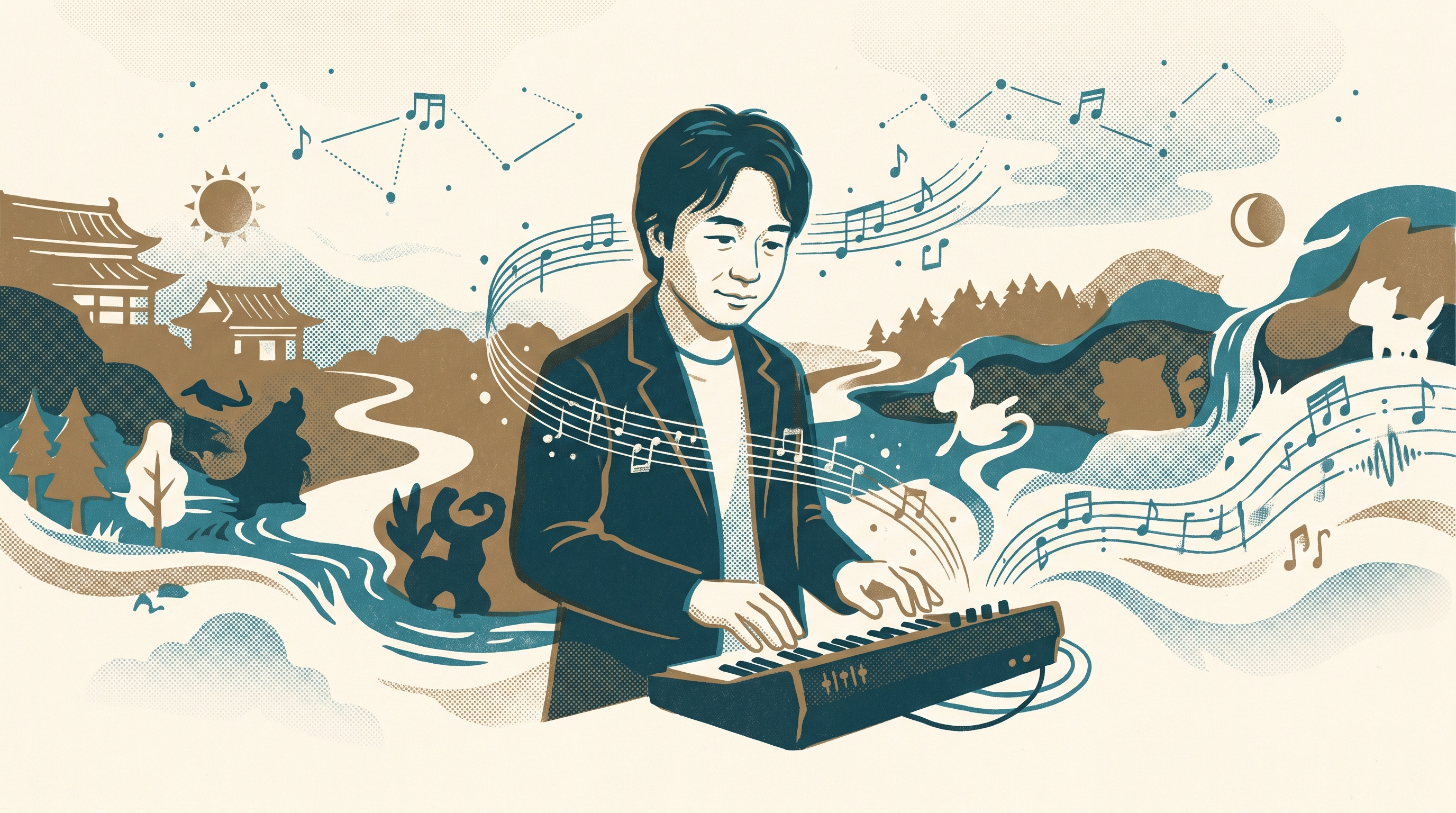
Junichi Masuda is a Japanese game composer, director, and producer who joined Game Freak in 1989. He composed the music for the original Pokémon Red and Green (1996) on the Game Boy, working within the constraints of a single sound chip to create melodies that became globally recognized. Over the following decades he transitioned into directing, leading Pokémon Ruby and Sapphire (2002), Diamond and Pearl (2006), HeartGold and SoulSilver (2009), X and Y (2013), and Omega Ruby and Alpha Sapphire (2014). He later served as CEO of Game Freak.
History
Junichi Masuda was born on January 12, 1968, in Kanagawa Prefecture, Japan. He grew up playing video games and became interested in both music and programming — a combination of skills that was unusual and, as it turned out, precisely what a small startup called Game Freak needed. He joined the company in 1989, becoming one of its earliest employees, at a point when Game Freak was still primarily known as a video game magazine before it transitioned into game development.
Masuda's first major project as composer was Pulseman (1994), a Sega Mega Drive game developed by Game Freak. The soundtrack demonstrated his ability to write punchy, memorable themes within the strict technical constraints of console sound hardware. But the work that would define his career came next: the entire soundtrack for Pokémon Red and Green (1996), written for the original Game Boy. The Game Boy's sound chip offered four channels — two pulse wave generators, a wave channel, and a noise generator — and within those constraints Masuda wrote the overworld theme, the battle themes, the town themes, and the brief melodic gestures that each became inseparable from the Pokémon experience. The music worked because it was designed to be looped indefinitely without becoming irritating, which required both compositional skill and a precise psychological understanding of how music feels over time.
Pokémon Red and Green sold 10 million copies in Japan alone and went on to become one of the best-selling franchises in entertainment history. The music Masuda wrote for the original games traveled with that success — into the animated series, into merchandise, into the cultural memory of an entire generation of players in Japan, North America, Europe, and beyond. By the time the international release arrived as Pokémon Red and Blue in 1998, the melodies were already part of something larger than any single game.
As the Pokémon series grew, Masuda transitioned from composer to director — a relatively unusual career path, but one that made sense for someone who understood the franchise at a foundational level. His directorial credits include Pokémon Ruby and Sapphire (2002), which introduced the third generation and the Hoenn region; Pokémon Diamond and Pearl (2006), which brought Pokémon to the Nintendo DS with full touchscreen and wireless functionality; HeartGold and SoulSilver (2009), remakes of the beloved Gold and Silver titles that many players consider the high point of the series; Pokémon X and Y (2013), which brought the franchise to full 3D on the Nintendo 3DS; and Omega Ruby and Alpha Sapphire (2014). Each generation expanded the franchise while attempting to preserve the core loop — catch, train, battle, trade — that Masuda had helped design from the beginning.
Throughout his directorial work, Masuda has been vocal about the philosophy he brings to Pokémon design. He has spoken consistently about the franchise's founding intention: to recreate, for children growing up in an urbanizing Japan, the experience of catching insects in the wild that was disappearing from their everyday lives. That origin — childhood exploration, the pleasure of finding something alive and unexpected — remained the north star of his design decisions even as the series scaled to hundreds of millions of players. The music, composed for a single Game Boy cartridge in 1995, was already an expression of that intention: it made the world feel worth exploring.
Masuda later became CEO of Game Freak, a position that gave him oversight of the studio's direction as both a creative and business entity. His career is a case study in what it means to stay with a project long enough to understand it from every angle — composer, director, executive — and to carry the founding intentions forward through decades of technological change. The Pokémon franchise generated more than $150 billion in lifetime revenue across all media as of the mid-2020s, making it the highest-grossing media franchise of all time. The Game Boy soundtrack Masuda wrote in his late twenties is, in a precise sense, the sonic foundation of that entire edifice.
Timeline & Works
Career milestones and all 6 games in the museum they worked on — in the order they happened.
- 1968 01
Born in Kanagawa Prefecture, Japan
Junichi Masuda was born on January 12, 1968, in Kanagawa Prefecture.
people - 1989
Joined Game Freak
Masuda became one of Game Freak's earliest employees, bringing both programming and music skills to the fledgling studio.
career - 1991
- 1994
Pulseman — debut as game composer
Masuda composed the soundtrack for Pulseman on the Sega Mega Drive, demonstrating his ability to write memorable themes within console hardware constraints.
product - 1994
- 1996
Pokémon Red and Green — the founding soundtrack
Masuda composed the entire Pokémon Red and Green soundtrack for the Game Boy, within four audio channels — creating melodies that became globally recognized and inseparable from the franchise.
milestonepokemon-red-blue - 1996
- 1998
- 1998
- 2000
- 2002
Pokémon Ruby and Sapphire — first directorial credit
Masuda directed his first Pokémon generation, introducing the Hoenn region and the third generation of Pokémon.
product - 2006
Pokémon Diamond and Pearl — Nintendo DS
He directed the franchise's first DS entry, bringing wireless connectivity and touch functionality to the core Pokémon experience.
product - 2013
Pokémon X and Y — full 3D on Nintendo 3DS
Masuda directed the franchise's transition to full 3D, the most visually significant leap since the original games.
product
Also connected to
- Satoshi Tajiri co-created Pokémon Yellow / co-created Pokémon Red and Green / co-created Pulseman / co-created Yoshi (Mario & Yoshi)
- Shigeru Miyamoto co-created Pokémon Red and Green / co-created Yoshi (Mario & Yoshi)
- Ken Sugimori co-created Pokémon Red and Green
Explore the work
Each title has its own page — history, trivia, and collector's notes.
Game Boy Color · 2000
Pokémon Crystal
The third trip through the same towns — and the one that finally let a girl lead…
Game Boy · 1998
Pokémon Yellow Version: Special Pikachu Edition
A child collected insects. That memory became a game. The game became a show. Th…
Game Boy · 1998
Pokémon Yellow
Your starter isn't in a ball. He's the one walking behind you — and whether he l…
Game Boy · 1996
Pokémon Red and Green
Some things can't be finished alone — and that isn't a flaw in the design. It's …
Sega Mega Drive / Genesis · 1994
Pulseman
The team that built Pokémon built this first.…
Family Computer (Famicom) / NES · 1991
Yoshi (Mario & Yoshi)
They needed to make Pokémon — so they made a puzzle game first.…
Rooms their games live in
Sources
- GDC Talks — Junichi Masuda on Pokémon design philosophy
- Pokémon franchise lifetime revenue documentation