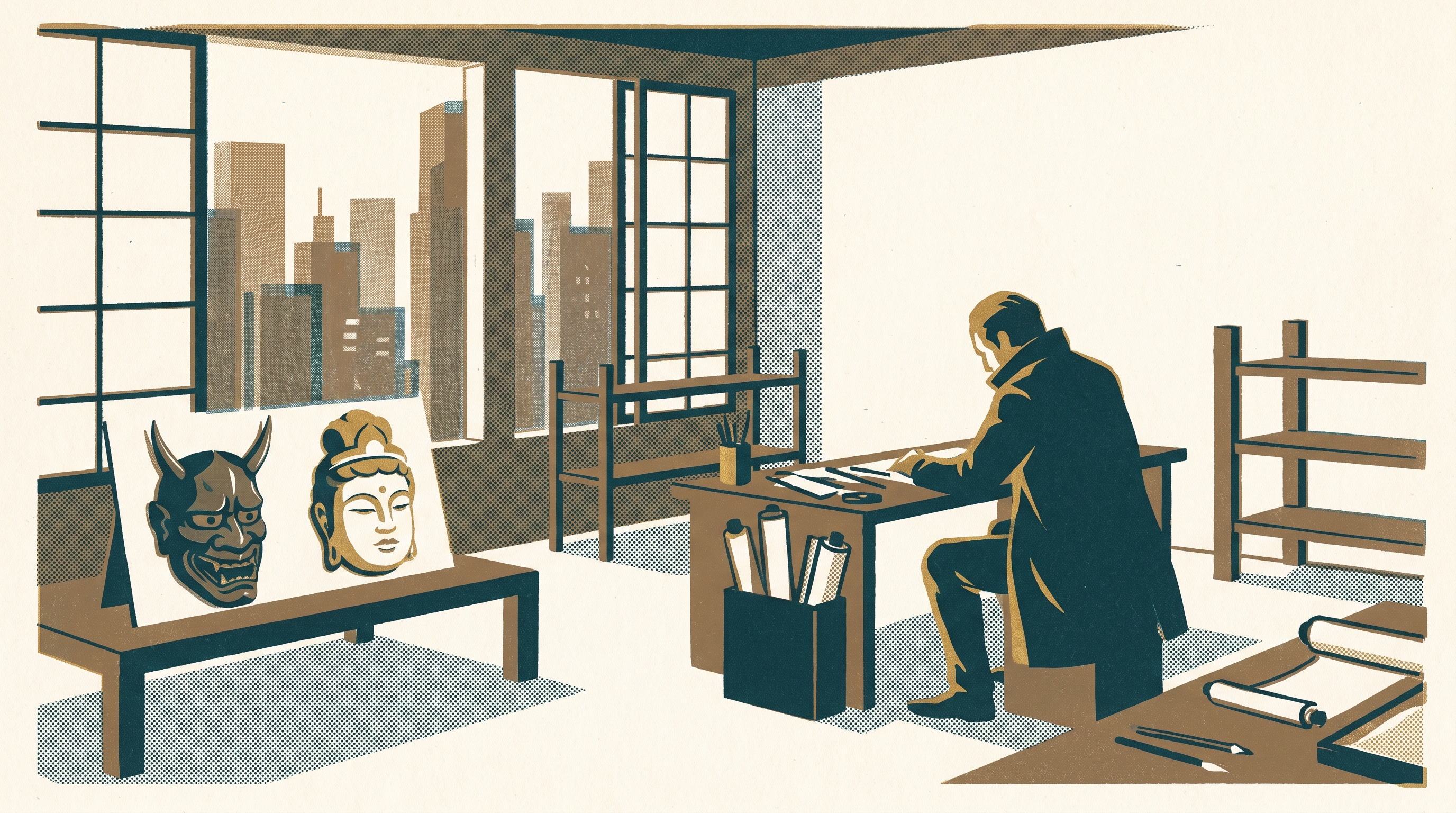
Kazuma Kaneko was born in Tokyo's Fukagawa neighborhood on September 20, 1964, to a family that ran a sushi restaurant. As a child he was drawn to yokai and the occult — the creatures that lived in the cracks between the ordinary and the inexplicable. After finishing high school, he worked for a time as a freeter, then became an animator, working on subcontracted American cartoons like The Transformers and on Japanese anime productions.
In February 1988, he joined Atlus, a small game company in Tokyo. He was a fan of RPGs and had played Digital Devil Story: Megami Tensei. The company had a problem: they needed someone to design demons. Hundreds of them. Creatures drawn from Hindu, Buddhist, Christian, Norse, Greek, Shinto traditions and the mythologies of Africa, the Americas, South and East Asia. Kaneko was given the assignment.
Most games of that era filled monster rosters with invented creatures — shapes designed to look dangerous or exotic. Kaneko decided to do the opposite. Before drawing a demon, he researched it in primary sources. He studied Hindu iconography, Christian demonology texts, Norse sagas, Shinto tradition. He worked to understand what each being was in its original context — what it represented, how it was described, why it mattered — before translating it into pixels.
This approach produced a catalog of hundreds of demon designs, each drawn with precise linework and a geometric art deco sensibility. The demons looked like their mythological sources, but they existed within a coherent design vocabulary. They all felt like they came from the same hand. A player encountering a Hindu deva, a Christian angel, a Norse giant, and a Japanese spirit in the same game could see that each had been treated with the same degree of attention and respect.
The work gave the Megami Tensei series something other RPGs did not have: authority. These were not made-up monsters. They were beings that had existed in human imagination for centuries or millennia. The games became places where a player could negotiate with demons, recruit them, fuse them into new forms — not as empty mechanics, but as engagements with traditions that carried history.
Over thirty-five years at Atlus, Kaneko worked as character designer, art director, creature designer, and director on titles across the Megami Tensei franchise and its spin-offs: Shin Megami Tensei, Devil Summoner, Persona. His visual language became the franchise's visual language. His demons became the franchise's demons. The influence was not merely aesthetic — the research-first approach shaped how the series treated mythology as material. The games were asking: what happens when gods from different traditions meet? What does it mean to choose one over another? What happens when belief systems collide in the same city?
In 2023, Kaneko left Atlus and joined COLOPL, a Tokyo-based publisher. He had spent thirty-five years drawing the faces of gods and demons. The question that had driven the work from the beginning remained simple: what does this being actually look like? The answer was never invented. It was researched.
Good and evil, in Kaneko's catalog, were not as far apart as some traditions claimed. A demon in one culture was a protector in another. A god could be wrathful. A devil could be reasonable. The distinctions blurred at the edges. The faces, when drawn honestly from their sources, often looked disturbingly similar.
The catalog sits in the games now, still being encountered by new players who do not know they are walking through a library of traditions. They see a demon. They do not always know it has a history. But the history is there, built into the linework, present in the proportions — a single artist's thirty-five-year argument that accuracy carries more weight than invention, that the old stories matter, and that the beings drawn from them deserve to be shown as they are, not as they might have been imagined by someone who did not do the work of looking.
— The player who recruits a demon in a Megami Tensei game does not always ask: who drew this, and why does it look like this? But the answer shapes what they feel when they see it. A creature invented to fill a slot is just data. A creature drawn from centuries of belief is a question left open: what does it mean that this being is here, and that you, the player, are deciding what to do with it?