illustrator
Kazuma Kaneko
金子一馬
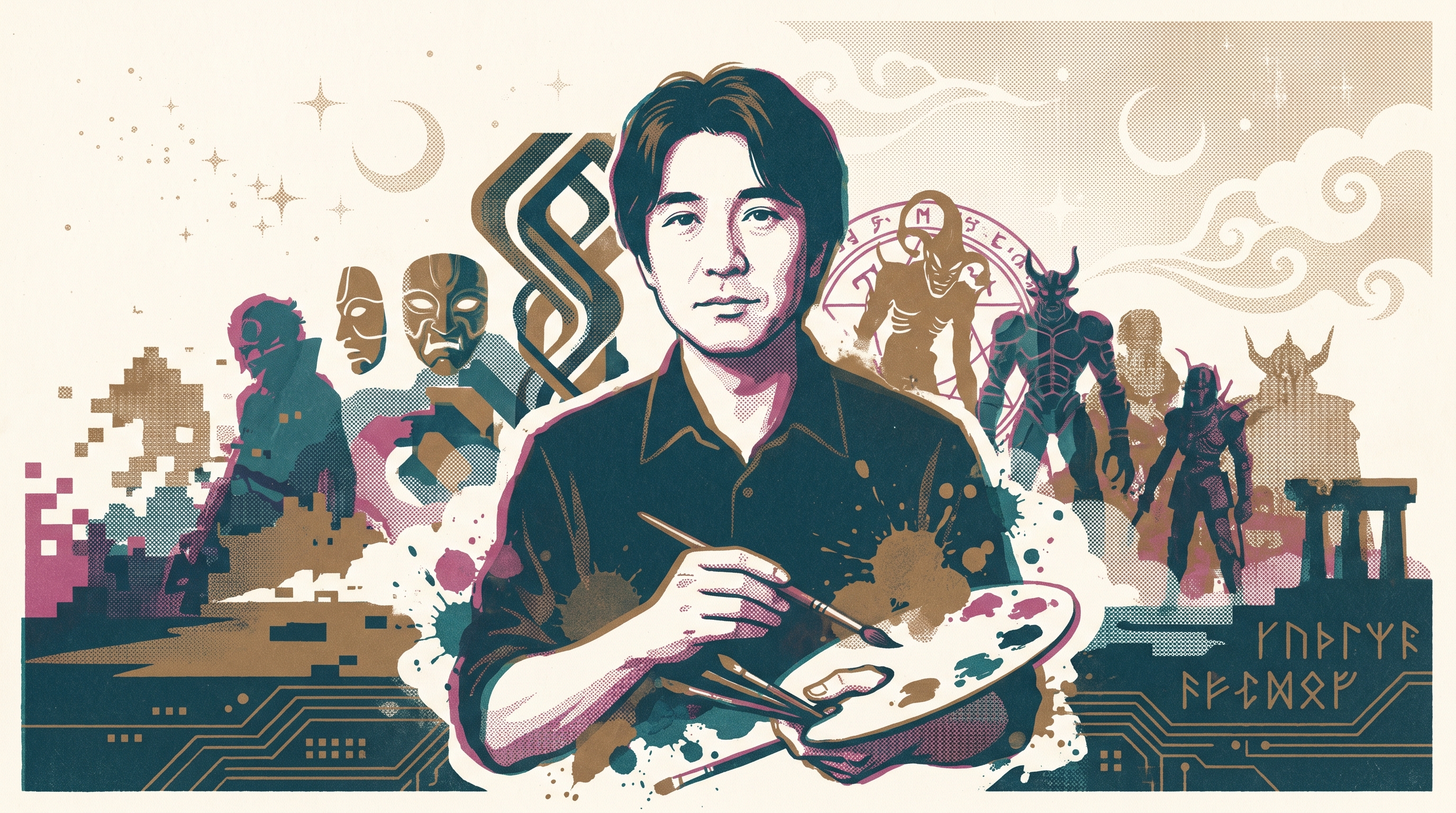
Kazuma Kaneko designed hundreds of demons for the Atlus franchise by studying each creature in its original mythological tradition first. The accuracy was the point — a demon that looks like what it actually is carries more weight than one invented to look scary.
About
Kazuma Kaneko is an illustrator and game director who joined Atlus in the mid-1980s and became the primary visual architect of the Megami Tensei franchise. His demon designs — drawn from Hindu, Christian, Norse, Japanese, Greek, and dozens of other mythological traditions — gave the series a visual consistency and intellectual credibility that distinguished it from other RPGs of the era. Where most games invented creatures to fill monster slots, Kaneko researched each demon in primary sources before drawing it. The resulting designs looked like the things they were supposed to be, which gave the franchise an implicit argument: these traditions matter, these beings carry history, and the player is engaging with something that existed long before this cartridge.
History
Kazuma Kaneko joined Atlus in the mid-1980s, arriving as a young illustrator at a company that was about to produce its most ambitious title to date. The original Megami Tensei (1987), developed for Namco, required visual designs for demons drawn from a wide range of mythological traditions — Hindu devas, Christian angels, Norse giants, Japanese spirits, Lovecraftian entities. Kaneko approached this not as a design problem but as a research problem: understanding what each being was in its original context before translating it into game art.
The franchise's distinctive demon aesthetic — recognizable monochromatic sketch quality in promotional materials, precise linework, an art deco geometric sensibility in character proportions — developed over the late 1980s and early 1990s as Kaneko refined his approach across successive Atlus projects. By the time Shin Megami Tensei arrived for the Super Famicom in 1992, the visual language was established: a demon that looked like its mythological source but existed in a coherent internal design vocabulary that made the entire roster feel like it came from one mind.
Kaneko's research methodology was distinctive in an industry where creature design was typically generated quickly and intuitively. He studied Hindu and Buddhist iconography, Christian demonology texts, Norse and Greek mythology, Shinto tradition, and the mythological traditions of cultures across Africa, the Americas, and South and East Asia. The result was a catalog of demon designs that spanned hundreds of entities, each drawn in a style consistent with the others but referencing its actual origin.
The expansion of the franchise through the 1990s — Shin Megami Tensei II (1994), Soul Hackers (1997), the original Persona (1996), and Persona 2 Innocent Sin and Eternal Punishment (1999) — was visually anchored by Kaneko's designs. As the franchise grew, his role expanded from illustrator to art director to, eventually, game director. His work on SMT: Strange Journey (Nintendo DS, 2009) included scenario design and direction in addition to character and demon art.
The consistency of Kaneko's demon catalog across the franchise's decades is one of its defining characteristics. Players who encounter a demon in Persona 5 are often looking at a design Kaneko produced in the early 1990s — updated but not reinvented, the same visual logic applied to each new platform. This continuity is unusual in a medium where visual styles typically shift dramatically between hardware generations.
Kaneko's influence on the broader anime and game visual culture is difficult to measure but visible. The monochromatic illustration style he developed for Atlus promotional materials was widely referenced in the 1990s and 2000s. His approach to designing mythological beings with research-first precision influenced subsequent generations of concept artists working in fantasy and RPG contexts.
Timeline & Works
Career milestones, in the order they happened.
- 1964
Born in Japan
Kazuma Kaneko is born in 1964.
people - 1986
Joins Atlus
Kaneko joins Atlus as an illustrator, arriving shortly before the company begins development on the original Megami Tensei (1987).
people - 1987
Megami Tensei — demon design work begins
Megami Tensei releases for Famicom through Namco. Kaneko contributes demon designs, beginning the research-first methodology that will define his career and the franchise visual language.
product - 1992
Shin Megami Tensei — art direction established
Shin Megami Tensei for Super Famicom marks the full maturity of Kaneko's demon design approach — hundreds of creatures unified by a consistent visual vocabulary rooted in mythological research.
product - 1996
Persona 1 — art direction for the Jungian RPG
Kaneko serves as character and demon designer for the first Persona game, establishing the visual language for the franchise's psychological branch.
product - 1999
Persona 2 duology — art direction
Kaneko's visual direction covers both Innocent Sin (June 1999) and Eternal Punishment (December 1999), completing the most ambitious narrative arc the franchise had produced.
product - 2009
SMT: Strange Journey — director role
Kaneko serves as director on Shin Megami Tensei: Strange Journey for Nintendo DS — his most expansive creative role to date, combining scenario, direction, and character design responsibilities.
product
Connections
- worked at atlus (1986–present)
Kaneko joined Atlus in the mid-1980s and served as primary demon designer and art director across the Megami Tensei franchise for decades, later expanding to director roles.
Sources
- 金子一馬 — Wikipedia(日本語) — accessed 2026-06-10
- Kazuma Kaneko — Wikipedia (English) — accessed 2026-06-10