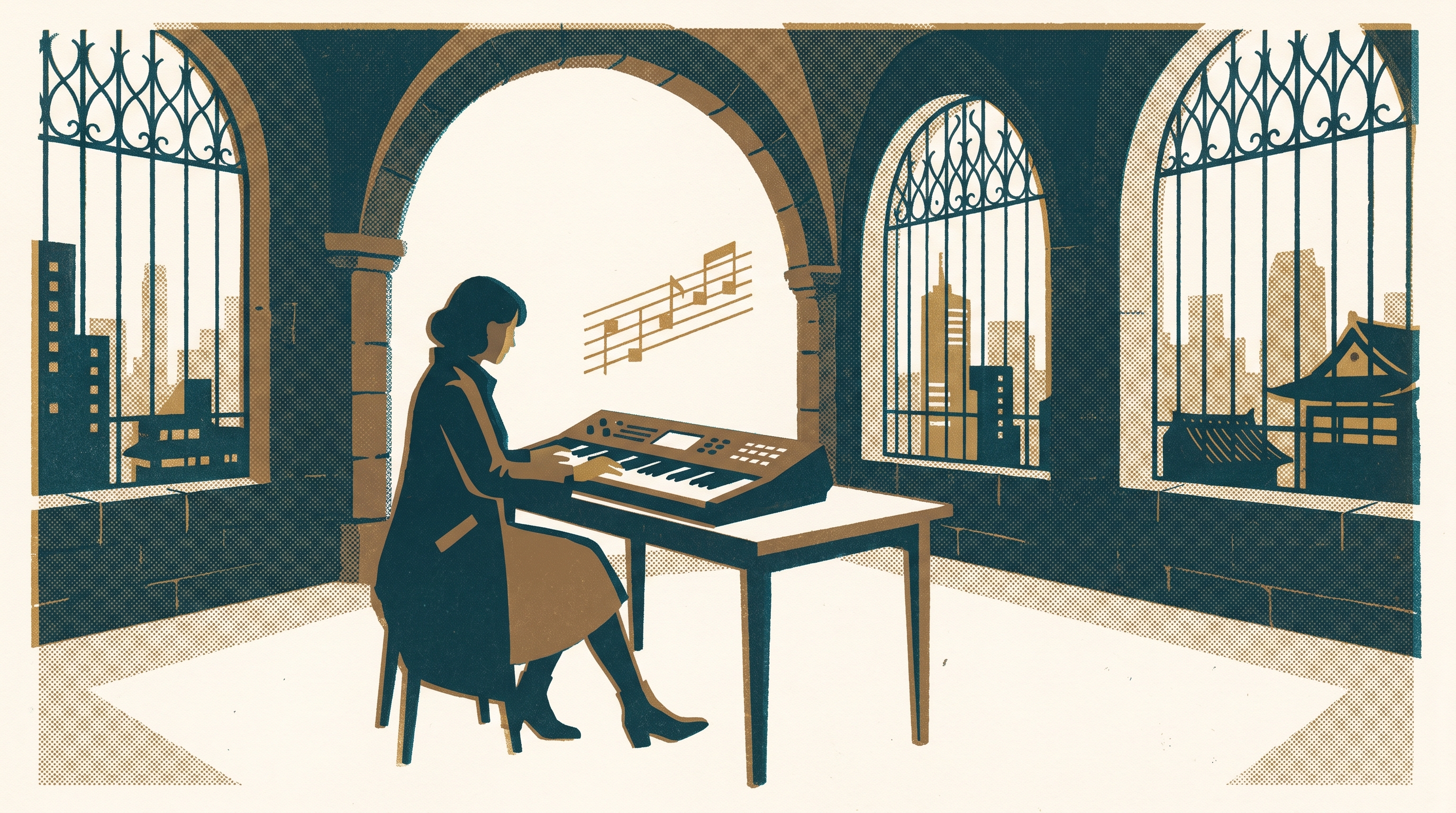
In September 1986, a game called Akumajō Dracula was released for the Famicom Disk System in Japan. It was a side-scrolling action game in which the player climbed through a castle, room by room, and fought monsters. The English version, released the following year, was called Castlevania. Within a few years, millions of players around the world knew the music that played in that castle. Few of them knew who had written it.
The composer's name was Kinuyo Yamashita. She was born in Amagasaki, Hyōgo Prefecture, on December 31, 1965. She began playing the piano at four years old. She studied electronic engineering at Osaka Electro-Communication University, intending to design electronic instruments. She graduated in 1986 and was hired by Konami. She was assigned to the audio department. She had not expected that. She began composing.
Castlevania was her first assignment. She co-composed it with Satoe Terashima. The Famicom Disk System could play five audio channels at once — three square waves, one triangle wave, and one noise channel. The constraints were severe. Every note had to be chosen not only for melody, but for how much memory it consumed. There was no room for waste. Yamashita's job was to make something that felt grand and gothic from those five thin lines of sound.

She wrote a piece called 'Vampire Killer.' It opened with a descending bassline and a driving rhythm that repeated, looped, and climbed back up. It was not subtle. It was meant to be heard over the sound of jumping and dying and trying again. It was a melody designed to stay in your head after you turned the game off. It did. The piece became one of the most recognizable themes in video game history. It has been remixed, reimagined, and performed in concert halls. It has outlasted the hardware it was written for.
In the credits for the English-language version of Castlevania, Yamashita and Terashima were listed under the pseudonym 'James Banana.' The name was a pun on James Bernard, the composer of the 1958 Dracula film. The pseudonym was also a practical choice — Konami, like many game companies in the 1980s, did not credit its employees by real name. The reason was to prevent competitors from poaching talent. The result was that the people who made the games became invisible.

Yamashita was part of the Konami Kukeiha Club, the company's in-house music and sound team. Over the next three years, she composed for Esper Dream, Arumana no Kiseki, Stinger, Maze of Galious, Knightmare III: Shalom, and Parodius. She was prolific. She was also working long hours under conditions that were physically demanding. In 1989, she left Konami. According to later interviews, the decision was made because of the strain — the repetitive tasks, the long hours, the physical toll of the work. She became a freelance composer.
After leaving Konami, she composed music for games including Mega Man X3. She continued to work, but her visibility did not increase. In 2010, she moved to the United States. She currently lives in New Jersey with her husband. She still composes. When people write about her now, they often begin with Castlevania. They mention 'Vampire Killer.' They mention that she was one of the very few women composing game music in the 1980s. All of that is true. But what remains most notable is not the rarity of her presence — it is the durability of what she made.
The castle is still there. The music is still there. Millions of people who have never heard the name Kinuyo Yamashita have walked through that castle and heard her work. The game has been ported, remastered, and re-released across decades and platforms. Every time it plays, the music she wrote in 1986 plays with it. The work outlasted the name. In a way, that is what she built — not fame, but a piece of architecture made from sound, something that would stand long after the people who made it had moved on.