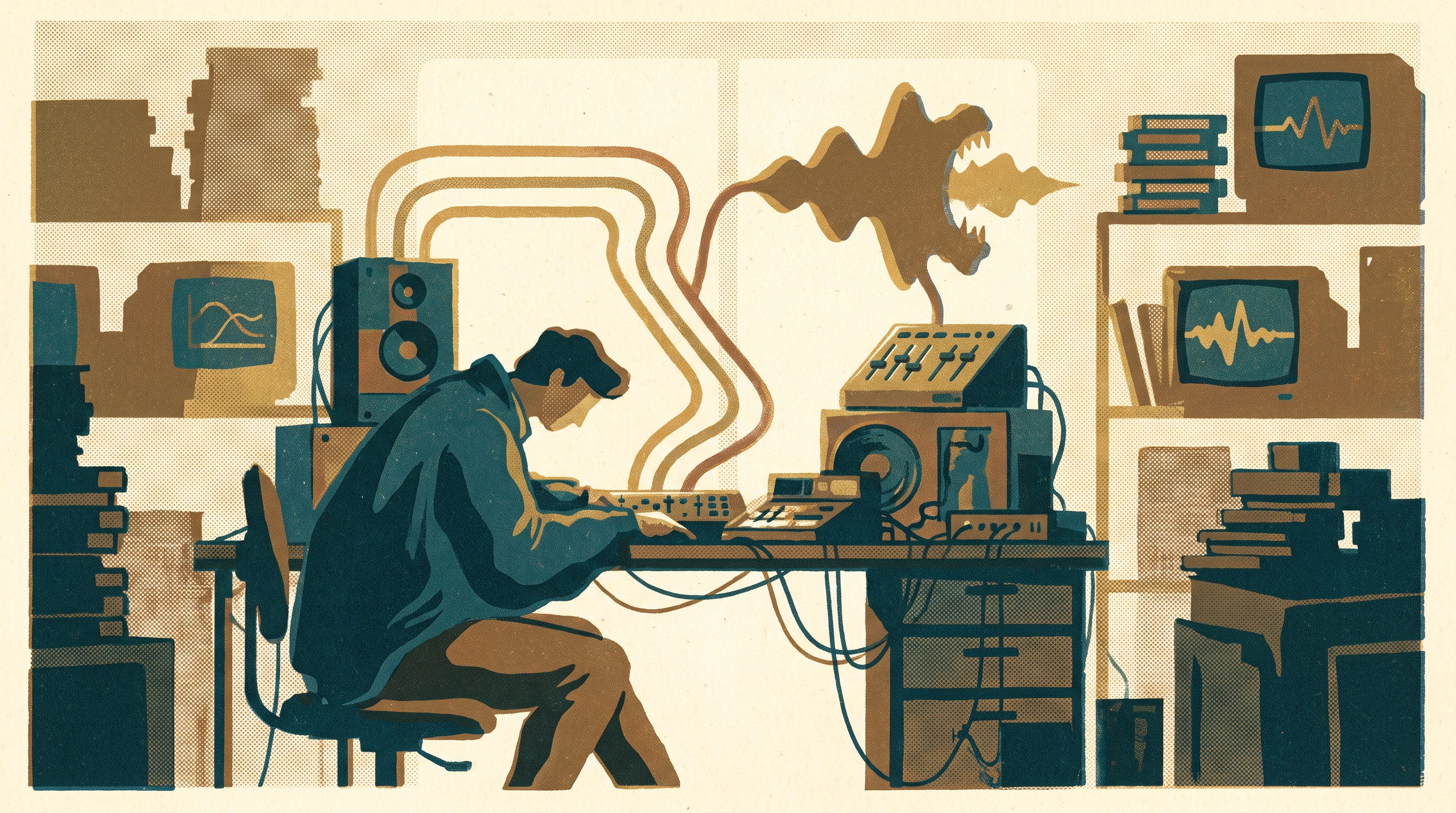
The Sega Genesis sound chip — the Yamaha YM2612 paired with a PSG — had six FM channels, which sounds generous until you realise what that actually meant. A melody. A bassline. A counter-melody. Drums split across the remaining channels and the PSG, with no room to breathe. Most composers in the early 1990s treated these constraints as a problem to be managed. Norio Hanzawa treated them as the starting material.
Hanzawa joined Konami around 1989, entering the company during the arcade era's final golden years. He became part of the Konami Kukeiha Club, an informal collective of sound engineers and composers who shared techniques, competed for scarce hardware resources, and learned to make arcade machines sing. Hanzawa's early assignments were not prestigious — Quarth, a spatial puzzle game, and Punk Shot, a chaotic arcade basketball title. But they were real. Game centre cabinets. Coins dropping. Players hearing his work whether they looked at the credit screen or not.

What he learned during those years was not how to work around limitation, but how to make limitation irrelevant. The YM2612 was notoriously difficult to program. Its FM synthesis could produce harsh, metallic tones that sounded grating in the wrong hands. Hanzawa did not try to soften it. He leaned into the harshness, shaping it into aggression. He wrote music that sounded larger than the machine playing it — not by cheating the hardware, but by understanding its voice so completely that every note occupied exactly the space it needed.
In 1992, a group of Konami employees left to found a new studio called Treasure. Among them were Hiroshi Iuchi, Katsuhiko Suzuki, and Hanzawa. The company's stated ambition was to make games that prioritised craft and intensity over mass-market appeal. Hanzawa became Treasure's primary composer, often credited under the alias NON. The decision to leave Konami — stable income, an established brand, predictable work — carried obvious risk. Treasure was small, underfunded, and idealistic. What it offered in return was creative autonomy and the chance to work with people who shared a specific vision.

Gunstar Heroes was released in September 1993 for the Sega Genesis. It was Treasure's first major title. The game was built for speed, chaos, and relentless forward motion. Hanzawa's soundtrack matched that energy: driving basslines, jagged melodic phrases, rhythms that accelerated rather than settled. The result was a soundtrack that sounded like nothing else on the platform — raw, percussive, uncompromising. In a developer interview that year, Treasure's staff mentioned that Hanzawa was not present because he was already hard at work on the next game.
Dynamite Headdy followed in 1994, then Alien Soldier in 1995. Both soundtracks extended the approach Hanzawa had established with Gunstar Heroes: high-tempo compositions built from minimal melodic material, propelled by rhythm and texture rather than harmonic development. Alien Soldier in particular is regarded among enthusiasts as one of the most technically demanding soundtracks ever written for the Genesis. The game itself was punishingly difficult, designed for players who wanted to be tested. Hanzawa's music was not background — it was structural. It told the player that retreat was not an option and that survival required forward motion at all times.

Hanzawa remained with Treasure for over three decades. His most recent credited work is Gaist Crusher God, a 2014 action game for the Nintendo 3DS. Public information about his activities since then is limited, and he has rarely given interviews. What is known is the catalogue he left: soundtracks written under severe technical constraints, each one refusing to treat limitation as an apology.
The lesson is not about nostalgia or hardware. It is about the choice to treat a constraint as a specification. To ask not 'what can't I do' but 'what does this force me to become good at.' Three channels became a roar because someone decided that three channels were enough. The question sitting in front of you now, with all its boundaries and fixed resources — is it a wall, or is it the starting line?