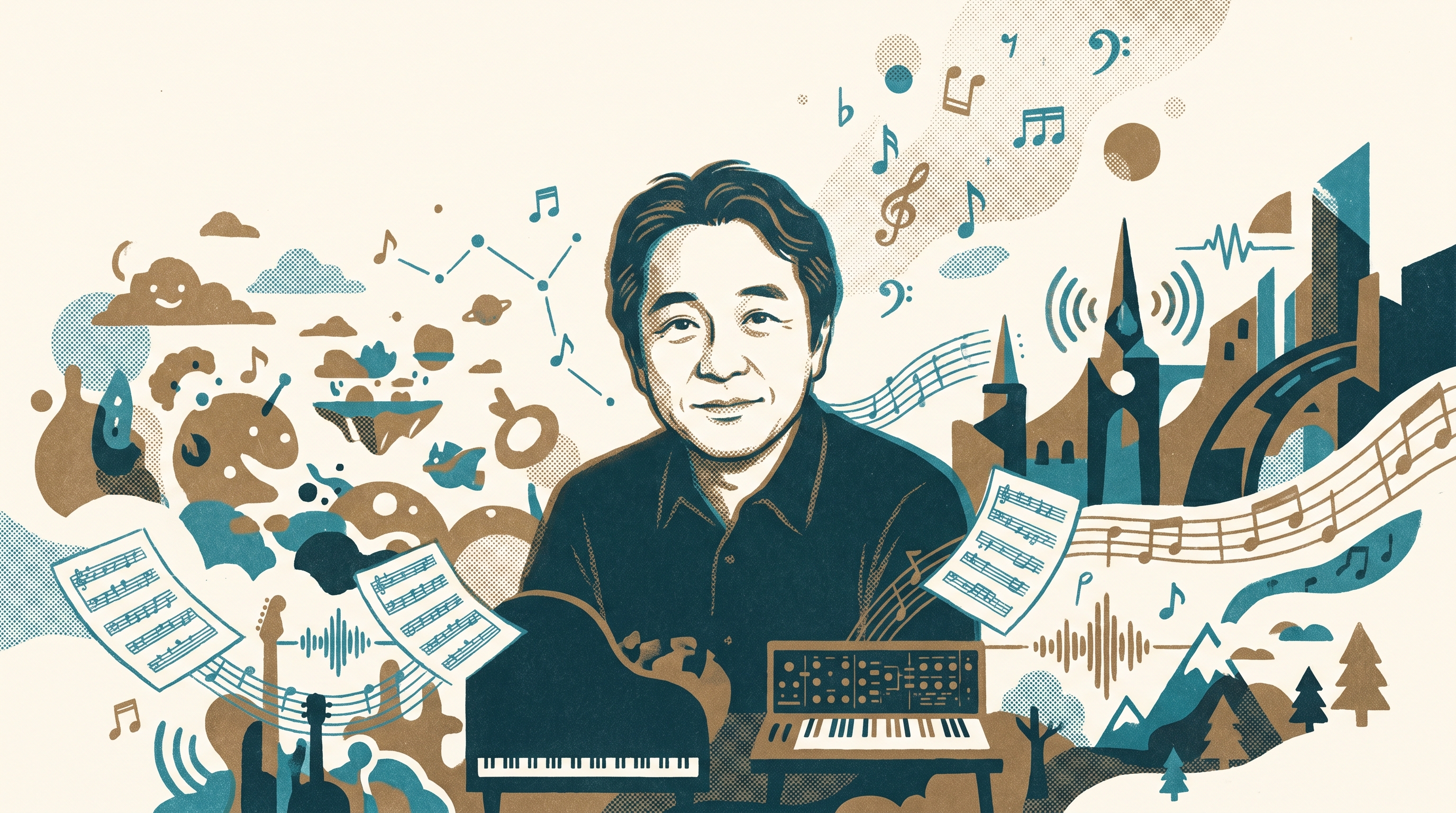
composer
Norio Hanzawa
半澤則夫
Three sound channels became a roar. Constraint was never the enemy — it was the starting line.
About
Norio Hanzawa is a Japanese video game composer and sound designer, known for his work with Konami and Treasure. He joined Konami around 1989 as part of the Konami Kukeiha Club under the alias "Playback Hanzawa," composing soundtracks for arcade games such as Quarth and The Simpsons. In 1992, he co-founded Treasure with fellow Konami colleagues and has since composed high-energy soundtracks for Gunstar Heroes, Alien Soldier, Dynamite Headdy, and Guardian Heroes.
History
Norio Hanzawa joined Konami around 1989, entering the company during the height of the arcade era. He became a member of the Konami Kukeiha Club, the company's in-house sound team, and was known within the group by the alias 'Playback Hanzawa.' The Kukeiha Club was not a formal department with business cards and budgets — it was a loose confederation of sound engineers and composers who shared techniques, competed for limited hardware channels, and learned to make arcade cabinets sing. Hanzawa's early assignments were puzzle games and sports titles: Quarth, a spatial puzzle game released in 1989, and Punk Shot, a chaotic arcade basketball game. These were not prestigious projects, but they were real — cabinets in game centers, coins dropping into slots, players hearing his work whether they noticed the credit screen or not.
The arcade hardware of that era offered composers a palette measured in channels, not notes. Each sound chip had a fixed number of simultaneous voices — typically three or four pitched channels plus one noise channel for percussion and effects. There was no room for lush arrangements, no possibility of a full orchestra. A melody, a bassline, a counter-melody, and a rhythmic marker: that was the full ensemble. What Hanzawa learned during these years was not how to work around the limitation but how to make the limitation irrelevant. He wrote music that sounded larger than the machine that played it — not by cheating the hardware, but by understanding its voice so completely that every note occupied exactly the space it needed and no more.
In 1991, Hanzawa composed the soundtrack for The Simpsons, a four-player beat 'em up arcade game based on the animated television series. The game required music that could sustain energy across long cooperative sessions while remaining recognisable to players who had never heard of the Konami Kukeiha Club but knew every note of Danny Elfman's television theme. Hanzawa's solution was to write propulsive, rhythm-forward tracks that sat behind the action rather than competing with it — music that became part of the spatial environment of the arcade cabinet, inseparable from the sound of buttons being hammered and players calling out to one another. The Simpsons was commercially successful, and Hanzawa's work was heard by tens of thousands of players who would never know his name. That asymmetry — ubiquity without recognition — defined the working life of nearly every game composer in that period.
In 1992, a group of Konami employees left the company to form a new studio. Among them were Hiroshi Iuchi, Katsuhiko Suzuki, and Norio Hanzawa. The new company was called Treasure. It was founded on June 19, 1992, and its stated ambition was to make games that prioritised craft and intensity over mass-market appeal. Hanzawa became the studio's primary composer, often credited under the alias 'NON.' The decision to leave Konami — a stable employer with an established brand and predictable income — carried obvious risk. Treasure was small, underfunded, and idealistic. What it offered in exchange for that risk was creative autonomy and the chance to work with people who shared a specific vision of what a game could be.
Gunstar Heroes, released for the Sega Genesis in September 1993, was Treasure's first major title and Hanzawa's introduction to the world beyond Konami. The game was a run-and-gun action platformer built for speed, chaos, and relentless forward motion. Hanzawa's soundtrack matched that energy: driving basslines, jagged melodic phrases, and rhythms that accelerated rather than settled. The Genesis sound chip — the Yamaha YM2612 FM synthesizer paired with a PSG chip — was notoriously difficult to program, capable of harsh, metallic tones that could sound grating in unskilled hands. Hanzawa leaned into that harshness, shaping it into aggression rather than fighting it into politeness. The result was a soundtrack that sounded like nothing else on the platform — raw, percussive, uncompromising. In a 1993 developer interview, Treasure's staff mentioned that Hanzawa was not present because he was already hard at work on the next game.
That next game was Dynamite Headdy, released in 1994 for the Genesis, followed by Alien Soldier in 1995. Both soundtracks extended the approach Hanzawa had established with Gunstar Heroes: high-tempo compositions built from minimal melodic material, propelled by rhythm and texture rather than harmonic development. Alien Soldier in particular is regarded among enthusiasts as one of the most technically demanding soundtracks ever written for the Genesis, exploiting the FM chip's capacity for percussive attack and rapid timbral change. The game itself was punishingly difficult, designed for players who wanted to be tested rather than entertained in the conventional sense. Hanzawa's music was not background; it was structural — it told the player that retreat was not an option and that survival required forward motion at all times.
In 1996, Hanzawa co-composed the soundtrack for Guardian Heroes, a 2D beat 'em up with RPG elements released for the Sega Saturn. He worked alongside Katsuhiko Suzuki, and the two composers divided responsibilities across the game's branching narrative paths and combat scenarios. The Saturn's sound hardware was more capable than the Genesis, offering CD-quality audio playback, but Hanzawa's aesthetic did not soften in response to greater technical freedom. He continued to write music defined by momentum and density, favouring clarity of rhythm over melodic embellishment. Guardian Heroes became a cult classic, praised for its combat system and narrative complexity, and Hanzawa's contributions reinforced the game's reputation as something uncompromising — a work made for players who valued intensity over accessibility.
Hanzawa has remained with Treasure for over three decades. His most recent credited work is Gaist Crusher God, a 2014 action game for the Nintendo 3DS developed by Treasure and published by Capcom. Public information about his activities in the years since is limited, and he has rarely given interviews or appeared in industry discussions. What is known is the body of work he has left: a catalogue of soundtracks written under severe technical constraints, each one refusing to treat limitation as an apology. The lesson encoded in that work is not about hardware or nostalgia. It is about the choice to treat a constraint as a specification — to ask not 'what can't I do' but 'what does this force me to become good at.' Hanzawa spent thirty-five years answering that question, one channel at a time, and the answer was always the same: make it roar.
Timeline & Works
Career milestones and all 7 games in the museum they worked on — in the order they happened.
- 1989
Joins Konami as member of Konami Kukeiha Club
Norio Hanzawa joins Konami around 1989 and becomes a member of the Konami Kukeiha Club, the company's in-house sound team, working under the alias "Playback Hanzawa." His early assignments include arcade soundtracks for Quarth and Punk Shot.
people - 1989
Quarth — arcade puzzle game soundtrack
Hanzawa composes the soundtrack for Quarth, a spatial puzzle game released by Konami in 1989 for arcade platforms. The game becomes one of his early credited works within the Konami Kukeiha Club.
product - 1989
- 1991
The Simpsons arcade game — commercial success
Hanzawa composes the soundtrack for The Simpsons, a four-player beat 'em up arcade game based on the animated television series. The game achieves commercial success, and Hanzawa's propulsive, rhythm-forward tracks are heard by tens of thousands of players.
product - 1992 06
Co-founds Treasure with Konami colleagues
Hanzawa leaves Konami and co-founds Treasure on June 19, 1992, alongside Hiroshi Iuchi, Katsuhiko Suzuki, and other former Konami employees. He becomes the studio's primary composer, often credited under the alias "NON." Treasure is founded with the ambition to prioritise craft and intensity over mass-market appeal.
people - 1993 09
Gunstar Heroes — Treasure's debut and Hanzawa's breakthrough
Gunstar Heroes launches for the Sega Genesis on September 10, 1993, as Treasure's first major title. Hanzawa's high-energy, percussive soundtrack establishes his signature style: driving basslines, jagged melodies, and uncompromising rhythm that lean into the Genesis sound chip's harsh, metallic tones rather than fighting them.
product - 1993
- 1994
Dynamite Headdy — extending the Treasure sound
Hanzawa composes the soundtrack for Dynamite Headdy, released in 1994 for the Genesis. The score extends the high-tempo, rhythm-driven approach established with Gunstar Heroes, built from minimal melodic material and propelled by texture rather than harmonic development.
product - 1994
- 1995
Alien Soldier — technical mastery on Genesis
Alien Soldier launches for the Genesis in 1995. Hanzawa's soundtrack is regarded among enthusiasts as one of the most technically demanding ever written for the platform, exploiting the FM chip's capacity for percussive attack and rapid timbral change. The music serves as structural support for the game's punishing difficulty, telling players that forward motion is the only option.
product - 1995
- 1996
Guardian Heroes — co-composition for Sega Saturn
Hanzawa co-composes the soundtrack for Guardian Heroes, a 2D beat 'em up with RPG elements released for the Sega Saturn in 1996. Working alongside Katsuhiko Suzuki, the two composers divide responsibilities across the game's branching narrative paths and combat scenarios. Despite the Saturn's greater audio capabilities, Hanzawa's aesthetic remains defined by momentum and density.
product - 1996
- 1999
- 2003
- 2014 09
Gaist Crusher God — latest credited work
Gaist Crusher God, an action game for the Nintendo 3DS developed by Treasure and published by Capcom, is released on September 4, 2014. Hanzawa composes the music, marking his most recent publicly credited work. Public information about his activities in the years since remains limited.
product
Connections
- employed konami (1989–1992)
Hanzawa joined Konami around 1989 as a member of the Konami Kukeiha Club, working under the alias "Playback Hanzawa." He composed soundtracks for arcade games including Quarth, Punk Shot, and The Simpsons before leaving the company in 1992 to co-found Treasure.
- founded treasure (1992–present)
Hanzawa co-founded Treasure on June 19, 1992, alongside Hiroshi Iuchi, Katsuhiko Suzuki, and other former Konami colleagues. He has served as the studio's primary composer for over three decades, often credited under the alias "NON."
Also connected to
- Konami Kukeiha Club co-created Castlevania: The Adventure / same employer (Konami, 1989–1992)
- Minako Hamano co-created Wario World
Explore the work
Each title has its own page — history, trivia, and collector's notes.
Nintendo GameCube · 2003
Wario World
Treasure made a Wario action game for GameCube. Punch, grab, throw, and smash th…
Dreamcast · 1999
Bangai-O
Treasure built a shooter where a full retaliatory blast could destroy every bull…
Sega Saturn · 1996
Guardian Heroes
Treasure built seven possible endings. Which one you reach depends on choices yo…
Sega Mega Drive / Genesis · 1995
Alien Soldier
Treasure made it for experts only. A boss appears every thirty seconds. There ar…
Sega Mega Drive / Genesis · 1994
Dynamite Headdy
Treasure's puppet platformer where swapping heads was the mechanic. Each boss re…
Sega Mega Drive / Genesis · 1993
Gunstar Heroes
Seven programmers, twelve months, and the most technically ambitious game the Me…
Rooms their games live in
Sources
- Norio Hanzawa - Video Game Music Preservation Foundation Wiki — accessed 2026-06-16
- Norio Hanzawa | Composer, Music Department, Sound Department - IMDb — accessed 2026-06-16
- Treasure – 1993/1994 Developer Interviews - shmuplations.com — accessed 2026-06-16
- Alien Soldier (Original Soundtrack) - Black Screen Records — accessed 2026-06-16
- Konami Kukeiha Club - Wikipedia — accessed 2026-06-16
- Gunstar Heroes - Wikipedia — accessed 2026-06-16
- Guardian Heroes - Wikipedia — accessed 2026-06-16
- Gaist Crusher God - VGMdb — accessed 2026-06-16
From the Museum's Screening Room
Hanzawa Three Channels — Dark Exhibit