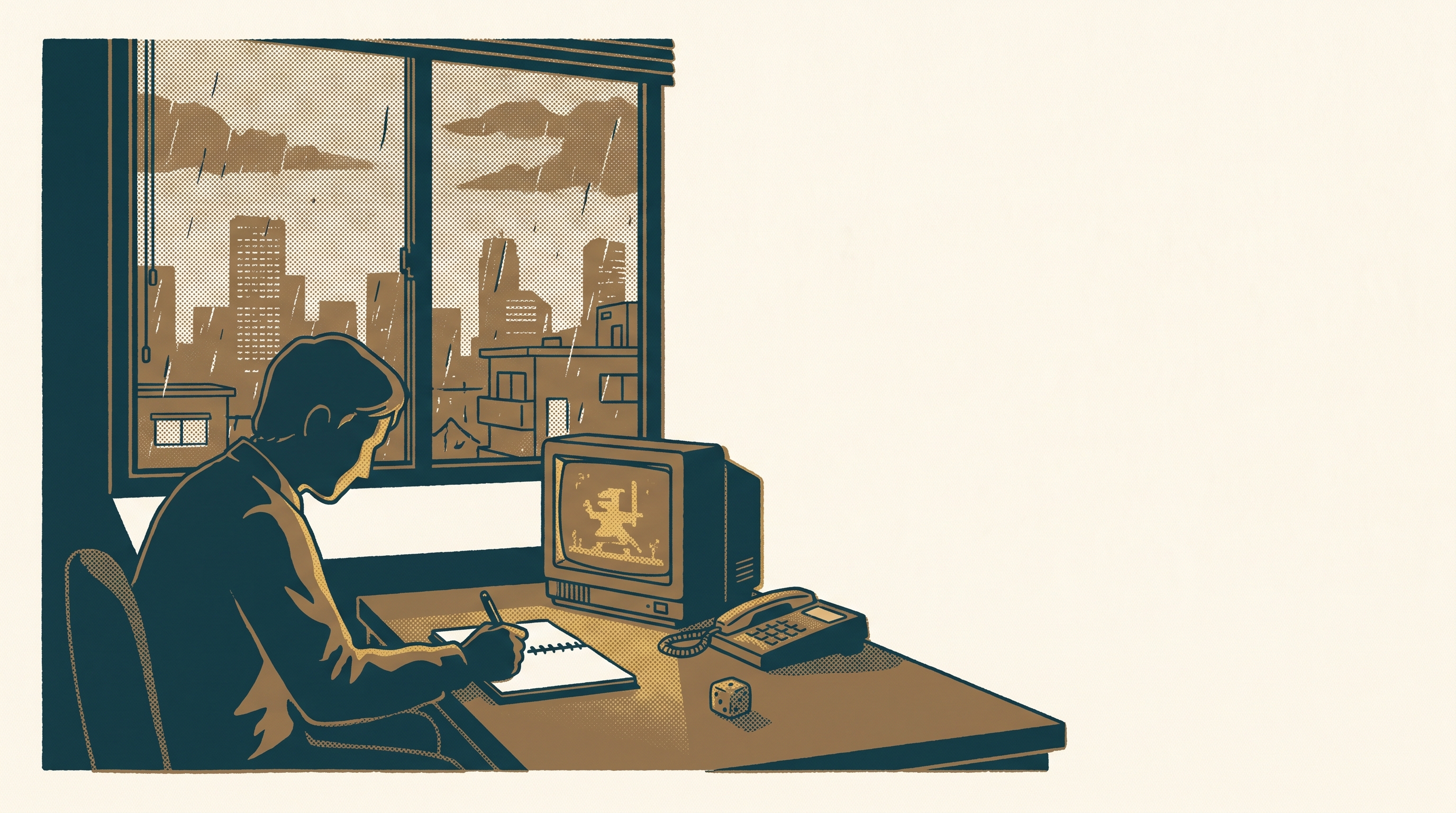
Hironobu Sakaguchi was born in Hitachi, Ibaraki in 1962. According to Wikipedia and various interview sources, he enrolled in the electrical engineering department at Yokohama National University but left in 1983, mid-semester, before finishing his degree. He had been working part-time at a small software company called Square — then still a subsidiary of an electrical equipment firm called Denyusha — and the work felt more real than the lectures. He stayed at Square when it became an independent company in 1986, taking a role that combined planning and development.
Square released games for the Famicom through the mid-1980s. Some sold moderately. None broke through in the way that the company needed. By 1987, Square had not established itself as a company capable of producing a hit, and there were real discussions about whether the game business was worth continuing. Sakaguchi, who was directing projects, later said in interviews that had the next game failed, he intended to leave the industry and return to university to finish what he had started.
The game he made in that state of mind was called Final Fantasy. The naming history is more complicated than the often-repeated story. One consideration was that the team initially explored 'Fighting Fantasy' as a title, but that name was already in use as a tabletop game series, making it unavailable. What remained workable was the abbreviation: 'FF' reads cleanly in both Roman letters and Japanese phonetics. In a 2015 Kotaku interview, Sakaguchi acknowledged the personal dimension directly — 'I was in a pretty desperate situation at that time, but to be honest, I was fine with any word that started with F' — while also confirming that the sense of finality was genuine. The two accounts are not mutually exclusive. What is clear is that the title was not chosen from strength.
The development team was small. Square at the time had limited resources for a project that, in scope, was attempting something beyond what the company had done before: a role-playing game with an extended story, multiple playable characters, a world with its own history. The Famicom cartridge had constraints that required constant decisions about what to cut and what to keep. Nobuo Uematsu, who composed the music, was among the contributors whose work shaped the final product in ways that could not have been planned.
Final Fantasy was released in Japan on December 18, 1987. The early sales figures were modest — the game did not immediately become a phenomenon. But it found its audience steadily, and by the end of its run in Japan it had sold well enough that a sequel was justified. Reported figures differ across sources, ranging from roughly 400,000 to 520,000 units. The company did not close. Sakaguchi did not go back to Yokohama National University. A sequel was made.

It should be noted that Sakaguchi has said in more recent interviews that the popular version of this story — Square was six months from bankruptcy, Sakaguchi bet everything, the game saved the company in a single dramatic reversal — is somewhat simplified. The pressure was real, but the collapse was not as imminent as it is sometimes told. What is not disputed is that the game sold, that Square continued, and that the title 'Final Fantasy' was genuinely chosen from a feeling of finality that turned out not to be final at all.
The franchise continued for decades. By the time of later sequels, it had become one of the most recognized names in the medium. Sakaguchi left Square Enix in 2004 and founded a smaller studio called Mistwalker. In interviews across the years, he has described the experience of naming the first game as a kind of honesty — putting into the title exactly what the situation felt like, without knowing what would follow.
What followed was more than thirty sequels, spin-offs, films, and adaptations. The word 'final' turned out to be the beginning. The game that was supposed to end something became the thing that defined it. That is perhaps what a genuine wager looks like from the outside, after enough time has passed: you cannot tell, until much later, whether what felt like an ending was the last word or the first.