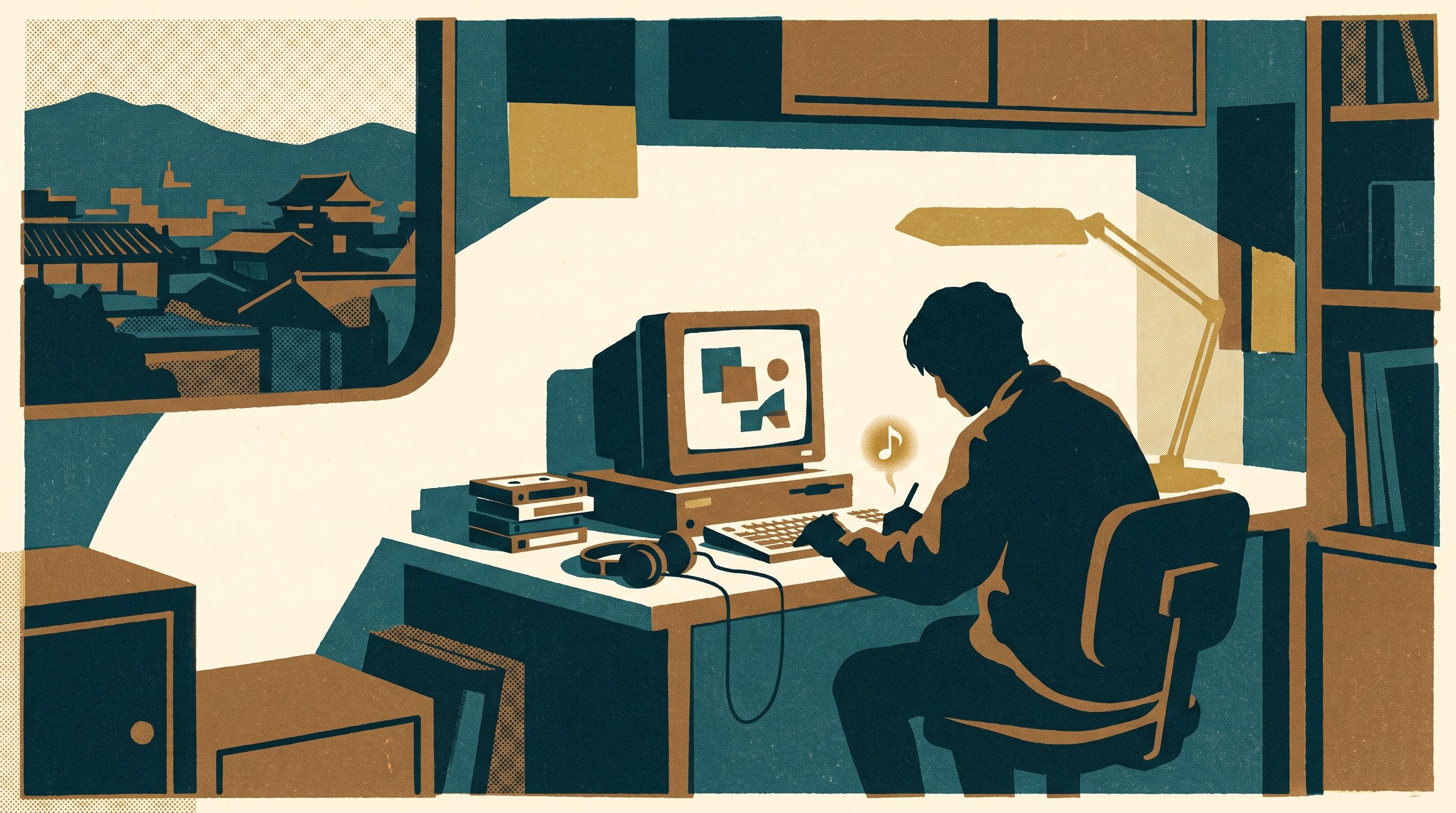
In 1990, a young composer named Kazumi Totaka joined Nintendo. He had graduated from the Kunitachi College of Music. He played piano, vibraphone, guitar, and bass. He was twenty-two years old. He was assigned to the Research & Development 1 Division — the same division that had built the Game Boy and was still led by Gunpei Yokoi.
His first work was not famous. He composed music for a Game Boy title called X — a vertical shooter that never left Japan. The following year he worked on a game called Kaeru no Tame ni Kane wa Naru, a role-playing adventure about a prince and a frog. These were not landmark games. They were the kind of small projects a young composer might be given to prove what he could do.
Then came Mario Paint in 1992. It was a creative tool, not a game with levels or a story. You painted pictures, built simple animations, and composed music by placing notes on a staff. Totaka wrote the soundtrack. And somewhere in the program, if you left the screen idle long enough — three minutes on one particular menu — a short melody would begin to play. Nineteen notes. Eight bars. It sounded simple, almost childlike. It would later be called Totaka's Song.

The melody appeared again. In Super Mario Land 2, it played on the game-over screen if you waited. In Link's Awakening, if you stood in Richard's house long enough. In Yoshi's Story. In Luigi's Mansion. In Virtual Boy Wario Land. In Wii Music. In Animal Crossing: New Horizons, released in 2020 — thirty years after Totaka joined Nintendo. The same nineteen notes, hidden in places most players would never find, placed there by the same quiet hand.
He did not announce these inclusions. There were no patch notes, no developer interviews pointing them out. Players found them by accident — or by waiting in silence longer than the game expected anyone to wait. Over time, the search for Totaka's Song became a ritual. When his name appeared in a game's credits, people began to listen.
Totaka's other signature was a voice. In the late 1990s, while working on Yoshi's Story for the Nintendo 64, he recorded the characteristic sounds of Yoshi — the cheerful yelps, the flutter, the simple syllables that needed no translation. Those recordings were used again in dozens of games that followed. He also voiced Professor E. Gadd in Luigi's Mansion, Captain Olimar in Pikmin, and Birdo. He became the sound behind characters who rarely spoke but were never silent.

He worked on the Yoshi series and the Animal Crossing series for decades. In Animal Crossing, a character named K.K. Slider — a dog who plays guitar and gives concerts in the town square every Saturday night — was modeled after him. The character's Japanese name is Totakeke, a shortening of Totaka K., which is how colleagues sometimes wrote his name. The character sings songs about small things — rain, morning routines, the feeling of walking at night. They are gentle. They do not demand anything.
Totaka directed the development of Wii Music in 2008. It was a game about making music without needing to know how to read sheet music or play an instrument. Critics were divided. Some said it lacked structure. Others said it captured something true about the joy of simply making sound. It did not sell as well as Nintendo had hoped. Totaka did not leave the company. He kept working.
By 2026, he had been at Nintendo for thirty-six years. He had composed music for more than fifty games. His hidden song had appeared in at least twenty-four of them. He had never explained why he kept placing it there, and no formal interview on record contains his reasoning. It was simply there — a small thread running through decades of work, left for anyone patient enough to stand still and listen.
The work you do quietly, without announcement, without asking for attention — does it matter less than the work that is seen? Or does it live longer, in a different way, because it was left as a gift rather than a statement?