developer
Nintendo R&D1
任天堂開発第1部
Japan
About
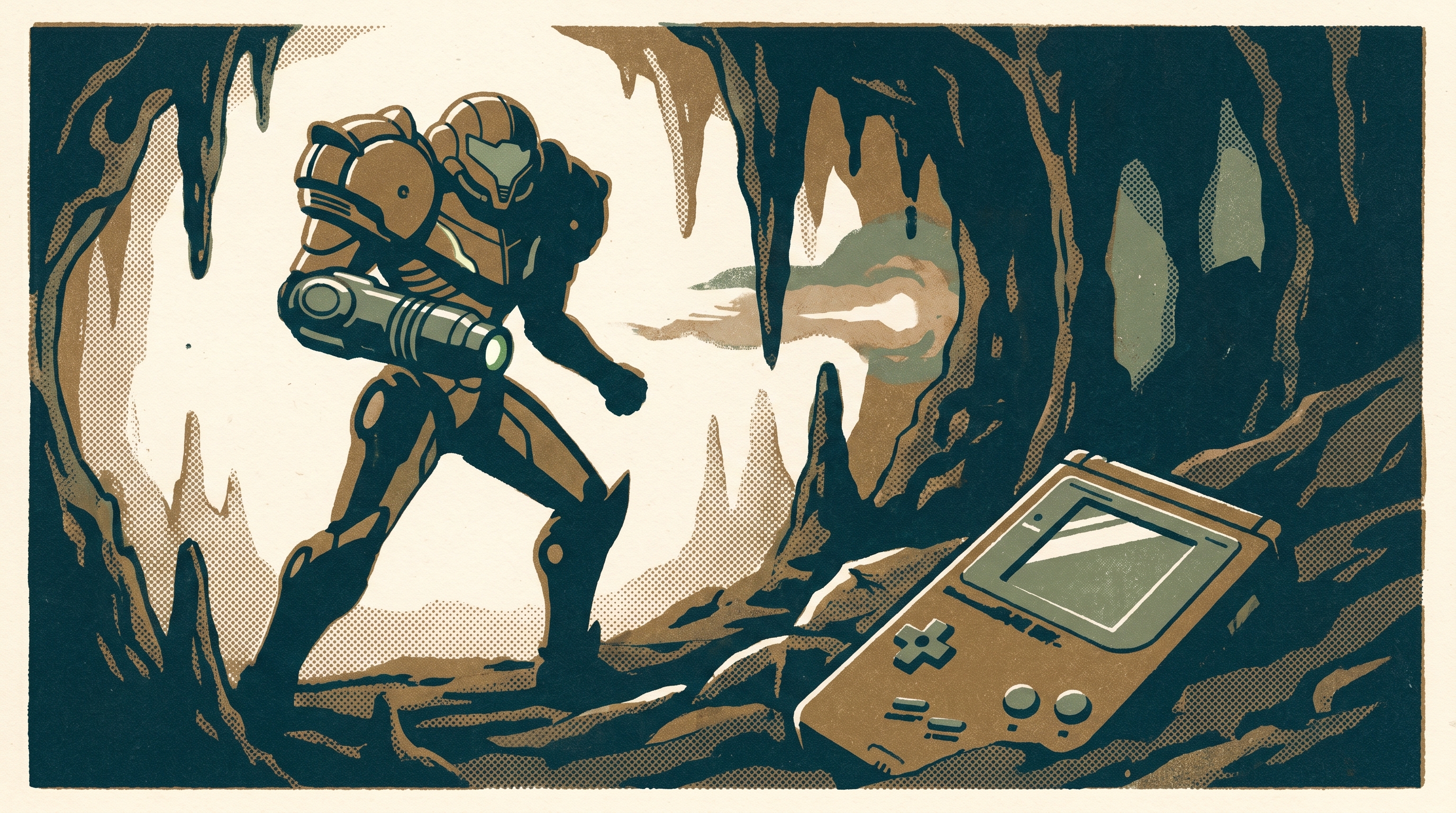
Nintendo Research & Development 1 (R&D1) was Nintendo's oldest internal development division, established in 1970 and led by Gunpei Yokoi until his departure in August 1996. The division created the Game & Watch series (1980), the original Game Boy hardware (1989), Metroid (1986), Kid Icarus (1986), Super Mario Land (1989), and the Virtual Boy (1995). In 2004, R&D1 merged with R&D2 to form Nintendo Software Planning & Development under Satoru Iwata's restructuring.
History
In 1965, Gunpei Yokoi joined Nintendo as a maintenance engineer for the assembly-line machinery used to produce Nintendo's hanafuda playing cards. He was the only electronics engineer at the company. In 1969, while Yokoi was travelling on the Shinkansen, company president Hiroshi Yamauchi spotted him playing with a cross-shaped lattice he had improvised for amusement — extending and collapsing it between fingers. Yamauchi told Yokoi to develop it as a product. The result was the Ultra Hand, a mechanical toy that sold over a million units and established Nintendo's direction as a toy and then electronics company. The incident also established something about Yokoi's working method: ingenuity with simple materials, repurposed for entertainment.
In 1970, Nintendo formally established its Research & Development department, with Yokoi as general manager. The division's early years produced a range of electronic toys and light-gun games: the Beam Gun series, the Laser Clay Shooting System (1973), the Color TV Game series (1977). In 1978, as Nintendo expanded into the coin-operated arcade market, the single R&D department split into two. R&D1 remained Yokoi's domain; R&D2 was assigned to Masayuki Uemura, who would later design the Famicom hardware. The division of responsibilities made the subsequent decade possible: Uemura focused on console hardware; Yokoi focused on portables and gameplay invention.
R&D1's foundational franchise was Game & Watch — handheld LCD games using a format Yokoi described as "lateral thinking with withered technology." The principle: take established, inexpensive components and configure them in ways that create new value. The first Game & Watch, Ball, released in April 1980, was conceived from Yokoi's observation of a salaryman playing with his pocket calculator on a train. The directional pad (D-pad), introduced in the Donkey Kong Game & Watch of 1982, became the industry-standard control input for the next three decades. By the time the series ended in 1991, over 43 million Game & Watch units had been sold across 59 titles.
The Famicom era expanded R&D1's reach into software. Metroid (1986), directed by Satoru Okada and produced by Yoshio Sakamoto, introduced a non-linear exploration structure to a console audience — a labyrinthine world without maps, in which the protagonist's identity was concealed until the game's final seconds. Kid Icarus (1986), co-developed with the same team, was released on the same day in Japan. Super Mario Land (1989), designed for the launch of the Game Boy, placed Mario in a completely new world — Egypt, China, Bermuda — distinct from the Mushroom Kingdom of EAD's titles. The game sold 18 million copies, becoming the Game Boy's best-selling launch title.
The Game Boy itself was R&D1's most consequential hardware project. Yokoi oversaw its development beginning around 1987. The design was deliberately conservative: a monochrome LCD screen when color screens were available, a non-backlit display, simple processor. Competitors and colleagues questioned the choices. Yokoi's argument was that color consumed battery power children could not reliably replace, and that a backlit screen would create glare outdoors. The Game Boy launched in Japan on April 21, 1989, and in North America in July 1989. Packaged with Tetris in North America, it sold more than a million units in its first few weeks — ultimately becoming the third best-selling gaming platform in history, with over 118 million units sold across the original and Color variants.
In August 1996, Yokoi left Nintendo following the commercial failure of the Virtual Boy (1995) — a red-tinted stereoscopic headset that caused eye strain and was discontinued after six months. The machine's failure was painful: it had been Yokoi's most technically ambitious hardware, and it demonstrated that even the Game Boy's designer could not simply will portability into a new form factor. After his departure, Yokoi founded Koto Laboratory and began developing the Bandai WonderSwan. On October 4, 1997, he was killed in a traffic accident on an expressway in Toyama Prefecture, at age 56. R&D1 continued under Takehiro Izushi until 2004, when Nintendo's restructuring under Satoru Iwata merged it with R&D2 to form a unified software development department.
Timeline & Works
Corporate milestones and all 15 games in the museum this studio developed — in the order they happened.
- 1970
Nintendo R&D1 established under Gunpei Yokoi
Nintendo formally establishes its R&D department, with Gunpei Yokoi as general manager. The division splits from manufacturing to focus on electronic toys and games.
founding - 1980 04
Game & Watch launched — "Ball"
The first Game & Watch title. Over 59 titles and 43 million units would follow. The series introduced the D-pad in 1982's Donkey Kong edition.
product - 1983
- 1984
- 1985
- 1986
Metroid and Kid Icarus released
Both titles released the same day in Japan. Metroid introduced non-linear exploration to console games; Kid Icarus brought vertical-scrolling adventure to the Famicom.
product - 1986
- 1986
- 1989
Super Mario Land and Tetris (Game Boy)
Super Mario Land sells 18 million copies — the Game Boy's best-selling launch title. Tetris, published in North America, drives hardware adoption.
product - 1989 04
Game Boy hardware launched in Japan
Game Boy launches April 21, 1989. A deliberate choice of monochrome LCD — battery life over color. Bundled with Tetris in North America, it sells over a million units in weeks.
product - 1989
- 1989
- 1990
- 1990
- 1991
- 1991
- 1994
- 1995
Virtual Boy released — and discontinued six months later
The red-tinted stereoscopic headset causes eye strain and sells poorly. Discontinued in early 1996. The failure precedes Yokoi's departure.
product - 1996 08
Gunpei Yokoi departs Nintendo
After 31 years and the Game & Watch, Game Boy, Metroid, and Kid Icarus, Yokoi leaves Nintendo to found Koto Laboratory. He would later begin development of the Bandai WonderSwan.
corporate - 1997 10
Gunpei Yokoi killed in traffic accident
Yokoi is killed in a traffic accident on an expressway in Toyama Prefecture on October 4, 1997, at age 56, while developing the WonderSwan for Bandai.
corporate - 2000
- 2002
- 2004
R&D1 merged with R&D2 — division dissolved
Under Satoru Iwata's restructuring, R&D1 and R&D2 merge to form Nintendo Software Planning & Development, ending R&D1's 34-year independent existence.
corporate
Also developed (release year to be confirmed)
Connections
- parent nintendo (1970–2004)
Nintendo R&D1 was an internal Nintendo division from 1970 until its merger in 2004.
- employed gunpei-yokoi (1965–1996)
Gunpei Yokoi joined Nintendo in 1965 and led R&D1 from its founding until August 1996.
- employed yoshio-sakamoto (1982–present)
Yoshio Sakamoto joined Nintendo in 1982 and worked in R&D1 as director of Metroid and Kid Icarus.
Rooms their games live in
Sources
- Nintendo Research & Development 1 — Wikipedia — accessed 2026-06-11
- Gunpei Yokoi — Wikipedia — accessed 2026-06-11
- Game & Watch — Wikipedia — accessed 2026-06-11
- Game Boy — Wikipedia — accessed 2026-06-11