designer
Yoshio Sakamoto
坂本賀勇
A flame that never goes out — just burns quietly, waiting for the right moment to light the next thing.
About
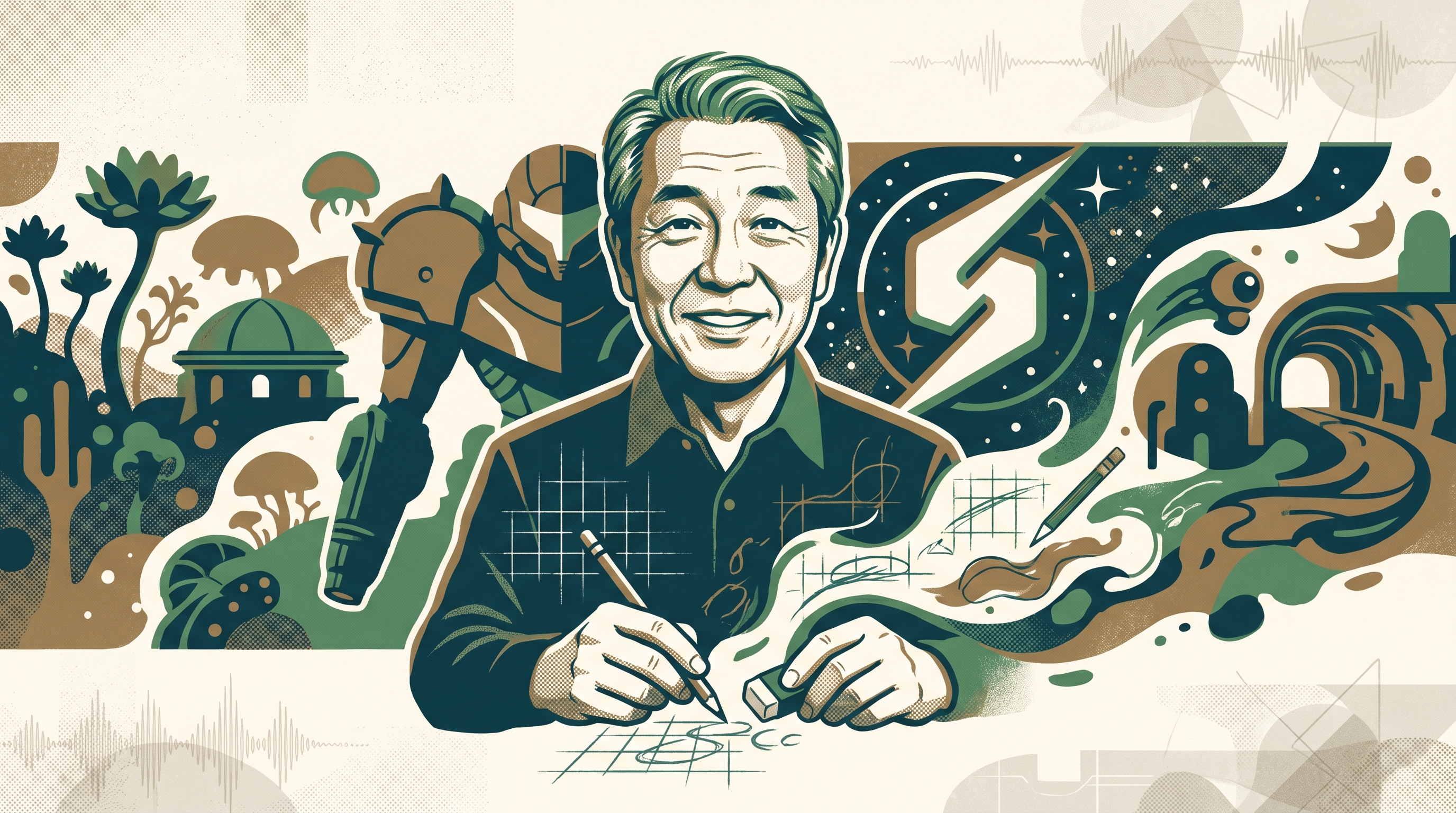
Yoshio Sakamoto is a Nintendo game director and producer who co-created the Metroid series in 1986 alongside Gunpei Yokoi. He directed or produced the majority of 2D Metroid titles, including Metroid (1986), Super Metroid (1994), and Metroid: Fusion. He also directed the Wario Ware series.
History
Yoshio Sakamoto was born on July 23, 1959, in Nara Prefecture. He graduated from art college and joined Nintendo in 1982, entering the company at a time when the Famicom had just been released and the language of video games was still being written. He was assigned to the Research and Development 1 division — R&D1 — the department led by Gunpei Yokoi, a hardware inventor who had designed Game & Watch and would soon oversee the Game Boy. Sakamoto began as a pixel artist, drawing the small sprites that filled the screens of handheld and arcade machines. His first credited work was the pixel art for the Game & Watch version of Donkey Kong, followed by the arcade game Donkey Kong Jr. It was detailed, quiet work, and not yet work that bore his name in a way anyone outside the company would have noticed.
Yokoi saw something in the young artist that went beyond technical skill. He told Sakamoto directly: if you can make pixel art, you can make a game. The statement was not a compliment. It was an assignment. Sakamoto was moved from drawing to design, and his early NES titles — Wrecking Crew, Balloon Fight, Gumshoe — showed a designer learning to think in systems rather than images. Then in 1986, during the final three months of development on a project that had stalled, Sakamoto was brought in to help finish it. The project was Metroid. Two junior developers, Hiroji Kiyotake and Hirofumi Matsuoka, had been working on the game under Yokoi's oversight, but the release date was approaching and the work was incomplete. Yokoi called in Sakamoto and others from R&D1 to stabilize the project and push it across the line. Sakamoto handled character design and scenario direction. The result was a side-scrolling exploration game built around isolation, atmosphere, and a protagonist whose gender was hidden until the final reveal. Metroid was not the biggest release of 1986, but it defined a genre that would later carry its name.
For the next eight years Sakamoto worked on other projects — Kid Icarus, X, the early experiments that would become the foundation of Nintendo's portfolio — but Metroid remained unfinished in his mind. In 1994 he directed Super Metroid for the Super Famicom. It took over two years to develop after approval. Intelligent Systems handled the programming; Sakamoto wrote the scenario and led the design. The game opened with the end of the previous installment and immediately asked the player to retrace familiar ground before pulling it all apart. Super Metroid refined everything the original had suggested: the sense of being alone in a vast and hostile place, the architecture of progression through tools rather than keys, the way a map slowly coheres from fragments into a legible whole. Yokoi produced the game, and it would be one of the last major projects the two men worked on together before Yokoi left Nintendo in 1996. Super Metroid was released in Japan on March 19, 1994, in North America on April 18, and in Europe on July 28. It sold respectably but not spectacularly. It was only years later, as players returned to it and spoke about it, that its influence became clear.
When Yokoi departed in 1996 and died in 1997, the Metroid series lost its original producer, and Sakamoto became its steward. He directed Metroid Fusion and Metroid: Zero Mission for the Game Boy Advance, both of which carried forward the 2D design language he and Yokoi had established. In the 2000s, as the series shifted toward first-person 3D with the Metroid Prime trilogy developed by Retro Studios in the United States, Sakamoto remained involved as a supervisor but stepped back from direct creative control. He returned fully to the series in 2010 with Metroid: Other M, a divisive entry that attempted to merge cinematic storytelling with traditional gameplay, and then again in 2021 with Metroid Dread, a game that had been planned, shelved, and restarted multiple times over fifteen years. Dread was developed by MercurySteam under Sakamoto's direction, and it marked the first new 2D Metroid in nineteen years. The game was well-received, and it closed a story arc Sakamoto had been building since Fusion.
Throughout the same period Sakamoto also directed and produced the WarioWare series, a collection of rapid-fire microgames that required players to react in seconds, and the Rhythm Heaven series, which built entire worlds out of musical timing. Both franchises were structurally opposite to Metroid — brief where Metroid was slow, light where Metroid was somber — but they shared a commitment to clarity of input and the pleasure of mastery through repetition. Sakamoto's range as a designer was wider than any single series suggested. He has remained at Nintendo for over forty years, currently serving as a senior officer in the Entertainment Planning & Development division. He has never left the company that hired him as a pixel artist in 1982.
What persists across Sakamoto's career is not a single style but a sustained attention to the way a player learns a space and a system without being told. His games rarely explain themselves. They let the player deduce the rules by moving through them. Metroid taught a generation of designers that exploration does not require a guide, that atmosphere can be a form of narrative, and that a protagonist does not need to speak to carry emotional weight. Sakamoto did not invent those ideas alone — Yokoi shaped the early vision, and many hands contributed — but he is the one who kept the flame burning after Yokoi was gone, and who made sure it lit the next thing, and the next. The work continues, quietly, as it always has. There is still ground to cover, still rooms left unmapped. Sakamoto knows how to wait.
Timeline & Works
Career milestones and all 5 games in the museum they worked on — in the order they happened.
- 1959 07
Yoshio Sakamoto born in Nara Prefecture
Yoshio Sakamoto is born on July 23, 1959, in Nara Prefecture, Japan.
people - 1982
Joins Nintendo as pixel artist
After graduating from art college, Sakamoto joins Nintendo and is assigned to the Research and Development 1 division (R&D1) led by Gunpei Yokoi. His first work is pixel art for Game & Watch Donkey Kong and the arcade game Donkey Kong Jr.
people - 1984
Balloon Fight released
Sakamoto serves as designer on Balloon Fight, one of his early game design projects for the Famicom.
product - 1985
- 1986
Kid Icarus released
Sakamoto works as game designer on Kid Icarus, another R&D1 title under Yokoi's production.
product - 1986
Metroid released — co-creator with Gunpei Yokoi
Sakamoto joins the final three months of Metroid development, handling character design and scenario direction under Yokoi's supervision. The game defines a new genre of side-scrolling exploration and becomes a foundational work in his career.
product - 1986
- 1990
- 1994 03
Super Metroid released — director
Sakamoto directs Super Metroid for the Super Famicom, writing the scenario and leading the design. The game takes over two years to develop and refines the Metroid formula into a form that will influence game design for decades. Released March 19 in Japan, April 18 in North America, July 28 in Europe.
product - 1994
- 2002
Metroid Fusion released
Sakamoto directs Metroid Fusion for Game Boy Advance, continuing the 2D Metroid lineage after Yokoi's departure and death.
product - 2002
- 2003
WarioWare, Inc. released — director
Sakamoto directs the first WarioWare game, a collection of rapid-fire microgames structurally opposite to Metroid but sharing a commitment to clarity of input and mastery through repetition.
product - 2004
Metroid: Zero Mission released
Sakamoto directs the Game Boy Advance remake/reimagining of the original Metroid, carrying forward the 2D design language established with Yokoi.
product - 2006
Rhythm Tengoku released — producer
Sakamoto produces the first Rhythm Heaven (Rhythm Tengoku) game for Game Boy Advance, a rhythm-action series built entirely around musical timing.
product - 2010
Metroid: Other M released
Sakamoto returns fully to the Metroid series as director and scenario writer for Other M, a divisive entry attempting to merge cinematic storytelling with traditional gameplay.
product - 2021
Metroid Dread released — producer
Sakamoto produces Metroid Dread, the first new 2D Metroid in nineteen years, developed by MercurySteam. The game closes a story arc Sakamoto had been building since Fusion and is well-received critically and commercially.
product
Connections
- employed nintendo (1982–present)
Sakamoto joined Nintendo in 1982 as a pixel artist assigned to R&D1 and has remained with the company for over forty years. He currently serves as a senior officer in the Entertainment Planning & Development division.
- mentored gunpei-yokoi (1982–1996)
Gunpei Yokoi was Sakamoto's supervisor in R&D1 and told him directly: "If you can make pixel art, you can make a game." Yokoi mentored Sakamoto through the creation of Metroid and Super Metroid, and Sakamoto became the steward of the series after Yokoi left Nintendo in 1996.
Also connected to
- Minako Hamano co-created Metroid Fusion / co-created Super Metroid / co-created Super Metroid / same employer (Nintendo, since 1991)
- Hirokazu Tanaka co-created Balloon Kid / co-created Metroid / same employer (Nintendo, 1982–1999)
- Kenji Yamamoto co-created Super Metroid / co-created Super Metroid / same employer (Nintendo, since 1987)
- Hiroji Kiyotake co-created Metroid / same employer (Nintendo R&D1, 1983–2001)
Explore the work
Each title has its own page — history, trivia, and collector's notes.
Game Boy Advance · 2002
Metroid Fusion
Samus wiped out the Metroids in Super Metroid. That extinction freed the X Paras…
Super Famicom / SNES · 1994
Super Metroid
She didn't pull the trigger then. And that small mercy came back to save her.…
Game Boy · 1990
Balloon Kid
They built a whole world out of a bonus level nobody wanted to leave.…
Family Computer Disk System · 1986
Metroid
No one handed you a map. You drew one by going where you hadn't been.…
Family Computer (Famicom) / NES · 1985
Wrecking Crew
His name was in the credits before anyone knew his name.…
Rooms their games live in
Sources
- Yoshio Sakamoto — Wikipedia (English) — accessed 2026-06-11
- 坂本賀勇 — Wikipedia(日本語版) — accessed 2026-06-11
- Yoshio Sakamoto | Wikitroid | Fandom — accessed 2026-06-11
- Yoshio Sakamoto, Gunpei Yokoi and the creation of Metroid — accessed 2026-06-11
- Super Metroid — Wikipedia — accessed 2026-06-11
- Metroid Database Developer Profile: Yoshio Sakamoto — accessed 2026-06-11
From the Museum's Screening Room
Sakamoto Metroid The Sentence Said Out Loud — Feature