composer
Kenji Yamamoto
山本健誌
Solitude, it turns out, has a sound — vast, quiet, and just a little afraid.
About
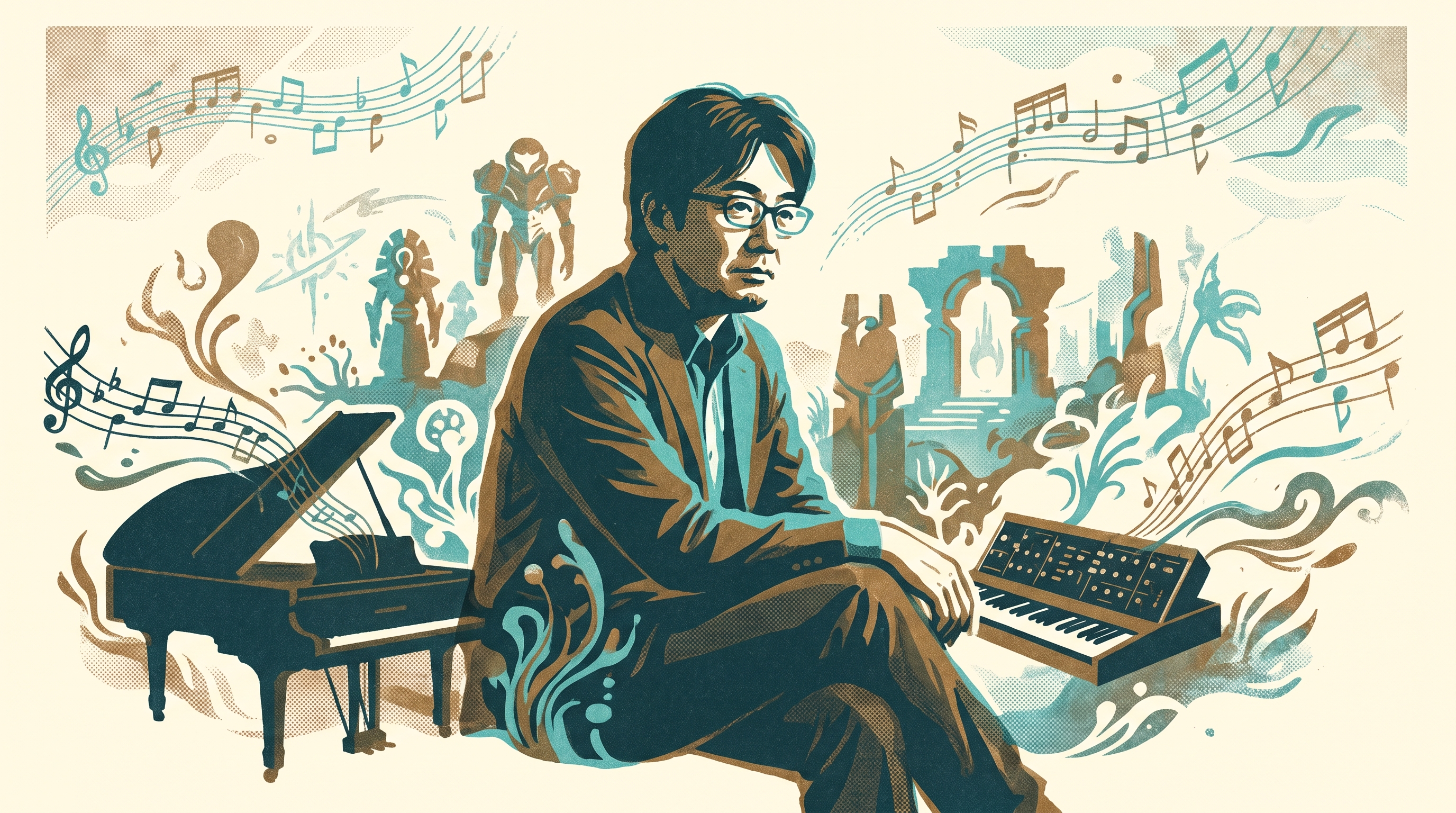
Kenji Yamamoto is a Nintendo composer and sound director. He composed the music for Super Metroid (1994) and co-composed the score for Metroid Prime (2002) with Eveline Fischer. His atmospheric, ambient compositions for the Metroid series are widely regarded as defining examples of environmental music in games.
History
Kenji Yamamoto was born April 25, 1964, in Ueno, Mie Prefecture, Japan. He studied music at Osaka University of Arts and graduated with a degree in music composition. In 1987, at twenty-three, he joined Nintendo as a sound designer — a time when game audio was still measured in kilobytes and the role itself was barely a decade old. The tools were primitive. The medium was unproven. What separated those who succeeded from those who gave up was not technical skill alone but the ability to hear something no one else had imagined yet.
His early years at Nintendo were spent learning the constraints of the hardware. Cartridge memory was expensive. Audio channels were few. A composer did not write for an orchestra — they wrote for three or four simultaneous voices, each competing for space in a mix that had to stay under a size limit so small it would later seem impossible. Yamamoto worked on games across Nintendo's catalog through the late 1980s and early 1990s, but the project that would define his voice came in 1994: Super Metroid.
Super Metroid was not a loud game. It was the opposite. Where other action games filled silence with melody, Metroid asked for something harder — music that felt like the absence of safety. Yamamoto composed the score almost entirely in minor keys and ambient textures. The result was a soundscape that made players feel alone even when enemies were present, uneasy even when standing still. During development, the team rarely left the office. There was a nap room lined with futons where staff took turns sleeping. Yamamoto came up with some of the game's themes by humming them to himself while riding his motorcycle home from work, the hum of the engine blending with the melody in his head.
The game released in March 1994 and became one of the Super Nintendo's most critically acclaimed titles. What players remembered years later was not just the gameplay but the way the music made them feel — isolated, cautious, small. That atmosphere was not an accident. It was architecture. Yamamoto had shown that game music could do more than accompany action. It could be the action.
In 2002, when the Metroid series moved to three dimensions under the direction of the American studio Retro Studios, Yamamoto was asked to compose the music for Metroid Prime to maintain the series' continuity. He worked from Japan while Retro developed the game in Texas, an arrangement that required coordination across time zones and cultures. On the night Metroid Prime went gold — the moment a game is finalized and sent to manufacturing — Yamamoto called Retro's audio lead Clark Wen at 9:00 PM to request last-minute changes. Wen spent four hours implementing them. Later, Wen said it was worth it, crediting Yamamoto with pushing him to make the best game possible.
Yamamoto went on to compose for Metroid Prime 2: Echoes (2004) and Metroid Prime 3: Corruption (2007), deepening the sonic identity of the Prime trilogy. He became a music director at Nintendo, overseeing audio for multiple projects and frequently collaborating with fellow composers Minako Hamano and Masaru Tajima. His work extended beyond Metroid to other Nintendo titles, but it is the Metroid series for which he remains best known — a body of work that proved silence, when shaped with care, can be as powerful as any note.
What Yamamoto understood, and what his compositions quietly taught a generation of game composers, is that music does not need to fill every moment. Sometimes the most important sound is the one you almost don't hear — the hum beneath the surface, the breath before the fall. That restraint, that willingness to let a player sit in unease without resolution, is not timidity. It is confidence. It is the sound of someone who knows that loneliness, rendered in the right key, does not push a listener away. It pulls them in.
Timeline & Works
Career milestones and all 5 games in the museum they worked on — in the order they happened.
- 1964 04
Born in Ueno, Mie
Kenji Yamamoto was born April 25, 1964, in Ueno, Mie Prefecture, Japan.
people - 1987
Joined Nintendo as sound designer
After graduating from Osaka University of Arts with a degree in music, Yamamoto joined Nintendo at age twenty-three.
people - 1987
- 1989
- 1994 03
Super Metroid released
Yamamoto composed the atmospheric score for Super Metroid, defining the sound of solitude and unease that would become the series signature.
product - 1994
- 2002 11
Metroid Prime released
Yamamoto composed the music for the first 3D Metroid game, working remotely from Japan while Retro Studios developed the game in Texas.
product - 2003
- 2004 11
Metroid Prime 2: Echoes released
Yamamoto continued to shape the sonic identity of the Prime trilogy with the second installment.
product - 2004
- 2007 08
Metroid Prime 3: Corruption released
Yamamoto completed the Prime trilogy soundtrack, cementing his legacy as the definitive voice of modern Metroid.
product - 2010
Promoted to Music Director at Nintendo
Yamamoto took on a leadership role overseeing audio for multiple Nintendo projects.
leadership
Connections
- employed nintendo (1987–present)
Joined Nintendo as a sound designer in 1987 and later became a music director.
- collaborated with retro-studios (2002–2007)
Composed music for the Metroid Prime trilogy developed by Retro Studios, working remotely from Japan.
Also connected to
- Minako Hamano co-created Super Metroid / co-created Super Metroid / same employer (Nintendo, since 1991)
- Yoshio Sakamoto co-created Super Metroid / co-created Super Metroid / same employer (Nintendo, since 1987)
- Shigeru Miyamoto co-created Metroid Prime / same employer (Nintendo, since 1987)
- Eveline Fischer co-created Metroid Prime
Explore the work
Each title has its own page — history, trivia, and collector's notes.
Nintendo GameCube · 2004
Metroid Prime 2: Echoes
Light and dark ammo. Two dimensions, two meters, one planet split between them. …
Nintendo GameCube · 2003
Metroid Prime
The willingness to hand something you love to someone you've just met — that too…
Super Famicom / SNES · 1994
Super Metroid
She didn't pull the trigger then. And that small mercy came back to save her.…
Family Computer Disk System · 1989
Famicom Detective Club Part II: The Girl Who Stands Behind
Nintendo's second mystery on Famicom Disk System. A new case, new suspects — and…
Family Computer (Famicom) / NES · 1987
Mike Tyson's Punch-Out!!
Little Mac is semitransparent so you can see the opponent's face. Their expressi…
Rooms their games live in
Sources
- Kenji Yamamoto (composer, born 1964) — Wikipedia — accessed 2026-06-17
- Kenji Yamamoto — Metroid Wiki — accessed 2026-06-17
- Super Metroid Developer Interview Released — Shinesparkers — accessed 2026-06-17
- Nintendo Classic Mini: SNES developer interview – Volume 3: Super Metroid — Nintendo UK — accessed 2026-06-17
- Former Nintendo audio devs discuss famed Metroid composer Kenji Yamamoto — GoNintendo — accessed 2026-06-17
- A Blast From The Past: Metroid Prime 3 With Kenji Yamamoto and Retro Studios — Original Sound Version — accessed 2026-06-17