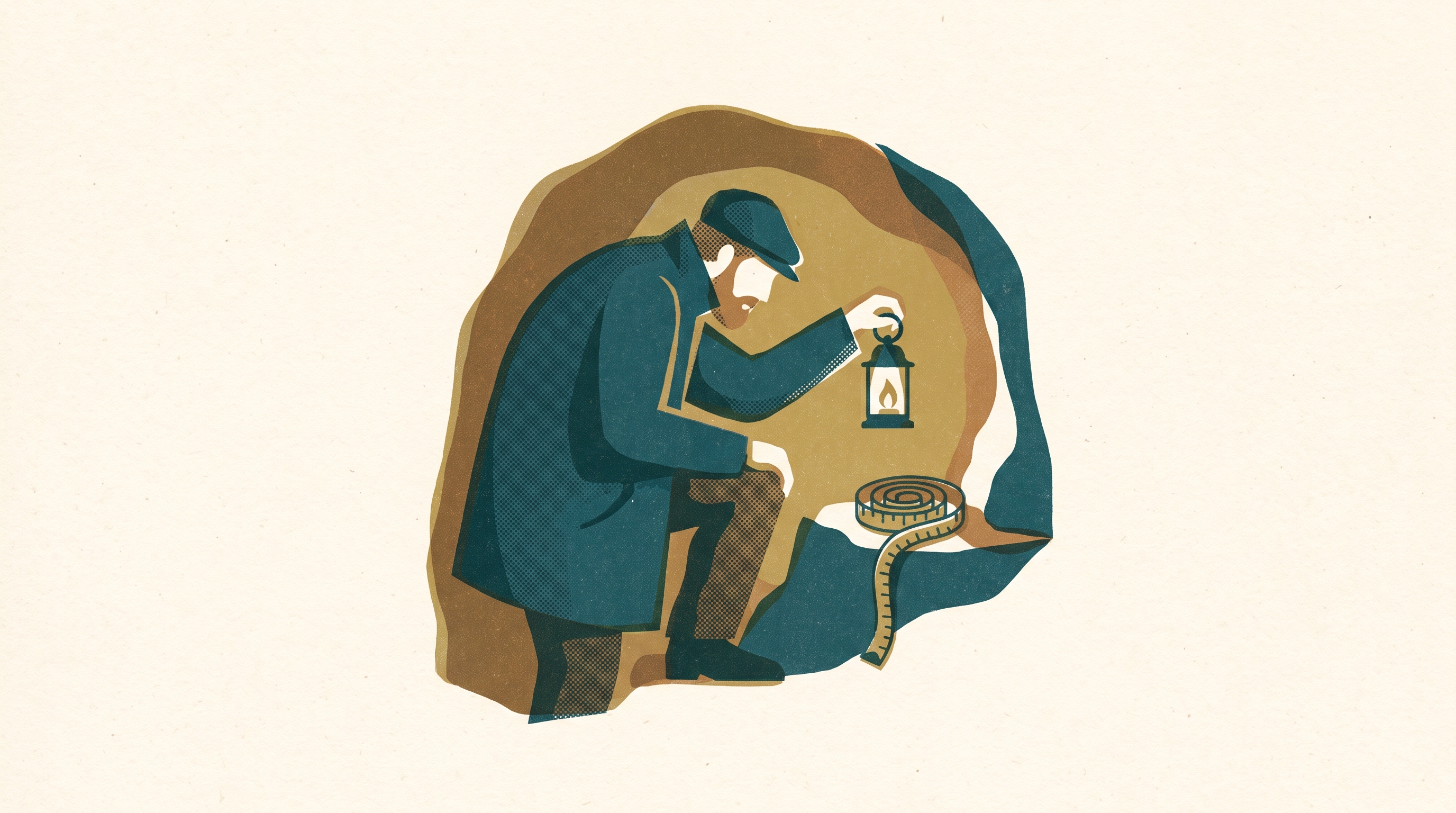
As a boy in Sonobe, a rural town in Kyoto Prefecture, Shigeru Miyamoto found a cave in the hillside. He returned the next day with a lantern. Then the day after that, pushing deeper each time. He had no map, no companion, only a small flame and a hunger to see what lay around the next bend. That experience — the negotiation between curiosity and caution, the controlled thrill of advancing into the unknown — became the template from which he would later build dungeons, levels, and entire worlds.
He did not invent the cave. He walked into it. He paid attention to how it felt.

In 1977, fresh out of Kanazawa College of Art with a degree in industrial design, Miyamoto leveraged a connection through his father to meet Hiroshi Yamauchi, president of Nintendo. The company had recently entered the consumer electronics business and needed designers. Miyamoto was hired as one of the first artists Nintendo had ever recruited. His early work was modest: toy prototypes, casings for the Color TV-Game series. He had never designed a video game.
In 1981, Nintendo of America urgently needed a new arcade title. Their warehouse was full of unsold Radar Scope units. Gunpei Yokoi, the company's veteran hardware inventor, recommended Miyamoto for the job. Nintendo had hoped to license the Popeye property for the cabinet, but the deal fell through. Miyamoto was forced to invent his own characters from scratch. The constraints of low-resolution arcade hardware shaped every design decision: a hat instead of hair (too hard to animate), a moustache instead of a mouth (too small to draw), overalls to make the arms legible against the body. The character was first called Jumpman. He later became Mario. The game was Donkey Kong, and it sold approximately 67,000 units in the United States alone. A constraint is not an obstacle — it is a specification waiting to be turned into an asset. That principle, demonstrated in his first game, would guide the rest of his career.
In 1986, Miyamoto directed The Legend of Zelda for the Famicom Disk System. The game grew directly from the memory of entering that cave with a lantern. He wanted to give players the same feeling he had experienced: the freedom to wander, the reward of discovery, the autonomy to decide where to go next. Zelda offered no linear path. It offered a world. By this time, working inside Nintendo's Entertainment Analysis and Development division, Miyamoto had developed a creative process he described not as invention but as editing. He absorbed a wide range of experiences — playing the banjo, tending his garden, measuring objects with a pocket tape measure, watching his dog Picky navigate the furniture — and reassembled those observations into interactive systems. 'I'm not a creator who makes things from zero,' he reflected in a 2020 Famitsu interview. 'I take what I've absorbed and edit it into something new.'
He still carries a small tape measure in his pocket. He stops to estimate the dimensions of whatever catches his eye, then checks whether his guess was right. The habit began when he built his own house and needed to judge the proportions of rooms and furniture. But it became something else — a discipline of attention, a way of staying close to the physical world. When he appeared on The Tonight Show Starring Jimmy Fallon, the host asked him to guess the lengths of objects on set: a taxidermied raccoon, a pizza, a question-mark block. Miyamoto got all of them wrong. He laughed. The point was never to be right. The point was to pay attention.

In 1996, Miyamoto led the design of Super Mario 64, the first major 3D platformer in the Mario lineage. He not only shaped the game's spatial design but also actively supported the inclusion of an analog thumbstick on the Nintendo 64 controller — a piece of input hardware that had never before appeared on a home console gamepad. He argued that moving through three-dimensional space required a degree of precision that a digital d-pad could not provide. The controller shipped with the analog stick. In 2001, after moving into a newly built house in Kyoto, Miyamoto began watching ants in his garden — the way they flowed around obstacles in long chains, the emergent behavior of a colony with a single shared purpose. The observation became Pikmin, a real-time strategy game about leading a small army of plant-animal creatures through a large, strange world. Pikmin was the first title Miyamoto developed that drew its DNA unambiguously from a hobby rather than a medium.
With Wii Sports in 2006, produced under Miyamoto's stewardship, Nintendo made its most deliberate effort to reach people who had never considered themselves players. The Wii Remote — a motion-sensing wand that responded to physical gestures — was designed so that anyone who had ever swung a tennis racket or bowled a ball already understood the input language. Bundled with the console in most regions outside Japan and South Korea, Wii Sports sold 82.88 million copies and introduced interactive entertainment to living rooms that had previously been indifferent to it. In 2015, Miyamoto stepped down as head of Nintendo's Entertainment Analysis and Development division and took on the title of Creative Fellow — later formalized as Representative Director, Fellow — a role that removed him from the daily management of projects and placed him in an advisory and mentoring position, working alongside younger designers rather than above them.

In 2019, the Japanese government recognized him as a Person of Cultural Merit, the first such designation in the country's history awarded for contributions to video games. He had also been decorated with France's Ordre des Arts et des Lettres (Chevalier rank) in 2006 and named to TIME magazine's TIME 100 in 2007. Miyamoto has described himself not as a film director but as a playground designer — someone whose job is to build a space in which others can have experiences that no one could fully predict or prescribe in advance.
What endures in his career is not any single design decision but a method: find what the constraint is, understand it precisely, and then let it tell you what the design must become. He did not invent the cave. He walked into it with a lantern. He did not invent the garden. He watched the ants. He did not invent the game controller. He measured the player's hand. The habit of attention — the same quality that sent a boy with a lantern into an unmapped cave — is the wellspring of everything he has built. That light was never loud. It was always quiet. And it is still burning.