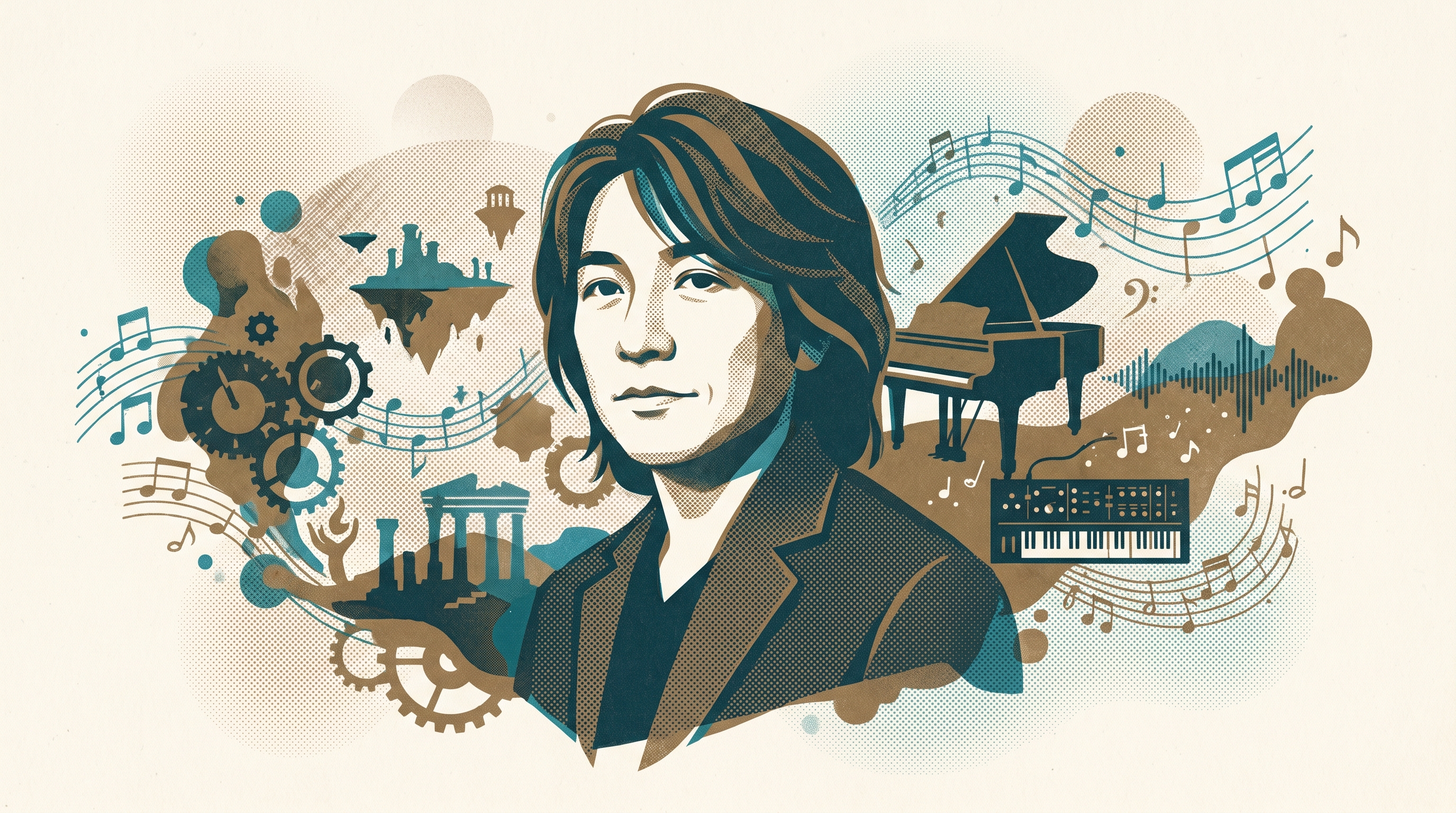
composer
Yasunori Mitsuda
光田康典
The melodies that linger are the ones carried home from a place you actually walked to.
About
Yasunori Mitsuda is a Japanese video game composer best known for the soundtracks of Chrono Trigger (1995) and Xenogears (1998). After joining Square in 1992 as a sound-effects engineer, he told vice-president Hironobu Sakaguchi he would quit unless he was allowed to compose — and was handed Chrono Trigger, his debut as a lead composer. He developed a stomach ulcer from overwork on the project, and Nobuo Uematsu stepped in to finish several tracks. He went independent in 1998 and founded Procyon Studio, later becoming the long-running composer of Monolith Soft's Xenoblade series.
History
Yasunori Mitsuda was born on January 21, 1972, in Tokuyama, Yamaguchi Prefecture (present-day Shūnan City) — not the distant Tokushima with which his name is sometimes confused, but a port town on the Inland Sea. He started piano at the age of five and quit at six, an unpromising beginning for a future composer. What actually drew him toward music was not the keyboard but the screen: as a boy he was captivated by film scores, by Vangelis's electronic textures for Blade Runner and Henry Mancini's playful theme for The Pink Panther. He did not want to play music so much as to build the feeling a piece of music gives you. After high school he moved to Tokyo to study at a music junior college, and while still a student he took an internship at the game developer Wolf Team, working under the composer Motoi Sakuraba — his first glimpse of how sound was made for interactive worlds.
In April 1992, Mitsuda joined Square. He had imagined himself writing melodies; instead he was assigned to sound effects — the footsteps, the menu blips, the swing of a sword. For roughly two years he engineered audio for titles such as Final Fantasy V and Secret of Mana, watching from the edge of the room as other composers wrote the scores he longed to write. The pay was low, the path to composition invisible. Most people in that position wait, hoping to be noticed. Mitsuda did the opposite. He decided that if the door would not open for him, he would force it — or leave.
In 1994 he walked into the office of Hironobu Sakaguchi, Square's vice-president and the creator of Final Fantasy, and told him plainly that he would quit the company unless he was allowed to compose a game of his own. It was an enormous risk: he was a junior employee with no track record as a lead composer, staking his entire career on a single demand. Sakaguchi did not fire him. He assigned him to a new project — Chrono Trigger — and told him that if he finished it, his salary would rise too. The gamble had worked. The sound-effects engineer who had threatened to walk out was now writing the score for one of the most anticipated games of the decade.
Chrono Trigger, released in March 1995, became Mitsuda's debut and his trial by fire. He poured himself into it without restraint, working to the point of physical collapse: he developed a severe stomach ulcer and was hospitalized before the score was complete. Nobuo Uematsu, the elder composer of the Final Fantasy series, quietly stepped in and finished roughly ten of the tracks so the game could ship. When it was done, Uematsu left him a note of congratulation — that it must have been hard, but he had done a great job seeing it through to the end. Mitsuda had written some fifty-four pieces of music for a game that would be remembered as one of the greatest of its era, and he had nearly destroyed his health to do it. The episode marked him: passion can carry you past your limits, but it also reveals who is standing beside you when you fall.
His next major work, Xenogears (1998), let him follow his instincts toward something more ambitious and more personal. The game's ending theme, 'Small Two of Pieces,' was among the first vocal ballads in a Square soundtrack, and the score as a whole began to reveal the Celtic and folk sensibility — Irish modes, acoustic instruments, the texture of music made by hand — that would become his signature. Xenogears was also a turning point in another sense: not long after completing it, in 1998, Mitsuda left Square to work as a freelance composer. He had arrived at the company demanding the right to compose; he left it as one of the most distinctive voices in the medium, ready to build his own house.
As an independent, Mitsuda scored Chrono Cross (1999) as a freelancer alongside the writer Masato Kato, and took on his first post-Square commission, Nintendo's Mario Party (1998). In 2001 he formally established his own company, Procyon Studio, together with the music label Sleigh Bells, giving himself the structure to produce, arrange, and release music entirely on his own terms. Free of a single employer, he could now chase the sound he wanted across whatever genre or platform called for it — from the Xenosaga series to handheld titles, anime, and orchestral concert albums.
What set Mitsuda apart was a refusal to fake the thing he was reaching for. Rather than approximate folk music from behind a desk, he traveled to its sources — Ireland, Austria, India, and beyond — to hear the instruments in their own air and learn how the music was actually built. He liked to point out that where Japanese folk melody rests on a five-note scale, Irish melody is shaped around the interval of a fourth, producing lines that feel at once bright and melancholy. He insisted on recording with live orchestras and real players wherever he could, because the small imperfections of human performance were exactly what made the sound feel alive. That patience became a long marriage with Monolith Soft, for whom he served as lead composer on Xenoblade Chronicles 2 (2017) and Xenoblade Chronicles 3 (2022), more than two decades after his Square debut.
Mitsuda's career offers a quiet, durable lesson for anyone who suspects they are in the wrong seat. Waiting to be chosen is not always a virtue; there are moments when the only way forward is to risk the safe path and say out loud what you actually want — as he did, at twenty-two, with nothing to fall back on. The cost can be real: he paid for his debut with his own health, and was carried across the finish line by a colleague's generosity. But the wisdom he kept is the one worth keeping. The sounds that stay with people are not assembled from convenient parts within reach; they are carried home from places you traveled to yourself, learned in person, and could not have faked. Whatever you are making, go to the source.
Timeline & Works
Career milestones and all 4 games in the museum they worked on — in the order they happened.
- 1972 01
Born in Tokuyama, Yamaguchi Prefecture
Yasunori Mitsuda is born on January 21, 1972, in Tokuyama, Yamaguchi Prefecture (present-day Shūnan City). As a boy he is drawn to music through film scores such as Vangelis's Blade Runner.
people - 1992 04
Joins Square as a sound-effects engineer
After studying at a music junior college in Tokyo and interning at Wolf Team under composer Motoi Sakuraba, Mitsuda joins Square in April 1992. For about two years he works on sound effects for titles including Final Fantasy V and Secret of Mana.
people - 1994
Threatens to quit unless allowed to compose
Frustrated by low pay and no path to composition, Mitsuda tells vice-president Hironobu Sakaguchi he will leave Square unless he is allowed to score a game. Sakaguchi assigns him to Chrono Trigger instead of letting him go.
milestone - 1995 03
Chrono Trigger — debut as lead composer
Chrono Trigger launches on March 11, 1995, with Mitsuda's debut score of roughly fifty-four pieces. He develops a severe stomach ulcer from overwork and is hospitalized; Nobuo Uematsu steps in to finish about ten tracks so the game can ship.
product - 1995
- 1998
Mario Party — first post-Square commission
As a freelancer, Mitsuda takes his first post-Square commission, composing for Nintendo's Mario Party (1998).
product - 1998
Xenogears released; goes independent
Mitsuda scores Xenogears, whose ending theme "Small Two of Pieces" is among Square's first vocal ballads and which crystallizes his Celtic and folk sensibility. Not long after, in 1998, he leaves Square to work as a freelance composer.
product - 1998
- 1998
- 1999
Chrono Cross composed as a freelancer
Mitsuda composes the acclaimed score for Chrono Cross alongside writer Masato Kato — now from outside Square, as an independent composer.
product - 1999
- 2001 11
Founds Procyon Studio and the Sleigh Bells label
Mitsuda formally establishes his own company, Procyon Studio, together with the music label Sleigh Bells, giving himself full control over composing, arranging, and releasing his work.
milestone - 2002
Xenosaga Episode I
Mitsuda composes the orchestral score for Xenosaga Episode I, extending the cinematic, ensemble-driven sound he had begun developing on Xenogears.
product - 2012
Kid Icarus: Uprising
Mitsuda contributes to the soundtrack of Kid Icarus: Uprising, one of many cross-studio collaborations he takes on as an independent composer.
product - 2017
Xenoblade Chronicles 2 — lead composer for Monolith Soft
Mitsuda serves as lead composer on Xenoblade Chronicles 2, deepening a long collaboration with Monolith Soft and recording with live orchestras and vocalists.
product - 2022
Xenoblade Chronicles 3
More than a quarter-century after his Chrono Trigger debut, Mitsuda composes the score for Xenoblade Chronicles 3, remaining one of the medium's most distinctive musical voices.
product
Connections
- employed square (1992–1998)
Mitsuda joined Square in 1992 as a sound-effects engineer, debuted as lead composer on Chrono Trigger (1995), and left in 1998 after Xenogears to work independently.
- collaborated with nobuo-uematsu (1995–present)
When Mitsuda was hospitalized with a stomach ulcer during Chrono Trigger, senior composer Nobuo Uematsu stepped in to finish roughly ten tracks so the game could ship.
- collaborated with hironobu-sakaguchi (1994–present)
Square vice-president Hironobu Sakaguchi assigned Mitsuda to Chrono Trigger rather than accept his resignation, launching his career as a lead composer.
Also connected to
- Akihiko Matsui co-created Chrono Trigger
- Akira Toriyama co-created Chrono Trigger
- Kazuhiko Aoki co-created Chrono Trigger
Explore the work
Each title has its own page — history, trivia, and collector's notes.
PlayStation · 1999
Chrono Cross
Yasunori Mitsuda has said Chrono Cross is the score he is most proud of — more t…
PlayStation · 1998
Xenogears
Square rejected it as too dark for Final Fantasy VII. Built standalone, it ran o…
Nintendo 64 · 1998
Mario Party
Four players, one board, dice no one controlled. It ended friendships. You playe…
Super Famicom / SNES · 1995
Chrono Trigger
They traveled to the ends of time — to find out what you can still change today.…
Rooms their games live in
Sources
- Yasunori Mitsuda — Wikipedia (English) — accessed 2026-06-01
- 光田康典 — Wikipedia(日本語) — accessed 2026-06-01
- STAFF 光田康典 — Procyon Studio 公式 — accessed 2026-06-01
- Yasunori Mitsuda 2000 Developer Interview — shmuplations — accessed 2026-06-01
- 光田康典 20周年記念インタビュー — 2083WEB — accessed 2026-06-01
From the Museum's Screening Room
Corridors Of Time — The Sound of the Machines